Tibetan Monastic Musical Instruments (Chöröl · 藏传寺院法乐器)
Dungchen Long Horns, Gyaling Oboes, Ḍamaru Drums, Cymbals & Peaceful vs. Wrathful Liturgical Acoustics
Authentic Tibetan ritual music never seeks concert entertainment or ambient background mood: governed by Sakya Paṇḍita’s Treatise on Music, winds, drums, bells, and two distinct geometries of cymbals form a sonic mandala—divided strictly between peaceful Zhi-rol and wrathful Drag-rol ensembles.
The Seven Canonical Monastic Instruments & What Each Sound Signifies
In Himalayan monasteries, liturgical instruments are never played solo for personal expression; they enter in precisely notated rhythmic cycles (rnga-grangs, “drum-counts” written in curving graphic dbyangs-yig neumes) led by the chant master (Umdze, དབུ་མཛད།). Every instrument belongs to one of four classical acoustic families—struck bronze, stretched membrane, reed melody, or brass/shell column:
| Instrument & Tibetan (Wylie) | Physical Anatomy | Acoustic Character | Primary Liturgical Role |
|---|---|---|---|
| 1. Dungchen · དུང་ཆེན། (Long Horn) | Pair of 2–4m telescoping red-copper & silver-banded horns resting on stands | Earth-shaking sub-bass Pedal drone (“voice of elephants / dragons”) | Rooftop summons at dawn, welcoming high lamas, & anchoring wrathful/festival cadences |
| 2. Gyaling · རྒྱ་གླིང་། (Reed Shawm) | Conical wooden pipe with double reed, brass lip-disc & 7 finger holes, played in pairs | Soaring, lyrical, unbroken circular-breathing melody | Inviting peaceful Buddhas/bodhisattvas, consecrations & auspicious processions |
| 3. Dungkar · དུང་དཀར། (White Conch) | Turbinella pyrum sea shell (prized when right-spiraling, g.yas-’khyil) often winged in gilt copper | Warm, far-carrying mid-horn call across courtyards | Calling monks to sutra assembly & debate; symbolizes fearless proclamation of Dharma |
| 4. Silnyen vs. Rolmo Cymbals · སིལ་སྙན། / སྦུག་ཆལ། | Silnyen: wide flat rim, tiny central boss (held vertically); Rolmo: deep dome boss (held horizontally!) | Silnyen: bright shimmering ring; Rolmo: thunderous rolling clash & accelerating trill | Silnyen = Peaceful Sūtra/Tārā rites; Rolmo = Wrathful Yidam & Dharma Protector rites! |
| 5. Ḍamaru · ཌཱ་མ་རུ། (Two-Headed Drum) | Waisted wooden (or Chöd acacia/bone) hourglass drum with two knotted striker cords & 5-color tail | Crisp rapid staccato pulse sounded by rotating the right wrist | Marks structural transitions in sādhana, ḍākinī tsok feasts & Machig Labdrön’s Chöd |
| 6. Chönga · ཆོས་རྔ། (Frame Drum + Curved Sickle Stick) | Double-skin circular frame drum mounted on a carved pole, struck from below with a swan-necked cane | Deep heartbeat pulse locking the entire assembly’s meter | Timekeeper across daily pūjās, Kangso protector rites & Tārā mandalas |
| 7. Dril-bu & Tingsha · དྲིལ་བུ། / ཏིང་ཤགས། | Bronze wisdom bell crowned with Prajñāpāramitā face (left hand) + tiny thick chime cymbals on leather cord | Clear high overtone shimmer dissolving into silence | Dril-bu paired with right-hand vajra; Tingsha dedicates food/water offerings to hungry ghosts (pretas) |
Peaceful (Zhi-rol) vs. Fierce (Drag-rol) Acoustics—and Separating Tradition from Modern Myth
If you ever step into a Tibetan temple courtyard during a ritual, glance at how the chant master holds his cymbals: if he holds wide, small-bossed silnyen (སིལ་སྙན།) vertically like two mirrors facing each other accompanied by lyrical gyaling oboes, the assembly is performing Zhi-rol (ཞི་རོལ།, Peaceful Music) for Buddhas, Tārā, or Amitāyus. If he holds deep-domed rolmo / bukchal (སྦུག་ཆལ།) horizontally one above the other, letting the top cymbal bounce in accelerating mathematical patterns (3–2–4“Nine Beats” or 1–2–3) alongside roaring dungchen bass horns, the assembly is performing Drag-rol (དྲག་རོལ།, Fierce Protective Music) for Mahākāla, Vajrakīlaya, or Palden Lhamo.
Equally important for museum literacy: despite ubiquitous Western spa marketing since the 1970s, rubbing metal bowls around their rim with a wooden mallet is NOT a traditional Tibetan Buddhist monastic practice. As ethnomusicologists Ter Ellingson (The Mandala of Sound) and Donald S. Lopez Jr. have documented, Himalayan metal standing bowls functioned historically as domestic kitchenware or grain-offering vessels on altars—never rubbed as “chakra-frequency” instruments in or liturgy.
How It Is Practiced in Living Tradition
In personal home practice, lay and monastic practitioners primarily use the vajra & bell (dril-bu) and small hand ḍamaru once instructed by a teacher on proper hand mudrās and rhythmic beats; full ensemble instruments (dungchen, gyaling, rolmo) belong to communal monastic liturgy.
Common Questions & Clarifications
How do monks play an unbroken 15-minute melody on the Gyaling oboe without ever stopping to breathe?
Monk-musicians train from youth in circular breathing: storing air in their cheeks to push steadily through the double reed with cheek muscles for a split second while simultaneously inhaling fresh air quickly through the nose—so the sonic offering thread never snaps!
Primary Sources & Further Reading
- Sakya Paṇḍita Kunga Gyaltsen, Treatise on Music (Rol-mo’i bstan-bcos, 13th c.) & Ter Ellingson, The Mandala of Sound: Concepts and Sound Structures in Tibetan Ritual Music
- The Walters Art Museum Open Collection (73.144): Painted Tibetan Ritual Hand Drum (Ḍamaru) with Five-Color Silk Banner
Connected in the Mandala Graph
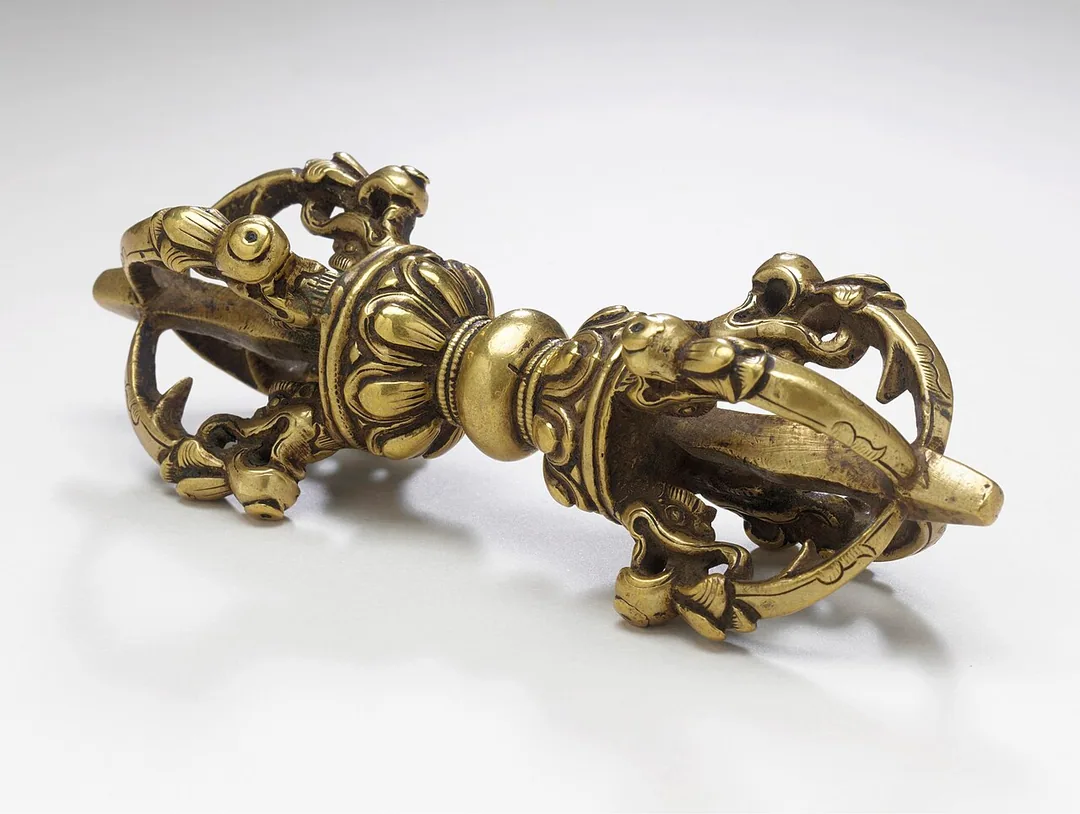
Vajra & Bell (Dorje & Drilbu · རྡོ་རྗེ་དང་དྲིལ་བུ།)
Never separated on a Tibetan altar, the brass five-pronged vajra held in the right hand embodies indestructible compassionate method (upāya), while the hollow bronze bell held in the left proclaims wisdom realizing emptiness (prajñā).
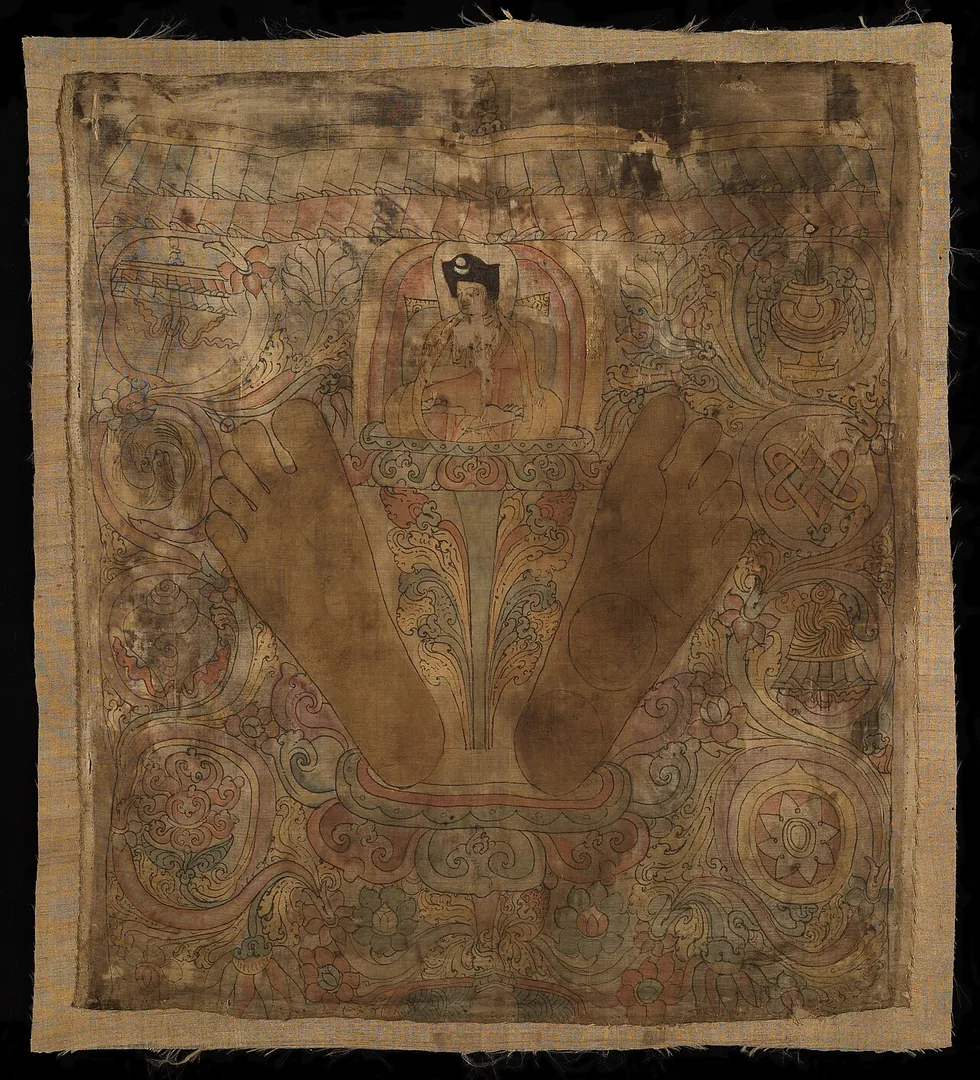
The Eight Auspicious Symbols (Ashtamangala)
Originally royal coronation offerings in ancient India and reinterpreted as attributes of the Buddha’s awakened body, speech, and mind, these eight emblems form the foundational grammar of Tibetan visual design.
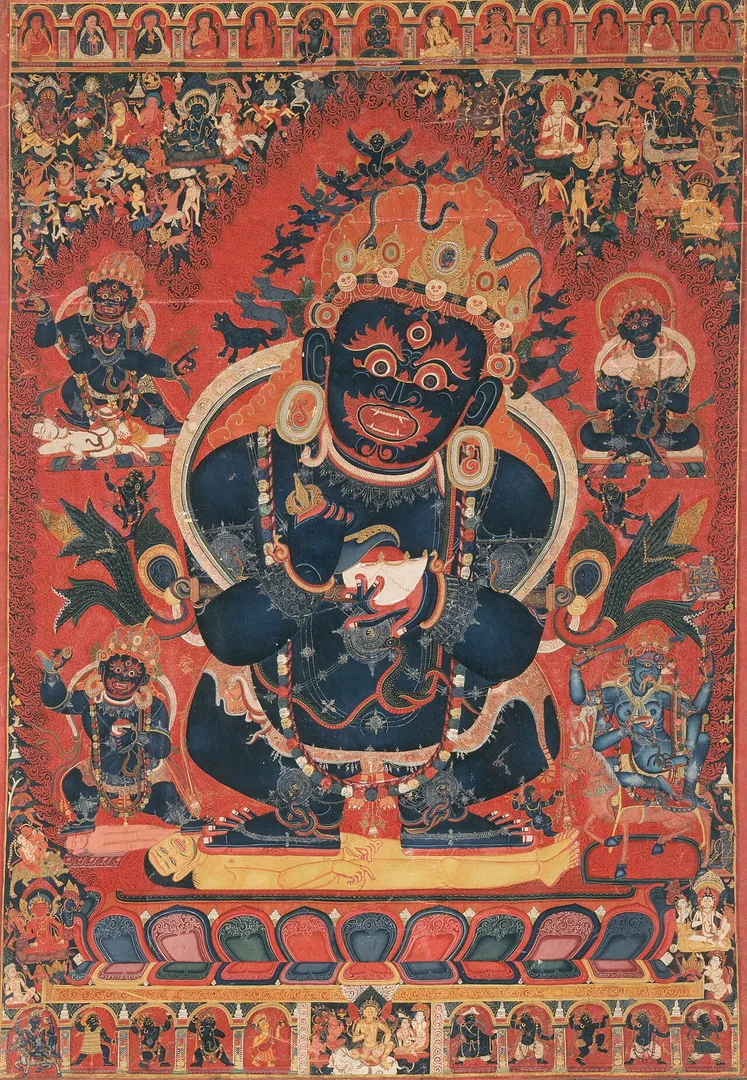
Mahākāla (Gönpo · Wisdom Dharma Protector)
Known simply in Tibetan as Gönpo (“The Protector”), Mahākāla (“Great Black One” / “Beyond Time”) manifests Avalokiteśvara’s compassion in fierce midnight-blue form—shattering self-deception and guarding ethical integrity across Kagyu, Sakya, and Gelug monasteries.
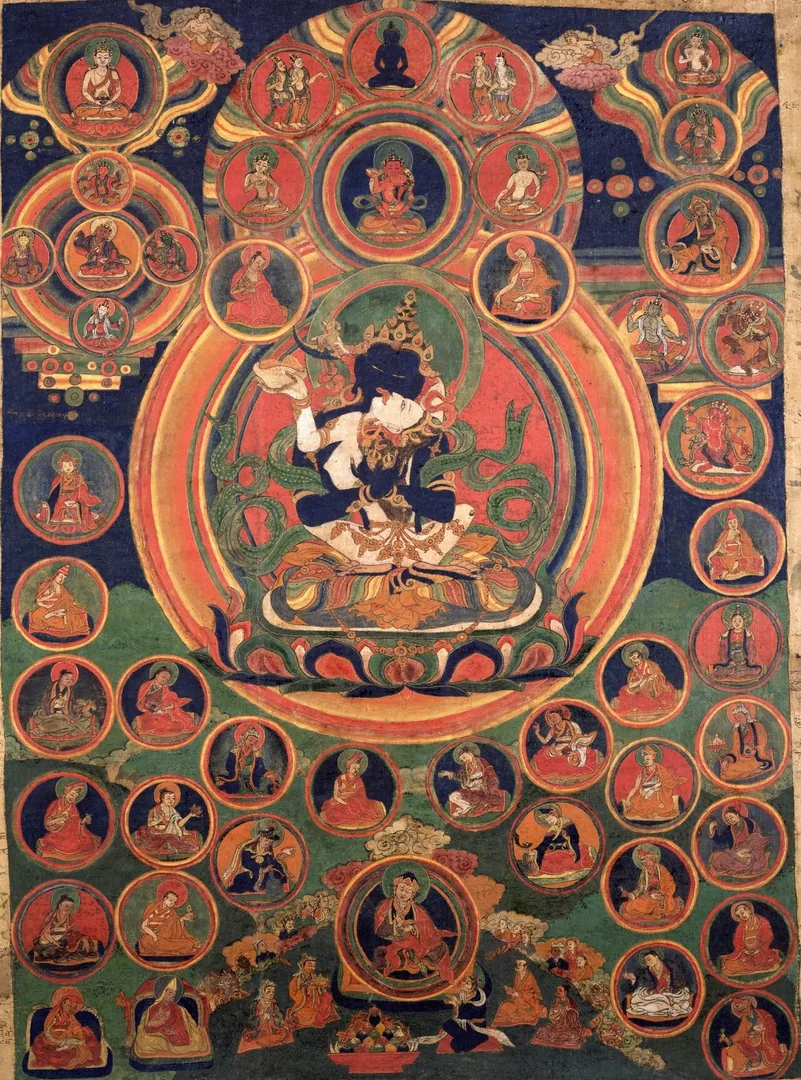
Padmasambhava (Guru Rinpoche)
Invited from Oddiyāna and Nālandā to Tibet by King Trisong Detsen in the 8th century, Padmasambhava (“Lotus-Born”) consecrated Samye Monastery and harmonized Himalayan indigenous spirits with Buddhist Dharma.