Hayagrīva (Tamdrin · Horse-Necked Wrathful Compassion)
Fierce Crimson Emanation of Avalokiteśvara Crowned with Neighing Emerald Horse Heads
When gentle Avalokiteśvara’s serene smile cannot rouse beings trapped in stubborn delusion or acute obstacle, Great Compassion blazes forth as cinnabar-red Hayagrīva—instantly identified across Tibetan, Newar, and East Asian art by one or three emerald-green horse heads neighing from his flaming hair.
Why Gentle Chenrezig Grows Fangs & Neighs Like a Stallion
For newcomers accustomed to serene white Avalokiteśvara (Chenrezig) holding a crystal rosary, discovering that blazing crimson Hayagrīva (Tamdrin) is the very same bodhisattva unlocks the heart of Tibetan Buddhist psychology. Tibetan masters compare awakened compassion to a skilled mother: ninety-nine times out of a hundred she speaks softly, yet if her toddler reaches toward a pot of boiling oil, she shouts and snatches the child’s arm in a split second. That fierce shout contains zero anger—only urgent, undivided love mobilizing energy to prevent harm.
Why specifically an emerald-green horse head rearing out of orange-red flames? Classical tantric commentaries offer three layered meanings: (1) Enlightened Speech (Padma gsung): Belonging to Amitābha’s red Lotus Speech family alongside Green Tārā’s wind-swift green activity, the stallion’s thunderous neigh (hī-hī) pierces all three realms without obstruction—proclaiming that all phenomena are empty and unborn, waking sentient beings from the heavy stupor of ignorance. (2) Mythic Subjugation of Ego: In Indian tantric narrative, when the demon Rudra (personifying inflated spiritual arrogance) wore a horse-headed guise, compassion manifested from within as Hayagrīva, neighing three times from the crown to dissolve egoic tyranny. (3) Swiftness Across Distances: Like the wind-horse (lungta) and solar steed Balāha (an earlier Jātaka incarnation of Avalokiteśvara as a flying white horse rescuing shipwrecked merchants), Tamdrin embodies compassion arriving faster than thought.
Rimé Panorama: Nyingma Padma Speech, Atiśa, Shangpa Kagyu & Sera Je Monastery
Hayagrīva is one of the rare deities practiced with equal devotion across every Tibetan school as well as East Asian esoteric Buddhism. When Atiśa Dīpaṃkara arrived in Tibet in 1042 CE, Hayagrīva was among his four personal heart deities; in Nyingma, Padma Hayagrīva anchors the Speech family of the Eight Kagyé and countless terma revelations (such as Nyangral Nyima Özer and Ratna Lingpa’s cycles); while in Gelug, Sera Monastery in Lhasa—and above all Sera Je College (Se-ra byes), founded by Kunkhyen Lodrö Rinchen Senge—reveres Tamdrin Yangsang (Most Secret Hayagrīva) as its defining guardian yidam, welcoming thousands of lay Lhasa families annually with the famed Tamdrin Phurba blessing:
| Lineage / School | Specific Cycle | Iconographic Form | Distinctive Focus |
|---|---|---|---|
| Nyingma (Kagyé & Terma) | Padma Sung / Tamdrin Sangdü | 3 faces, 6 arms, garuda wings, 3 green horse heads, often paired with Vajravārāhī | Enlightened Speech of the Eight Kagyé; magnetizing & obstacle-clearing |
| Gelug (Sera Je & Gyümé) | Tamdrin Yangsang & Kyergangpa | Blazing 3-faced 6-armed or solitary 1-faced 2-armed Kadam Sangdrub form | Heart yidam of Sera Je College; famed annual Lhasa blessing festival |
| Kagyu & Shangpa Kagyu | Tamdrin Khyung-nga (5 Garudas) | Crimson Hayagrīva radiating five garudas from body centers (Niguma / Khyungpo Naljor) | Purifying environmental imbalances, naga-related ailments & subtle channels |
| Tang Esoteric & Japanese Shingon | Batō Kannon (馬頭観音) | One of the Six Avalokiteśvaras: wrathful 3-faced 8-armed figure with white/green horse crown | Compassionately liberating beings across the animal realm & protecting travelers |
How It Is Practiced in Living Tradition
Encountered by pilgrims in the dimly lit, juniper-scented Tamdrin Lhakhang of Sera Je Monastery in Lhasa, invoked by pastoral nomads across Amdo and Kham for the well-being of horses and herds, and honored as the fierce face of Chenrezig’s compassion. Formal tantric sadhanas of Inner and Secret Hayagrīva (such as Tamdrin Yangsang and Sangdü) require empowerment (abhiṣeka / dbang), oral transmission (lung), and instruction (tri / khrid) from a qualified lineage teacher.
Common Questions & Clarifications
Why do Lhasa parents dab a tiny smudge of butter-lamp soot on babies’ noses at Sera Monastery’s Hayagrīva chapel?
It is one of Lhasa’s warmest living folk customs! Families visiting Sera Je’s Hayagrīva protector shrine receive a tiny protective dot of consecrated hearth/lamp soot (snum-dre) on a child’s nose—symbolically placing the toddler under Tamdrin’s fearless gaze so they sleep peacefully without night terrors.
Why is the horse head in Hayagrīva’s hair painted green when his body is bright red?
In the Five Buddha Families color grammar, cinnabar red belongs to Amitābha’s Padma family of magnetizing compassion and discerning speech, while emerald green belongs to Amoghasiddhi’s Karma family of all-accomplishing wind-swift action. Crowning a red body with a green neighing horse unites compassionate intent with instantaneous protective action.
Primary Sources & Further Reading
- Ārya-hayagrīva-vidyārāja (Toh 733), Tibetan Kangyur & Robert H. van Gulik, Hayagrīva: The Mantrayānic Aspect of Horse-Cult in China and Japan (Brill)
- José Ignacio Cabezón, Sera Monastery (Wisdom Publications / Tibetan & Himalayan Library)
- Jeff Watt, “Hayagrīva (Tamdrin) Main Page,” Himalayan Art Resources (HAR)
Connected in the Mandala Graph
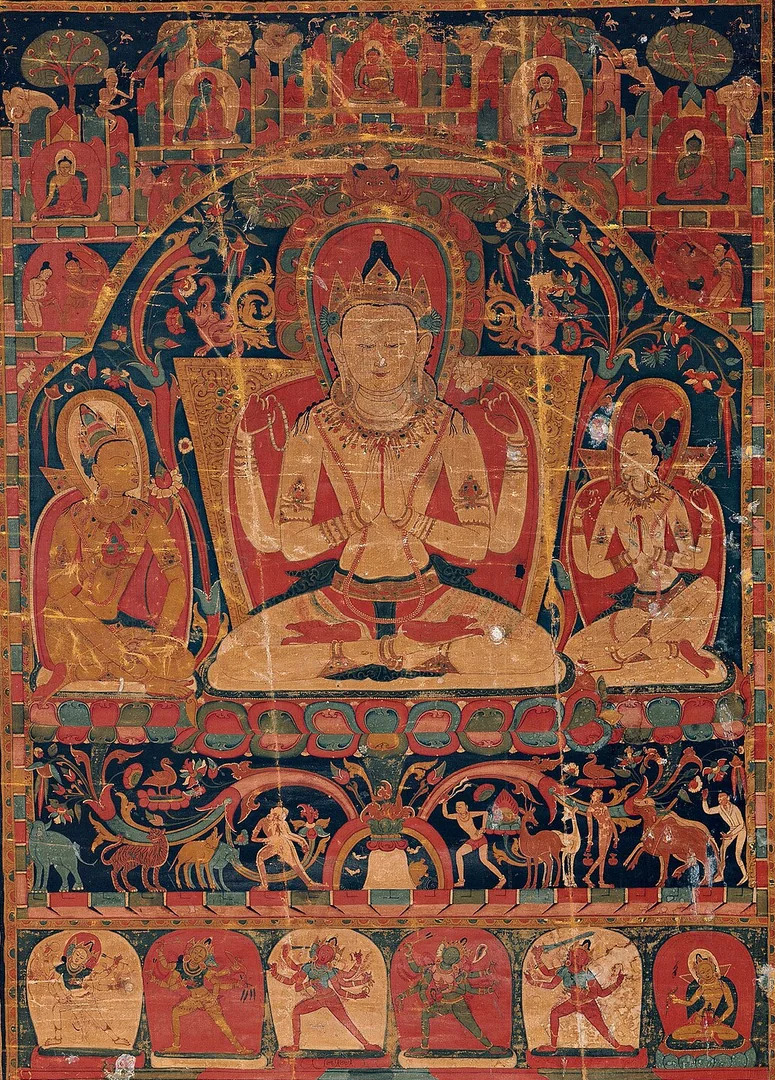
Avalokiteśvara (Chenrezig)
Known in Tibetan as Chenrezig (“One Who Gazes with Unwavering Eyes”), the four-armed white form embodies impartial compassion united with emptiness, associated with the Six-Syllable Mantra Oṃ Maṇi Padme Hūṃ.
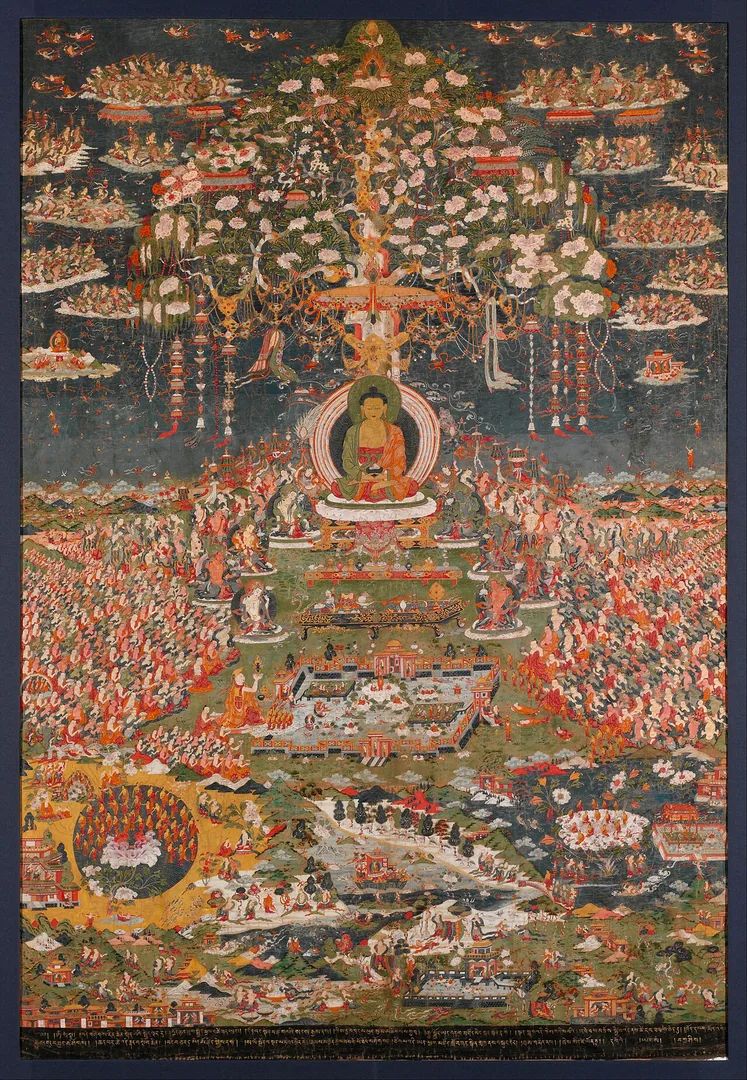
Amitābha (Öpakmé · Buddha of Infinite Light)
Radiating warm sunset-ruby red in the West of the Tibetan mandala, Amitābha (“Infinite Light,” Tibetan Öpakmé) rests both hands in meditation equipoise cradling an alms bowl of ambrosial nectar (amṛta), presiding over the Lotus Family to which Chenrezig and Padmasambhava belong.
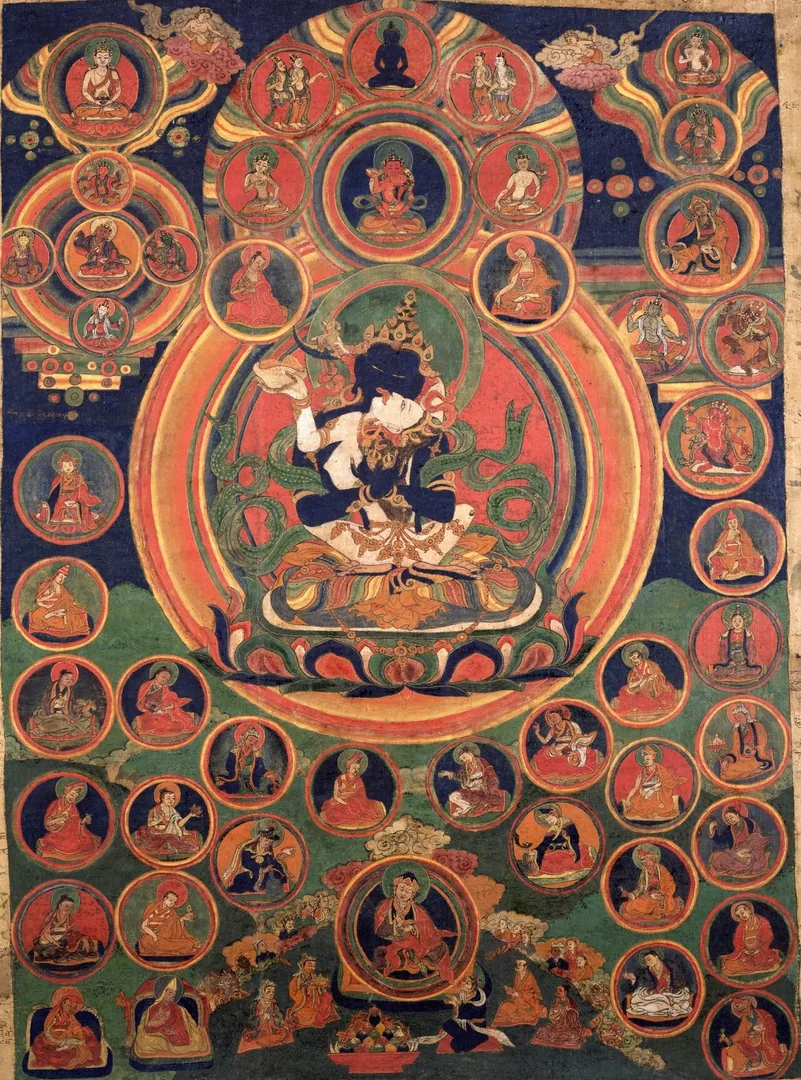
Padmasambhava (Guru Rinpoche)
Invited from Oddiyāna and Nālandā to Tibet by King Trisong Detsen in the 8th century, Padmasambhava (“Lotus-Born”) consecrated Samye Monastery and harmonized Himalayan indigenous spirits with Buddhist Dharma.
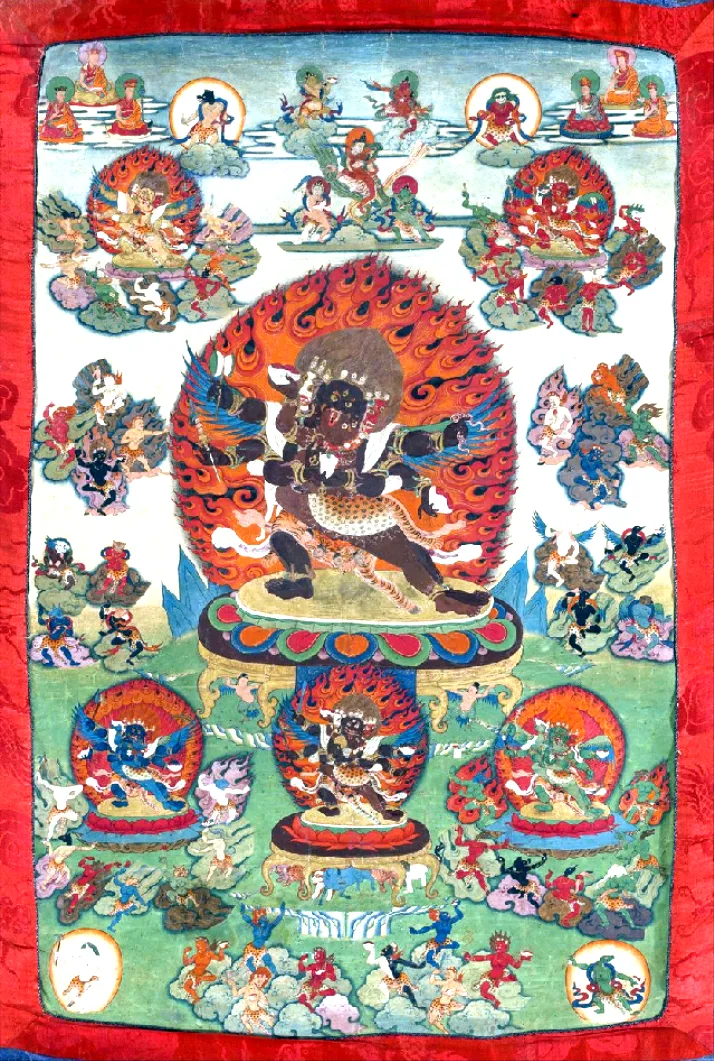
Mahottara Heruka (Chemchok Heruka · Supreme Wrathful Buddha)
Known in Tibetan as Chemchok Heruka (“Supreme Great Blood-Drinker of Ego”), Mahottara Heruka presides at the center of the Nyingma Eight Pronouncements (Kagyé) and dawns first among the fifty-eight wrathful bardo deities—revealing terrifying cosmic power as primordial Buddha Samantabhadra’s own luminous compassion.