Mahottara Heruka (Chemchok Heruka · Supreme Wrathful Buddha)
Central Sovereign of the Nyingma Eight Kagyé & the Fifty-Eight Wrathful Bardo Deities
Known in Tibetan as Chemchok Heruka (“Supreme Great Blood-Drinker of Ego”), Mahottara Heruka presides at the center of the Nyingma Eight Pronouncements (Kagyé) and dawns first among the fifty-eight wrathful bardo deities—revealing terrifying cosmic power as primordial Buddha Samantabhadra’s own luminous compassion.
What “Heruka” Actually Means: Drinking Up Ego-Clinging, Not Violence
First-time museum visitors encountering Tibetan wrathful bronzes and thangkas are often startled by the Sanskrit title Heruka, translated into classical Tibetan as Khrag-’thung (ཁྲག་འཐུང་།, literally “Blood-Drinker”). In Indian and Tibetan Buddhist exegesis, neither term has anything to do with physical bloodshed. Syllabically, commentarial literature unpacks he as the emptiness of causes, ru as freedom from conceptual aggregation, and ka as the non-abiding union of bliss and emptiness; Tibetan masters render it Khrag-’thung because awakened wisdom drinks up the “lifeblood” of cyclic existence—ego-clinging (bdag-’dzin) and the three poisons of craving, aversion, and delusion.
In his monumental twenty-one-faced, forty-two-armed iconographic form, Mahottara Heruka (“Supreme Great Heruka”) makes this philosophical unity unmistakable. His deep maroon-crimson body blazes with garuda wings signifying fearless flight beyond dualistic extremes. His central hands hold vajra and bell while embracing his wisdom consort Krodheśvarī (ཀྲོ་དྷཱི་ཤྭ་རཱི།, “Sovereign Lady of Wrathful Compassion”) in yab-yum (father-mother union)—an artistic grammar representing the indivisibility of compassionate skilful means (upāya) and wisdom realizing emptiness (prajñā), never mundane sensual passion. Most revealing of all, his upper radiating hands hold miniature peaceful Buddhas, visually reminding the viewer that wrathful energy is simply peaceful awakening mobilized to shatter stubborn self-deception.
Center of the Eight Kagyé & the Eighth Day of the Bardo Thödol
Textually and historically, Mahottara Heruka rests upon the philosophical foundation of the Guhyagarbha Tantra (dPal gsang-ba snying-po, Toh 832)—the crown jewel of Nyingma Mahāyoga, which demonstrates that all phenomena of mind and cosmos are primordially the pure mandala of awakened body, speech, and mind. Within the celebrated Eight Pronouncements (Sgrub-pa bka’-brgyad, transmitted through eight Indian vidyādharas including Padmasambhava and Vimalamitra and enshrined at Samye), five supramundane wisdom deities embody enlightened Body, Speech, Mind, Qualities, and Activity; Chemchok Heruka sits upon the central throne as the sovereign of Enlightened Qualities (yon-tan) who synthesizes all five Buddha families into one unified mandala.
His widest cultural renown comes from Karma Lingpa’s 14th-century Bardo Thödol (Liberation Through Hearing in the Intermediate State, popularly known in English as The Tibetan Book of the Dead). Within its cycle of One Hundred Peaceful and Wrathful Deities (Zhi-khro dam-pa rigs-brgya), forty-two peaceful Buddhas dawn from the heart during the first seven days after death. When unhabituated awareness shrinks back from their sheer luminosity, on the eighth day those very same peaceful Buddhas reappear from the crown center in fifty-eight wrathful forms—led first by Mahottara Heruka, who is explicitly identified as primordial Samantabhadra and Samantabhadrī in protective disguise. Recognizing that terrifying roar and flame as the empty, radiant display of one’s own nature dissolves fear on the spot.
| Enlightened Aspect | Deity Name | Tibetan (Wylie) | Peaceful Counterpart |
|---|---|---|---|
| Qualities (Central Sovereign) | Mahottara (Chemchok Heruka) | che mchog he ru ka | Samantabhadra & Ratnasambhava |
| Enlightened Body | Mañjuśrī Yamāntaka | ’jam dpal gshin rje | Mañjuśrī & Vairocana |
| Enlightened Speech | Padma Hayagrīva | padma gsung rta mgrin | Avalokiteśvara & Amitābha |
| Enlightened Mind | Viśuddha (Yangdak Heruka) | yang dag he ru ka | Vajrapāṇi & Akṣobhya |
| Enlightened Activity | Vajrakīlaya (Dorje Phurba) | rdo rje phur pa | Amoghasiddhi (Obstacle-Clearing) |
How It Is Practiced in Living Tradition
Encountered publicly across the Himalayas during monastic Kagyé Drupchen ceremonies, sacred Cham mask dances (where his form familiarizes laypeople with bardo visions so they remain unafraid at death), and Peaceful-Wrathful (Zhi-khro) purification prayers for the deceased. In accordance with Vajrayāna samaya, formal personal meditation on Mahottara Heruka’s sadhana and inner Mahāyoga yogas strictly requires empowerment (abhiṣeka / dbang), oral reading transmission (lung), and pith instruction (tri / khrid) from a qualified lineage holder.
Common Questions & Clarifications
Why do Tibetan monasteries perform masked dances of wrathful Herukas in public courtyards?
Traditional Cham dances display the outer symbolic form without exposing restricted inner liturgies, serving what Tibetan lamas call liberation through seeing (mthong-grol). By witnessing Mahottara Heruka and the Peaceful-Wrathful deities calmly in sunlight during life, ordinary villagers recognize those forms immediately as compassionate allies rather than nightmares during transitions.
How can museum visitors distinguish Mahottara Heruka from Cakrasaṃvara or Yamāntaka?
Check three instant visual markers: Mahottara Heruka is dark maroon-brown with blazing garuda wings on his back and holds tiny peaceful Buddhas in his upper hands; Yamāntaka is dark blue with an unmistakable horned water-buffalo head at center; and Cakrasaṃvara is sapphire blue without wings or animal horns, bearing a crescent moon tilted in his hair topknot while embracing crimson Vajravārāhī.
Primary Sources & Further Reading
- Guhyagarbha Tantra (dPal gsang-ba snying-po, Toh 832), Tibetan Kangyur & Mipham Rinpoche’s Essence of Clear Light
- Karma Lingpa, The Tibetan Book of the Dead (Bar-do thos-grol chen-mo), trans. Gyurme Dorje, ed. Graham Coleman & Thupten Jinpa (Penguin Classics)
- Jeff Watt, “Chemchok Heruka & Kagyé Iconography,” Himalayan Art Resources (HAR)
Connected in the Mandala Graph
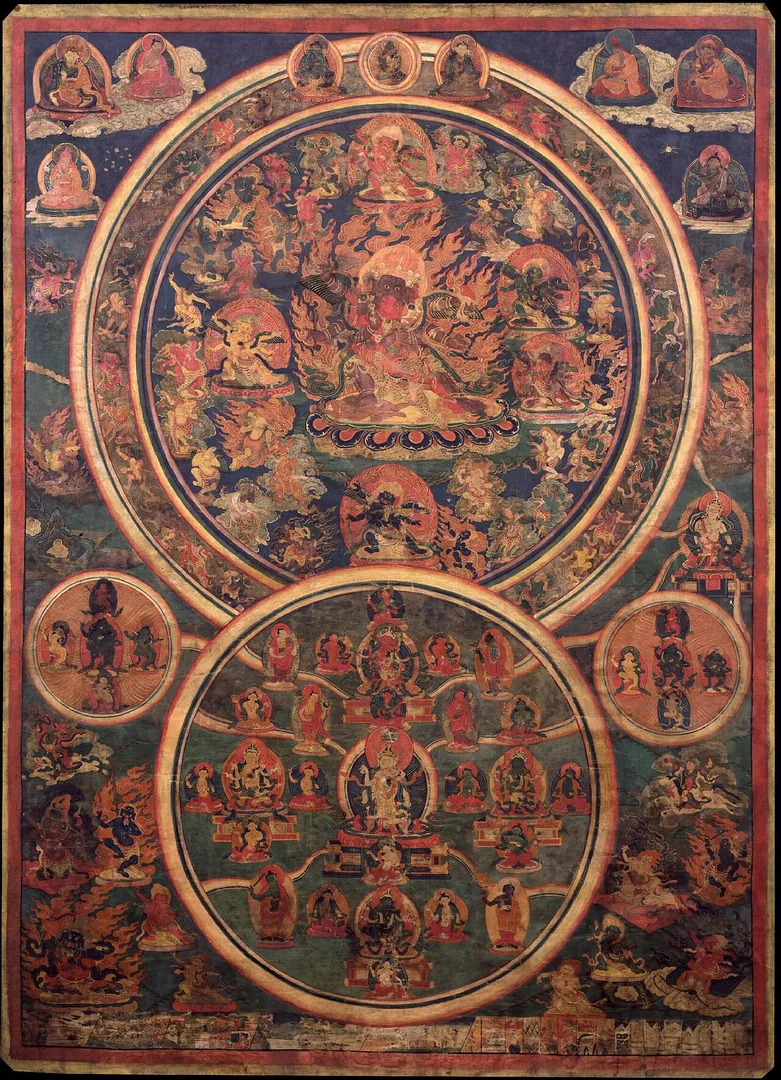
Bardo: The Six In-Between States
Literally “interval between two things” (bar-do), the famous Tibetan Book of the Dead (Bardo Thödol) maps not only death and rebirth, but six everyday transitional spaces—starting with this waking moment.
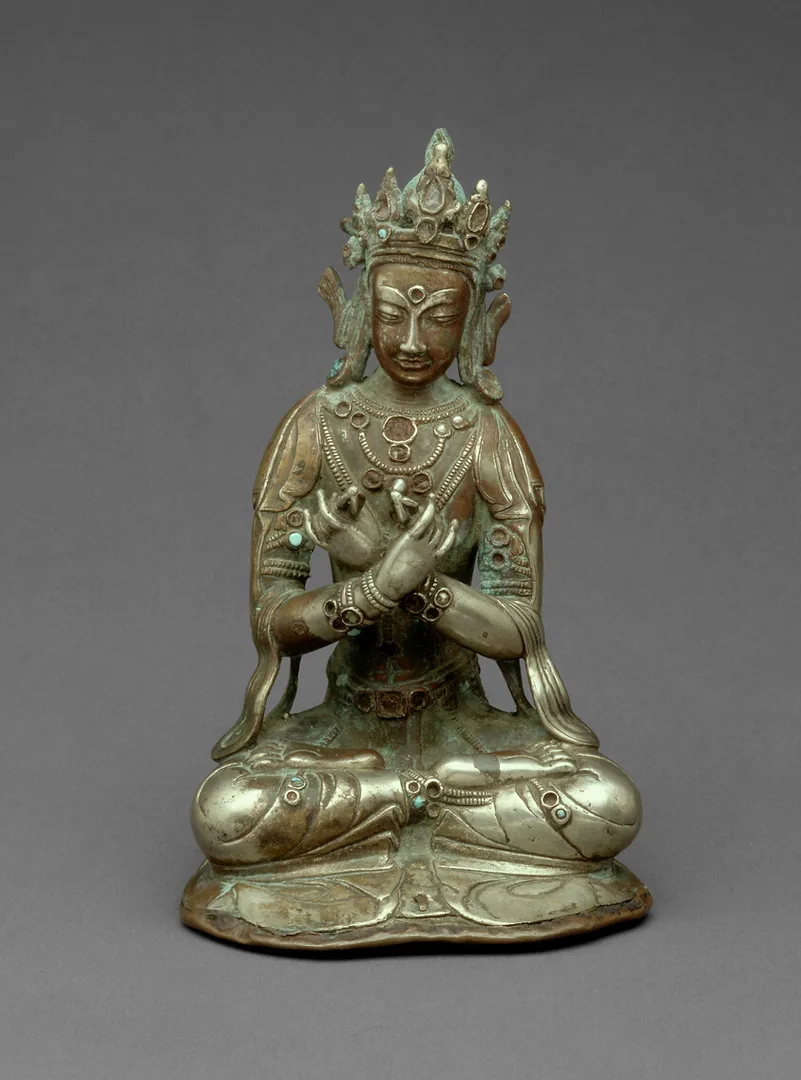
Ādi-Buddha: Samantabhadra & Vajradhara (Primordial Dharmakāya)
Placed at the very apex of every Tibetan refuge tree and thangka lineage, the Ādi-Buddha (“Primordial Buddha”) is never a creator god who made the universe, but the timeless, uncompounded nature of mind itself—depicted naked and sky-blue as Samantabhadra in Nyingma Dzogchen, or crowned in royal silks crossing vajra and bell as Vajradhara in Kagyu, Sakya, and Gelug.
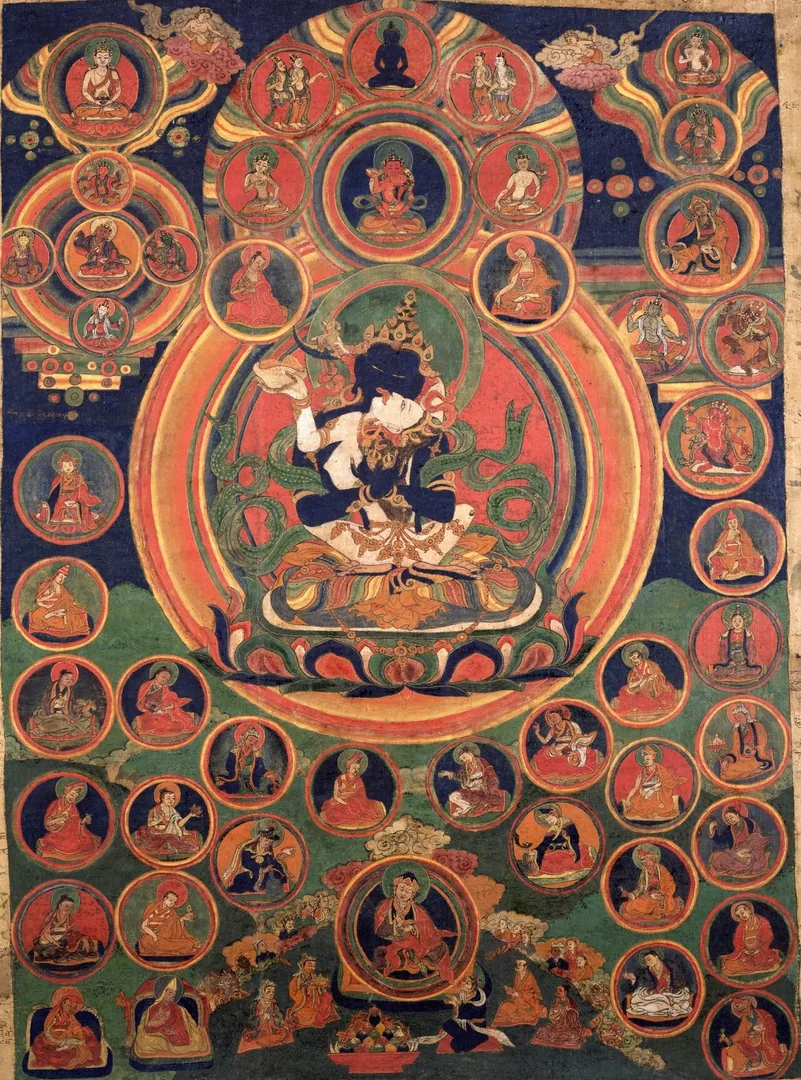
Padmasambhava (Guru Rinpoche)
Invited from Oddiyāna and Nālandā to Tibet by King Trisong Detsen in the 8th century, Padmasambhava (“Lotus-Born”) consecrated Samye Monastery and harmonized Himalayan indigenous spirits with Buddhist Dharma.
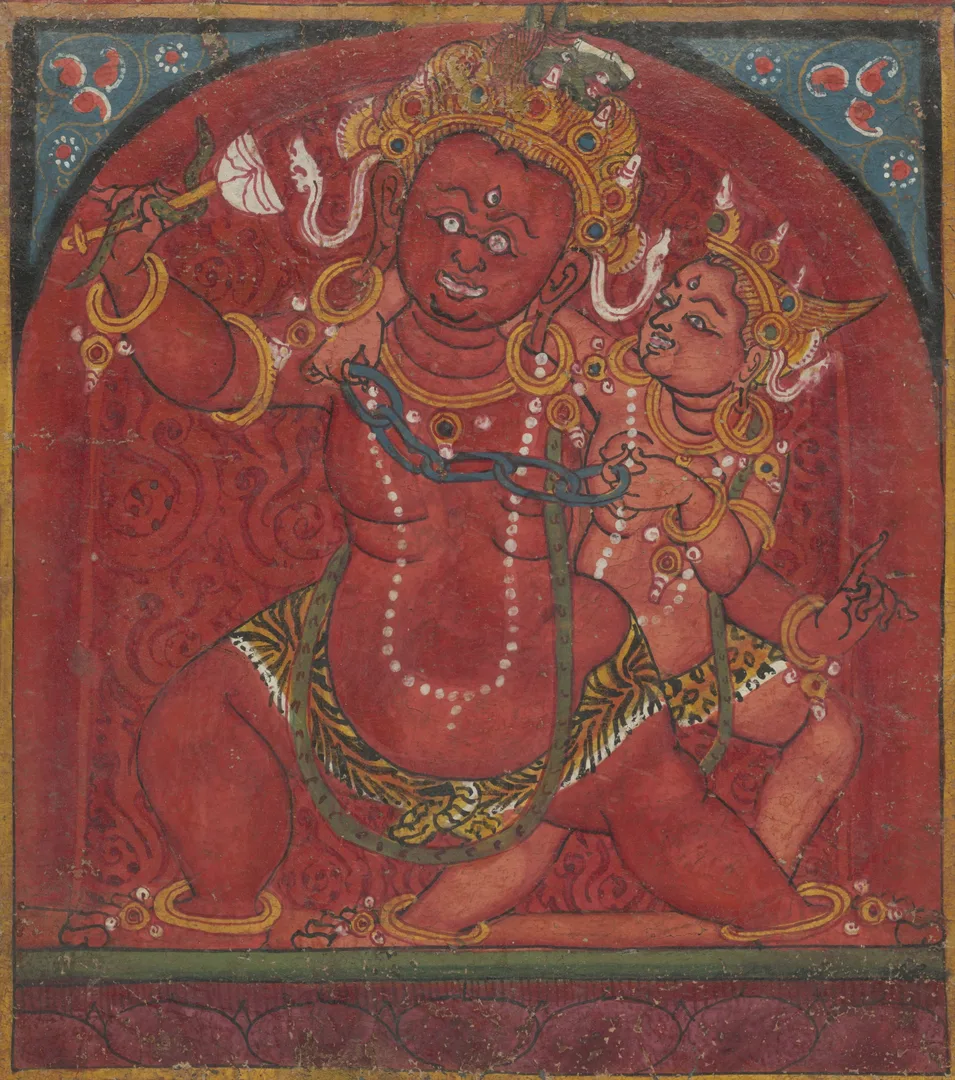
Hayagrīva (Tamdrin · Horse-Necked Wrathful Compassion)
When gentle Avalokiteśvara’s serene smile cannot rouse beings trapped in stubborn delusion or acute obstacle, Great Compassion blazes forth as cinnabar-red Hayagrīva—instantly identified across Tibetan, Newar, and East Asian art by one or three emerald-green horse heads neighing from his flaming hair.