Vajrakīlaya / Vajrakumāra (Dorje Phurba · Obstacle-Transmuting Heruka)
Three-Faced, Six-Armed Wrathful Buddha Rolling the Three-Bladed Kīla Dagger Through Dualistic Fixation
Embodying the enlightened activity (karma / phrin-las) of all Buddhas in wrathful form, three-faced, six-armed Vajrakīlaya rolls a three-bladed ritual dagger (phurba) between his central palms—not to harm living beings, but to pin down and transfix the stubborn root of ego-clinging, hatred, and inner paralysis.
Padmasambhava at Yangleshö & How the Sakya Khön Clan Preserved Kīla
In Himalayan sacred history, Vajrakīlaya is inseparable from Padmasambhava’s pivotal retreat at the Yangleshö cave (modern Pharping, south of Kathmandu). When severe drought, plague, and philosophical hostility obstructed his meditation on Mahāmudrā realization (Yangdak Heruka), Padmasambhava sent messengers to Nālandā in India requesting the Vajrakīlaya tantric texts. The very moment the bundles arrived in the valley, outer and inner obstacles cleared—establishing the classic Tibetan pairing: Yangdak for pure realization, Vajrakīlaya for clearing obstacles on the path.
At Samye in the 8th century, one of Padmasambhava’s closest disciples was Khön Lü’i Wangpo Srungwa—ancestor of the aristocratic Khön family that founded Sakya Monastery in 1073! Because the Khön clan kept this unbroken Khön-lugs Phur-pa transmission alive even through the 9th-century collapse of the Tibetan Empire, Sakya remains to this day the one New-Translation (Sarma) school enshrining an Old-Translation (Nyingma) Mahāyoga deity at the heart of its annual ritual calendar—and even preserved a fragmentary Sanskrit palm-leaf manuscript of the Vajrakīlaya Root Tantra inside Sakya’s great library.
Reading the Four Kīlas: Why a Dagger Is Really a Mirror of Mind
Canonical Kīla commentaries warn sharply against mistaking the physical brass or meteoric-iron phurba for the whole teaching. Even in our 18th-century LACMA initiation painting (AC1998.253.6), every fierce detail is contemplative: his spread eagle-like vajra wings (gshog-pa) signify fearless traversal of conventional and ultimate truth without obstruction, while his union with pale-blue consort Diptacakrā (’Khor-lo rgyas-’debs-ma) shows wrathful skillful means inseparable from spacious emptiness. Classical Nyingma and Sakya manuals distinguish Four Kīlas (Phur-pa bzhi), ascending from tangible symbol to non-dual awareness:
| Level of Kīla | Tibetan Term | Target (“Soil” Pierced) | Contemplative Meaning |
|---|---|---|---|
| 1. Material Ritual Kīla | rdzas kyi phur pa | Consecrated mandala boundary / effigy | Three-bladed bronze/wood implement symbolizing severance of the three poisons |
| 2. Immeasurable Compassion Kīla | snying rje’i phur pa | Six realms of sentient beings | Unwavering empathy directed continuously toward all suffering beings |
| 3. Bodhicitta Kīla | byang sems phur pa | Subtle channels & vital energy | Union of compassionate method and bliss stabilizing meditative equipoise |
| 4. Primordial Wisdom Kīla | ye shes rig pa’i phur pa | Dharmadhātu (expanse of reality) | Non-dual awareness (rigpa) realizing pierce, piercer, and pierced have never been two |
How It Is Practiced in Living Tradition
Visible publicly in Himalayan culture during year-end Gutor monastic masked dances (Phur-cham) dedicated to sweeping away collective misfortune before Losar (Tibetan New Year), and revered by contemporary Nyingma and Sakya communities worldwide (including the celebrated Ratna Lingpa and Jigme Phuntsok Rinpoche’s “Neck-Pouch Kīla” terma lineages). Because Vajrakīlaya belongs to the Mahāyoga / Anuttarayoga inner tantras, formal sadhana recitation and ritual kīla practice require empowerment (dbang), reading transmission (lung), and pith instruction (khrid) from a qualified lineage master.
Common Questions & Clarifications
Why is Vajrakīlaya usually painted with wings, while some museum bronzes have a blade lower body or no wings at all?
All three belong to distinct iconographic layers! 1. Winged Heruka in Yab-Yum (shown in our LACMA painting AC1998.253.6) is the standard Tibetan mandala sovereign across Nyingma and Sakya lineages—three faces, six arms, four legs, and spread Garuḍa wings symbolizing unimpeded enlightened activity. 2. Kīla-Bodied Supreme Son (Sras-mchog) tapers from the waist directly into a three-edged meteoric-iron blade emerging from a makara sea-dragon, fusing deity and implement. 3. Early Western Himalayan Solo Bronzes occasionally omit the wings and consort in compact 13th–14th century castings.
Primary Sources & Further Reading
- Martin J. Boord, The Cult of the Deity Vajrakīla: According to the Texts of the Northern Treasures Tradition (Institute of Buddhist Studies, 1993) & A Bolt of Lightning from the Blue (2002)
- Cathy Cantwell & Robert Mayer, Early Tibetan Documents on Phur pa from Dunhuang (Austrian Academy of Sciences Press, 2008)
- Los Angeles County Museum of Art (AC1998.253.6): 18th-Century Tibetan Painting of Winged Vajrakīlaya / Vajrakumāra and Consort
Connected in the Mandala Graph
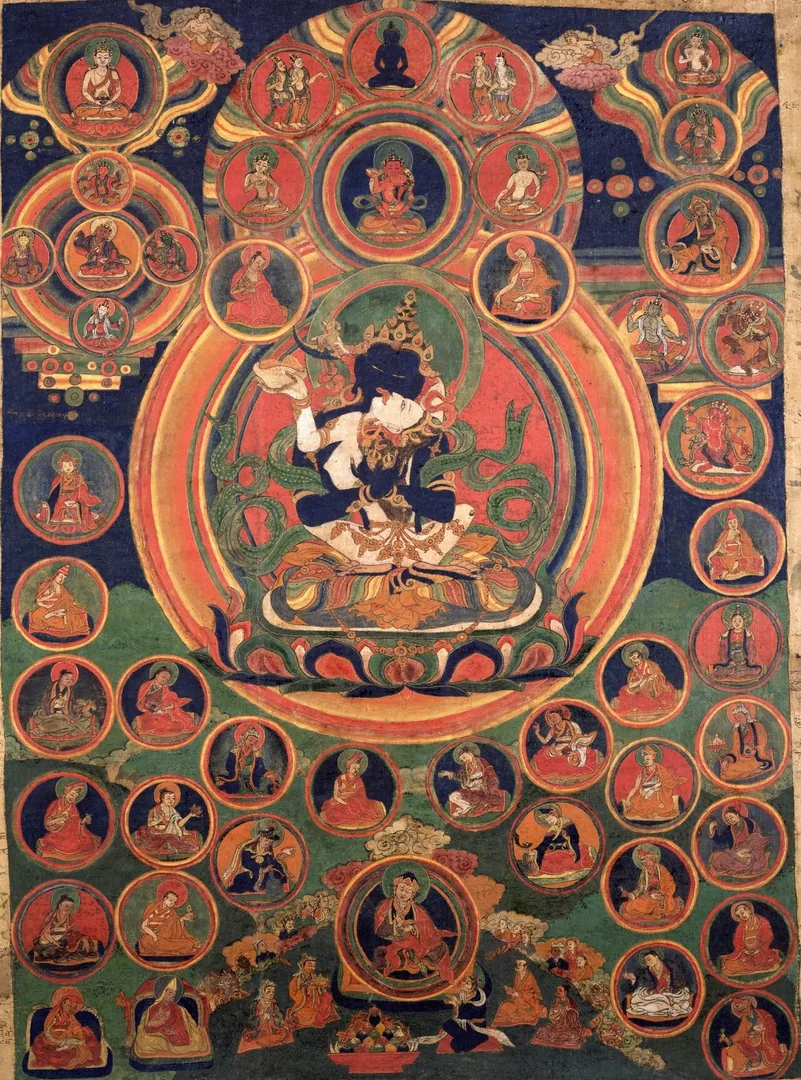
Padmasambhava (Guru Rinpoche)
Invited from Oddiyāna and Nālandā to Tibet by King Trisong Detsen in the 8th century, Padmasambhava (“Lotus-Born”) consecrated Samye Monastery and harmonized Himalayan indigenous spirits with Buddhist Dharma.
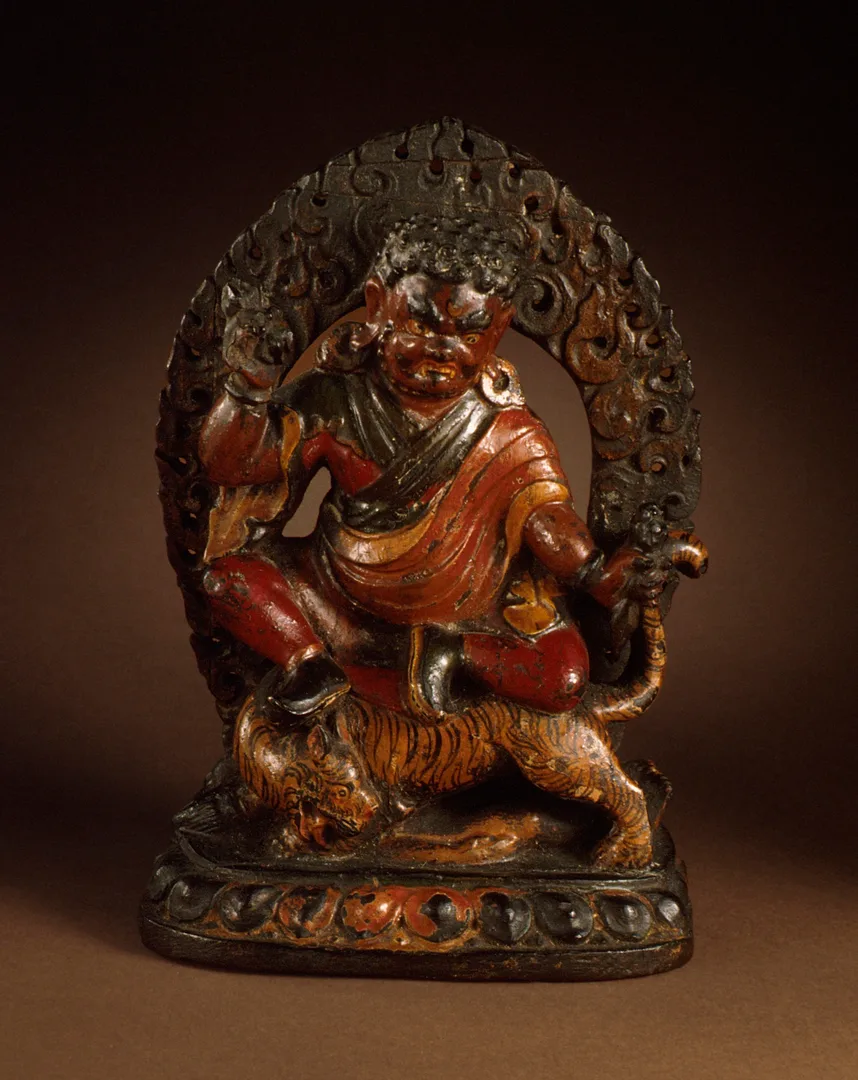
Dorje Drolö (Wrathful Padmasambhava on the Tigress)
Standing in a blaze of dark maroon flames atop a roaring pregnant tigress—actually wisdom consort Yeshe Tsogyal in fierce emanation—Dorje Drolö is the eighth and wildest of Padmasambhava’s Eight Manifestations, revered at Bhutan’s cliffside Taktsang (“Tiger’s Nest”) for shattering spiritual hypocrisy and turbulent-age obstacles.
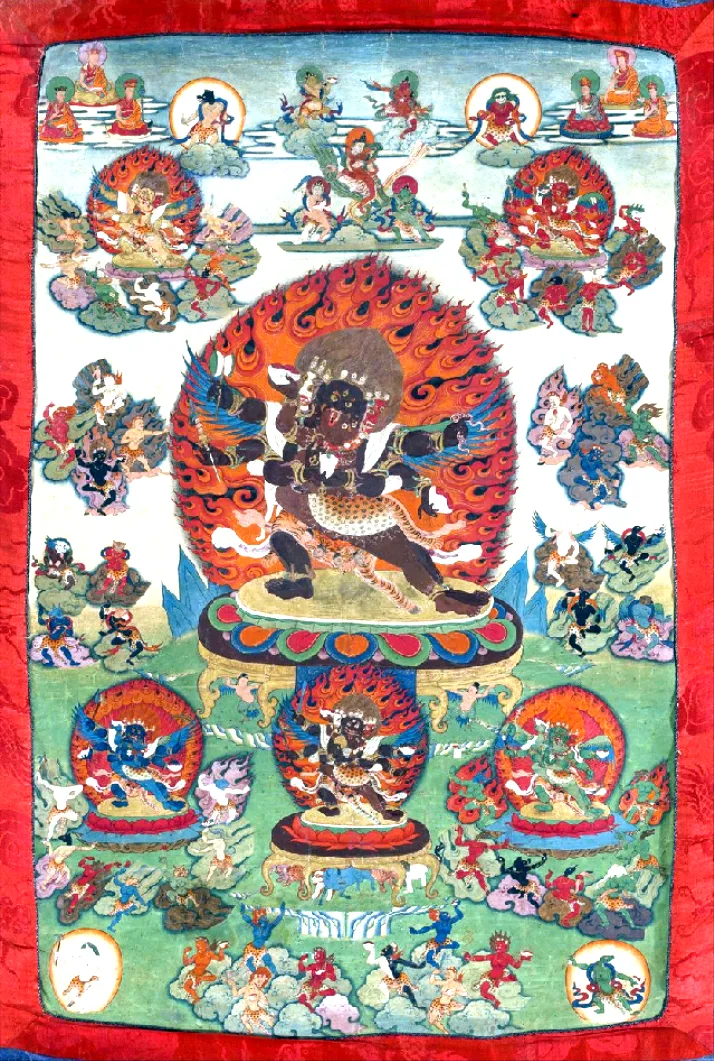
Mahottara Heruka (Chemchok Heruka · Supreme Wrathful Buddha)
Known in Tibetan as Chemchok Heruka (“Supreme Great Blood-Drinker of Ego”), Mahottara Heruka presides at the center of the Nyingma Eight Pronouncements (Kagyé) and dawns first among the fifty-eight wrathful bardo deities—revealing terrifying cosmic power as primordial Buddha Samantabhadra’s own luminous compassion.
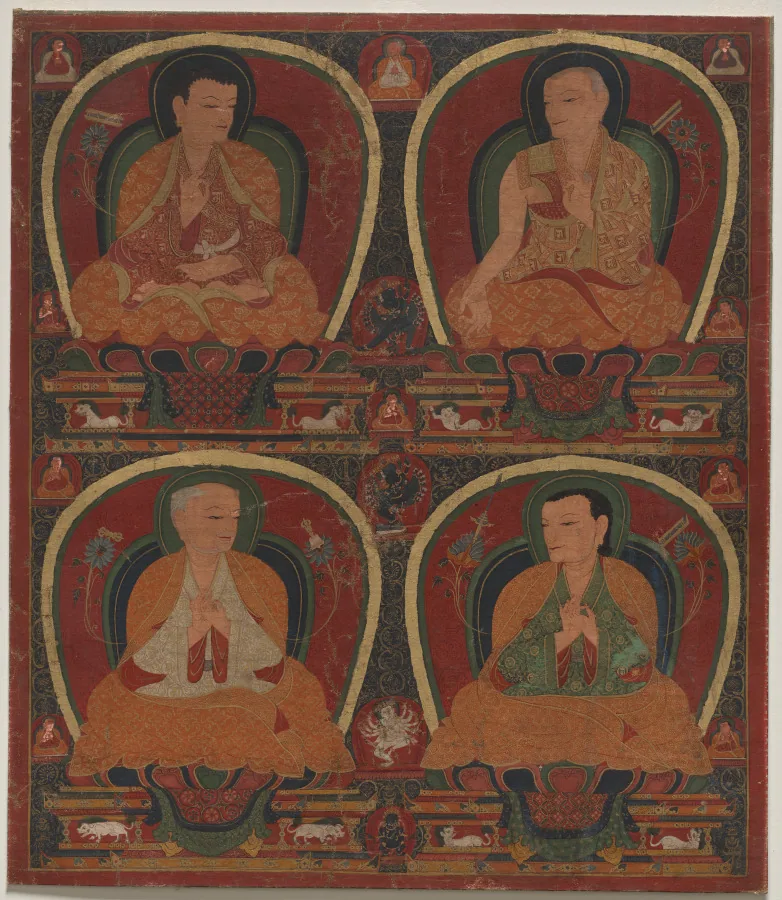
The Four Tibetan Schools & Bön Explained Clearly
Sharing the exact same Kangyur and Tengyur Buddhist canon, Tibet’s four major Buddhist schools differ not in core creed, but in historical translation era, pedagogical sequence, and meditative emphasis.