Dorje Drolö (Wrathful Padmasambhava on the Tigress)
Eighth & Fiercest Manifestation of Guru Rinpoche Associated with Bhutan’s Tiger’s Nest
Standing in a blaze of dark maroon flames atop a roaring pregnant tigress—actually wisdom consort Yeshe Tsogyal in fierce emanation—Dorje Drolö is the eighth and wildest of Padmasambhava’s Eight Manifestations, revered at Bhutan’s cliffside Taktsang (“Tiger’s Nest”) for shattering spiritual hypocrisy and turbulent-age obstacles.
Cliff of the Pregnant Tigress: Paro Taktsang & Uncompromising “Crazy Wisdom”
Anyone who has seen a photograph of Bhutan’s Paro Taktsang (sTag-tshang, “Tiger’s Lair,” clinging impossibly to a sheer 900-meter granite cliff above the Paro Valley) has already encountered the sacred geography of Dorje Drolö. According to 8th-century Himalayan accounts, before departing Tibet, Padmasambhava sought to tame turbulent local spirits blocking contemplative practice across thirteen remote borderland caves—foremost among them Singye Dzong and Paro Taktsang. His foremost Tibetan disciple and wisdom consort Yeshe Tsogyal spontaneously transformed herself into a ferocious pregnant tigress—pregnant not with ordinary cubs, but teeming with fierce awakened capability ready to burst forth—carrying Guru Rinpoche through the clouds onto the cliff ledge.
Look closely at the 18th-century polychrome sculpture in the Los Angeles County Museum of Art (M.86.281) and you notice how different Dorje Drolö looks from Indian gods: instead of naked bone ornaments alone, he wears heavy layered Tibetan monastic-yogin robes, a conch-shell earring, curly dark hair, and felt boots, glaring askance with unblinking wildness. Tibetan commentators call this Yeshe Chölwa (ye-shes ’chol-ba, “unruly or crazy wisdom”)—not erratic misbehavior, which genuine masters strictly condemn, but wisdom completely unbound by social pretense, spiritual vanity, or fear. His raised nine-pronged sky-iron (thog-lcags) vajra seals all nine vehicles into non-dual rigpa, while his downward phurba dagger pins reactive kleśas on the spot.
Where Dorje Drolö Fits: All Eight Manifestations of Guru Rinpoche
Museum visitors often ask why Padmasambhava appears sometimes as a gentle Indian pandita, sometimes as a wandering yogi in charnel grounds, sometimes as a radiant king, and finally as fierce Dorje Drolö. Preserved in revelations by Guru Chöwang (1212–1270) and Nyangral Nyima Özer, the Eight Manifestations (Gu-ru mtshan-brgyad) map eight pedagogical modes through which awakened mind responds to beings’ diverse needs:
| # | Manifestation Name | Tibetan (Wylie) | Visual Key & Pedagogical Function |
|---|---|---|---|
| 1 | Guru Orgyen Dorje Chang | o rgyan rdo rje ’chang | Deep blue embracing white Yeshe Tsogyal · Primordial inner union with Vajradhara |
| 2 | Guru Śākya Senge | shākya seng ge | Saffron monastic robes, alms bowl & vajra · Entering formal monastic discipline |
| 3 | Guru Loden Chogse | blo ldan mchog sred | Princely turban, damaru drum & skullcup · Boundless curiosity mastering all sciences |
| 4 | Guru Padmasambhava | padma ’byung gnas | Pointed pandita hat & kapāla · Pacifying obstacles & turning poison into nectar |
| 5 | Guru Nyima Özer | nyi ma ’od zer | Naked charnel-ground yogi pointing a finger at the sun · Dzogchen radiance |
| 6 | Guru Pema Gyalpo | padma rgyal po | Royal silks, mirror & damaru · Magnetizing auspiciousness without attachment |
| 7 | Guru Senge Dradog | seng ge sgra sgrogs | Dark-blue wrathful figure roaring against sectarian & nihilistic extremes at Bodhgayā |
| 8 | Guru Dorje Drolö | rdo rje gro lod | Maroon-red in robes & boots atop pregnant tigress · Subduing turbulent-age obstacles |
How It Is Practiced in Living Tradition
Celebrated with breathtaking masked Cham dances during Bhutan’s annual Paro Tshechu and Tibetan tenth-lunar-day (Tsok) festivals, and deeply treasured across Nyingma, Drukpa Kagyu, and Rimé terma lineages (notably Dudjom Lingpa, Khyentse Wangpo, and Dudjom Rinpoche’s revelations). Formal personal sadhana practice of Dorje Drolö requires empowerment (abhiṣeka / dbang), oral transmission (lung), and instruction (tri / khrid) from a qualified Vajrayāna master.
Common Questions & Clarifications
Why is the tigress beneath Dorje Drolö’s feet specifically described as pregnant?
In Himalayan natural lore, no creature in the forest is fiercer, more vigilant, or more fearless than a tigress heavy with cubs defending her young. Spiritually, Yeshe Tsogyal assuming that exact form signifies that emptiness is never barren—it is pregnant with boundless compassionate responsiveness (thugs-rje) ready to leap instantaneously to protect beings.
How can I tell Dorje Drolö apart from Guru Dragpo in Tibetan paintings?
Both are wrathful forms of Padmasambhava, but two cues separate them instantly: Dorje Drolö wears heavy layered Tibetan robes and boots and stands on a pregnant tigress, thrusting a phurba downward. Guru Dragpo is typically naked except for a tiger-skin loincloth and bone ornaments, standing directly on a lotus-sun disc while holding a black scorpion in his left hand.
Primary Sources & Further Reading
- Yeshe Tsogyal & Nyangral Nyima Özer, The Copper-Colored Palace (Zangs-gling-ma), trans. Erik Pema Kunsang (Rangjung Yeshe)
- Françoise Pommaret & John Ardussi, Bhutan: Fortress of the Gods & Sacred History of Paro Taktsang (Serindia)
- Los Angeles County Museum of Art (M.86.281): 18th-Century Tibetan Sculpture of Dorje Drolö
Connected in the Mandala Graph
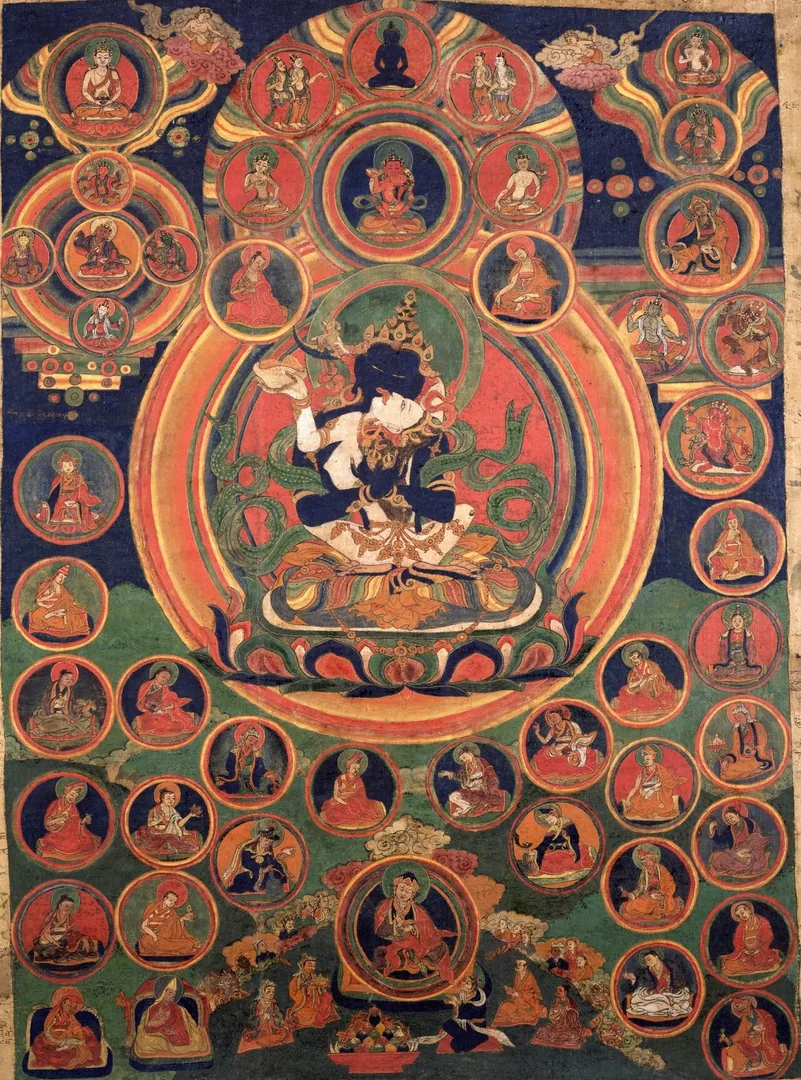
Padmasambhava (Guru Rinpoche)
Invited from Oddiyāna and Nālandā to Tibet by King Trisong Detsen in the 8th century, Padmasambhava (“Lotus-Born”) consecrated Samye Monastery and harmonized Himalayan indigenous spirits with Buddhist Dharma.
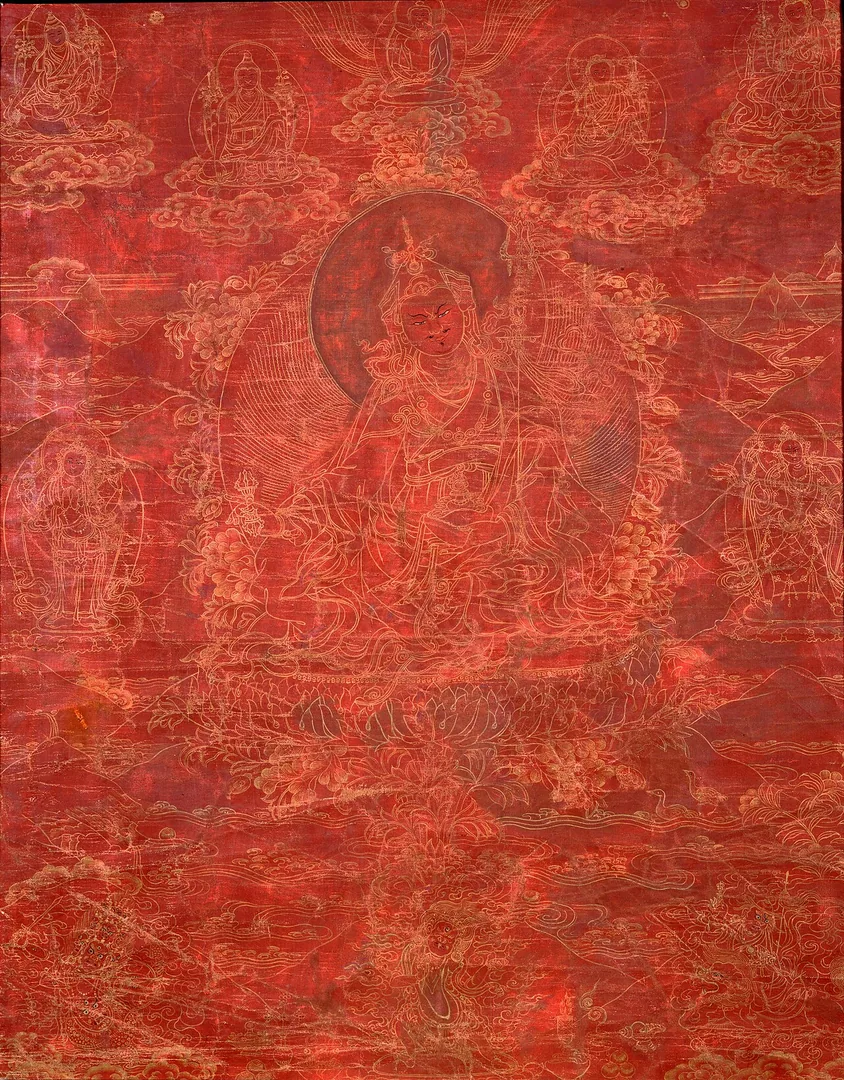
The Seven-Line Prayer to Guru Rinpoche (Tsik Dün Soldeb)
Revered across the Himalayas as the primordial invocation spoken by wisdom ḍākinīs at Nālandā, these seven metered Tibetan lines summon Padmasambhava outwardly as historical teacher and inwardly as the unborn clarity of one’s own mind (rigpa).
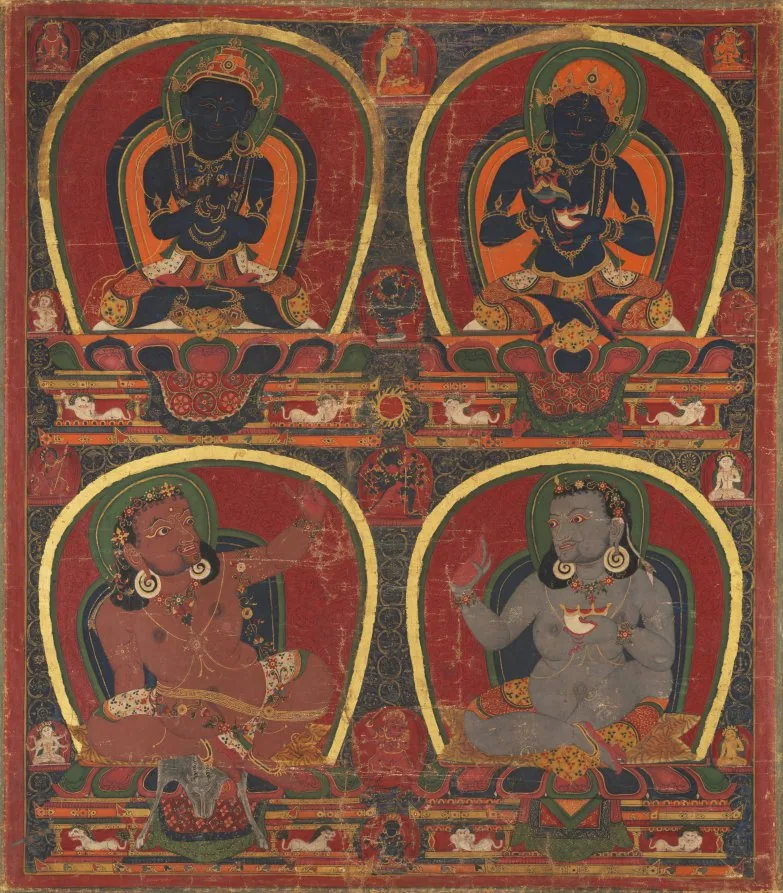
Oṃ Āḥ Hūṃ Vajra Guru Padma Siddhi Hūṃ (Vajra Guru Mantra)
Known across the Himalayas as the Vajra Guru Mantra, these twelve syllables align body, speech, and mind (Oṃ Āḥ Hūṃ) with indestructible wisdom (Vajra), noble guidance (Guru), and unstained compassion (Padma) to clear obstacles on the path.
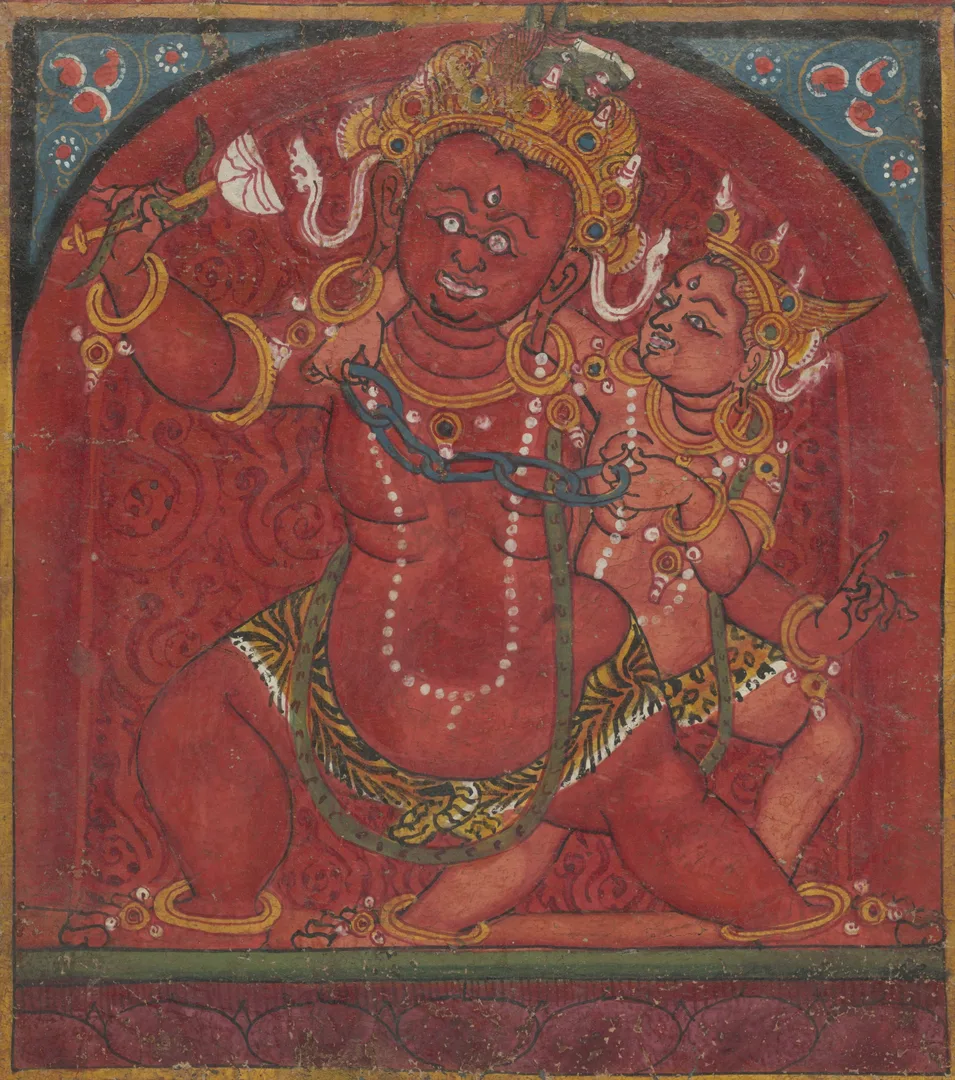
Hayagrīva (Tamdrin · Horse-Necked Wrathful Compassion)
When gentle Avalokiteśvara’s serene smile cannot rouse beings trapped in stubborn delusion or acute obstacle, Great Compassion blazes forth as cinnabar-red Hayagrīva—instantly identified across Tibetan, Newar, and East Asian art by one or three emerald-green horse heads neighing from his flaming hair.