Blue Acala / Achala (Miyowa · “The Immovable Wisdom Protector”)
Unwavering Sapphire Wrathful Emanation Brandishing Flaming Sword & Lasso Across Tibetan Kadampa & East Asian Art
Whose Sanskrit name Acala and Tibetan name Miyowa both mean “The Immovable One,” sapphire-blue Acala brandishes a flaming wisdom sword overhead and coils a vajra lasso at his heart, often dropping one knee directly onto rocky ground—honored by Atiśa Dīpaṃkara as one of the Four Deities of the Kadampa school for cutting distraction and karmic obstacles without budging an inch.
Atiśa’s “Kadampa Four Deities”: Why Every Meditator Needed an Unshakeable Anchor
When the great Bengali pandita Atiśa Dīpaṃkara Śrījñāna (982–1054) arrived in Tibet in 1042 CE to reform ethical and contemplative practice, Tibetan disciples asked why so many Indian scholars possessed vast book-learning yet modest realization, whereas Atiśa radiated serene unshakeable presence. Tradition records that Atiśa distilled the entire Buddhist path into a balanced quartet known ever since as the Kadampa Four Deities (bKa’-gdams lha-bzhi): Śākyamuni Buddha (root teacher and refuge), Avalokiteśvara (boundless compassion), Green Tārā (swift enlightened activity), and Blue Acala—the fearless guardian who clears inner lethargy, illness, and conceptual doubt whenever meditation wavers.
Our 12th-century Kadampa thangka plate preserves one of the earliest surviving Tibetan paintings of Ārya Acala: set against a glowing vermilion flame nimbus, dark-blue Acala locks his gaze slightly askance (signifying equal watchfulness over both conventional karma and ultimate emptiness), wearing a tiger-skin loincloth and serpent ornaments that tame pride and anger.
Pan-Asian Twins: Tibetan Miyowa vs. Japanese Shingon Fudō Myōō
Travelers who have visited temples in Kyoto, Kōyasan, or Nara immediately experience a flash of recognition when standing before a Tibetan Acala bronze: both traditions inherited the exact same 7th–9th century Indian Esoteric Buddhist deity—transmitted eastward via Chang’an by Śubhakarasiṃha, Amoghavajra, and Kūkai (806 CE) as Fudō Myōō (不動明王), and northward across the Himalayas by Rinchen Zangpo and Atiśa as Miyowa! Comparing them side by side illuminates how two great Asian civilizations preserved one Sanskrit blueprint:
| Feature | Tibetan Vajrayāna (Miyowa) | East Asian Tang-Shingon (Fudō Myōō) |
|---|---|---|
| Core Implements | Flaming sword (right) & vajra lasso (left) — 100% identical! | Kurikara dragon/wisdom sword (right) & braided lasso (left) — 100% identical! |
| Characteristic Stance | Left knee pressed directly to lotus/rock OR wide warrior lunge; also White & 4-armed forms | Seated or standing erect on rugged rock base (banjaku) amidst Garuda-beak flames |
| Hair & Facial Cue | Upward orange wisdom-hair, jewel/skull crown, askance eyes & bared fangs | Seven-knotted youth braid hanging over left shoulder, asymmetrical squinted eye & one up/one down fang |
| Primary Textual Basis | Caṇḍamahāroṣaṇa Tantra (Toh 431) & Kadampa Acala cycle (Toh 631) | Mahāvairocana Sūtra (T. 848 / Toh 494) & Amoghavajra manuals |
How It Is Practiced in Living Tradition
Historically invoked across Kadampa, Gelug, Sakya, and Kagyu monasteries before intensive meditation retreats (tsam) to clear dullness, agitation, and environmental disturbances. Formal recitation of Acala’s kriyā/caryā or anuttarayoga mantras and visualizations follows traditional oral reading transmission (lung) and permission empowerment (rjes-gnang) from a qualified teacher.
Common Questions & Clarifications
Why does Blue Acala drop one knee onto the ground in so many Tibetan bronzes?
Known in Tibetan iconographic manuals as the kneeling-immovable stance, pressing one knee directly into the diamond ground expresses total refusal to retreat in the face of delusion—anchoring awakening right inside the rough terrain of ordinary life rather than floating above it.
Primary Sources & Further Reading
- Śrīcaṇḍamahāroṣaṇa-tantra (Toh 431) & Ārya-acala-mahākrodharāja-sarvatathāgatabalāparimita-parākrama (Toh 495 / 631)
- Thupten Jinpa (trans.), The Book of Kadam: The Core Texts of Tibetan Buddhism’s Kadampa Lineage (Library of Tibetan Classics, Wisdom, 2008)
- Kadam Lineage Open Archive / Rubin Museum: 12th-Century Central Tibetan Thangka of Ārya Acala
Connected in the Mandala Graph
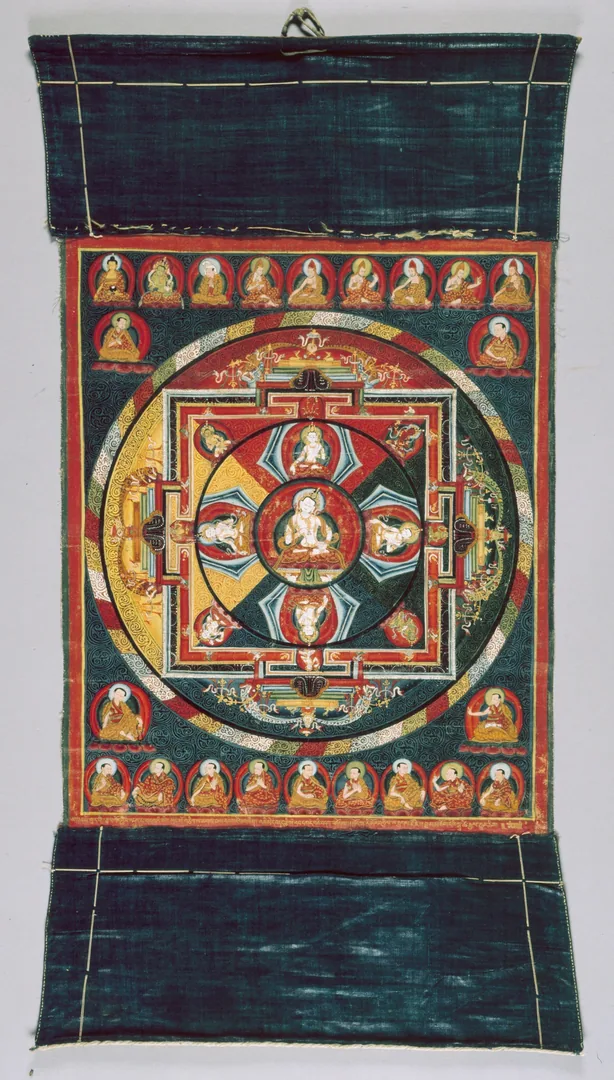
Vajrapāṇi (Chana Dorje · Wielder of the Thunderbolt)
Standing in midnight-blue warrior stance amidst blazing wisdom flames and brandishing a five-pronged vajra overhead, Vajrapāṇi embodies fearless spiritual power—completing Tibet’s beloved Rigsum Gönpo triad alongside Chenrezig (compassion) and Mañjuśrī (wisdom).
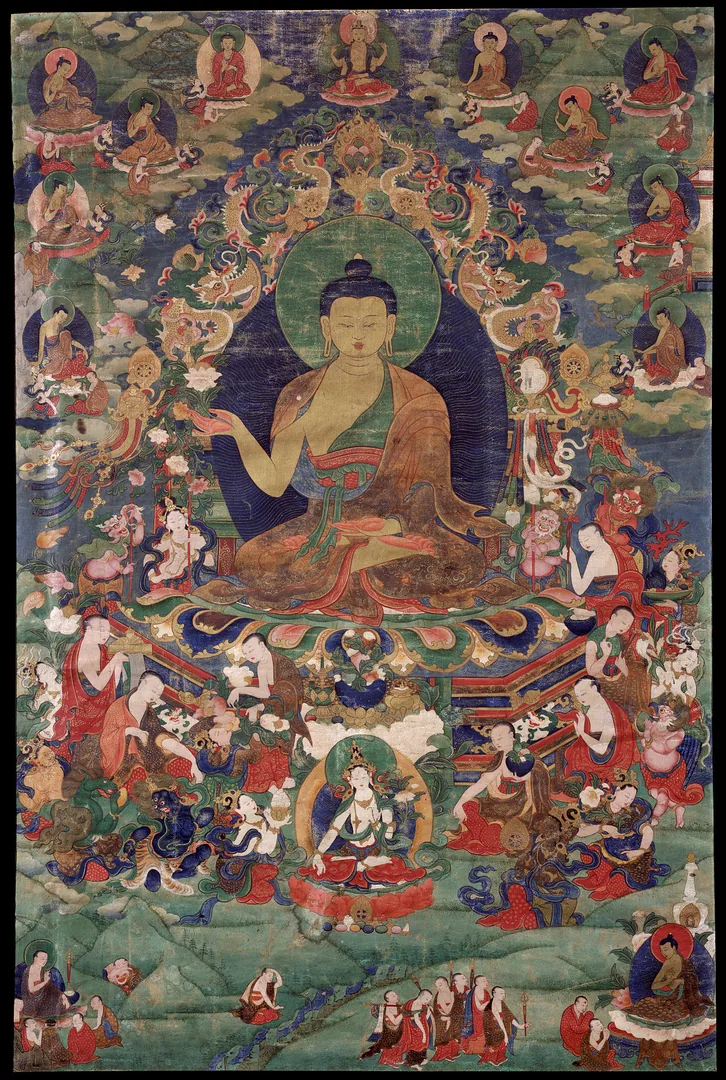
Śākyamuni Buddha (Shakya Thubpa)
Known in Tibetan as Shakya Thubpa (“Mighty Sage of the Śākyas”), the historical Buddha sits in unadorned monastic robes, touching the earth with his right fingertips to witness impartial awakening while cradling an iron alms bowl in his lap.
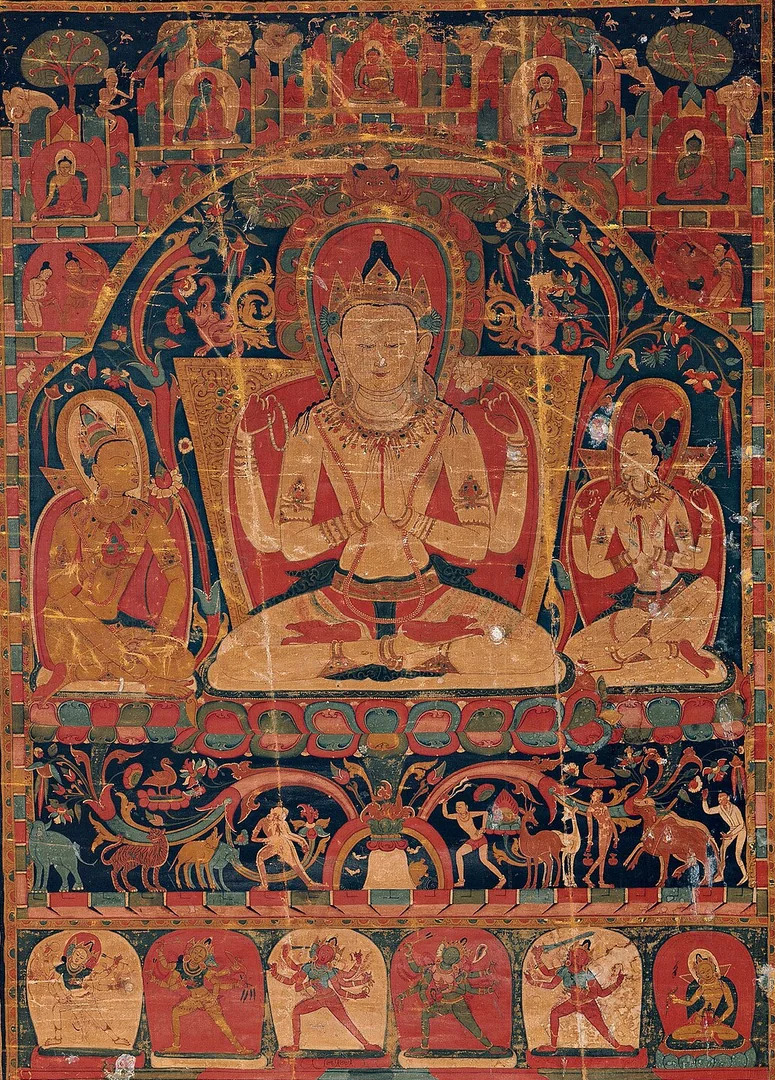
Avalokiteśvara (Chenrezig)
Known in Tibetan as Chenrezig (“One Who Gazes with Unwavering Eyes”), the four-armed white form embodies impartial compassion united with emptiness, associated with the Six-Syllable Mantra Oṃ Maṇi Padme Hūṃ.
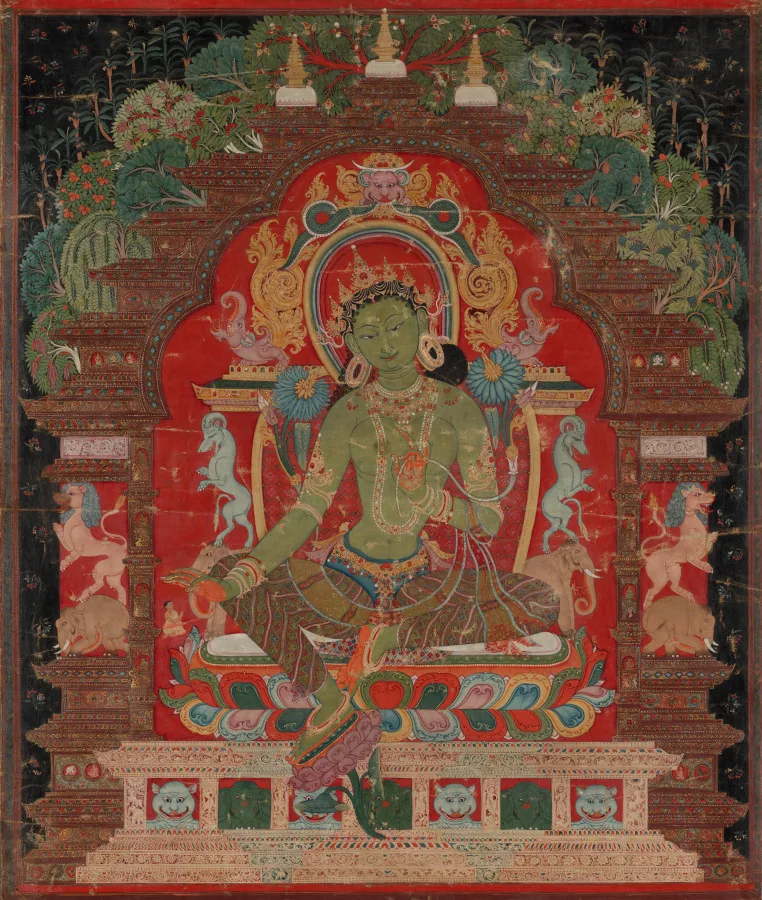
Green Tārā (Sgrol-ljang)
Seated in royal ease with her right foot already stepping off the lotus cushion, Green Tārā embodies enlightened compassion in immediate motion—green being the color of the Wind/Action Buddha Family.