Śākyamuni Buddha (Shakya Thubpa)
The Historical Awakened Teacher · Earth-Witness Mudra at Bodh Gayā
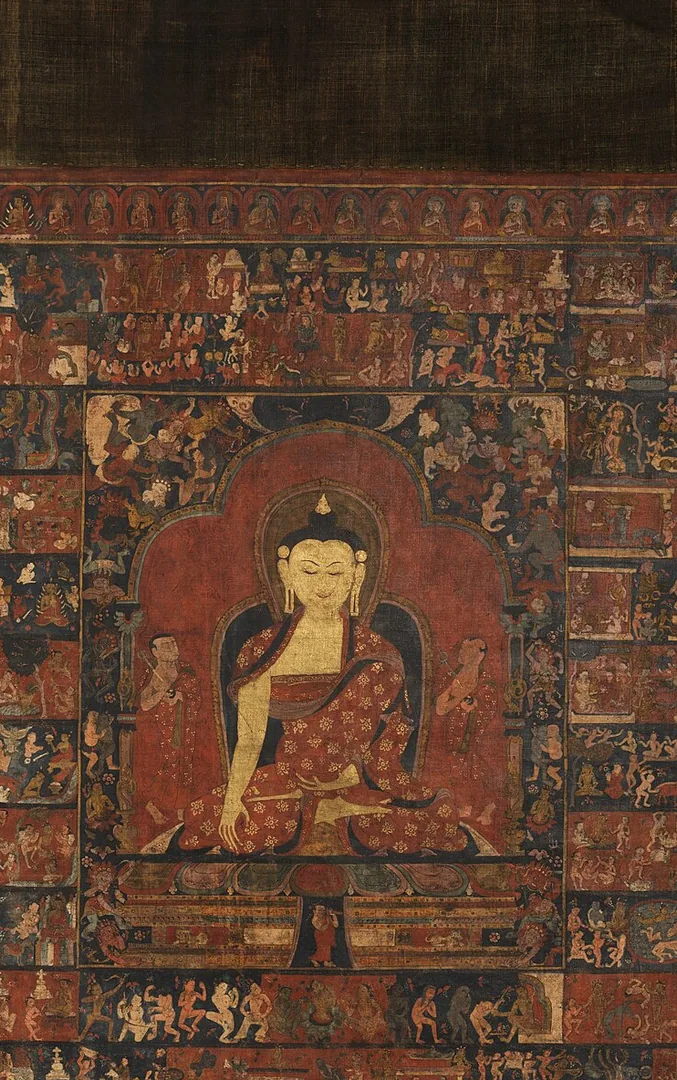
Known in Tibetan as Shakya Thubpa (“Mighty Sage of the Śākyas”), the historical Buddha sits in unadorned monastic robes, touching the earth with his right fingertips to witness impartial awakening while cradling an iron alms bowl in his lap.
Why Touching the Ground Answered Doubt Without a Single Argument
Every visitor to a Tibetan monastery sees the central golden Buddha reaching his right hand gently over his knee until his fingertips touch the lotus seat. That gesture—the bhūmisparśa (“earth-touching”) mudra—captures the decisive night under the Bodhi tree at Bodh Gayā. When Māra (personifying inner fear, self-doubt, and craving) challenged Siddhārtha Gautama, asking “Who will vouch for your right to sit here and awaken?”, Siddhārtha neither argued nor summoned thunderbolts. He silently lowered his right hand to touch the impartial earth, which trembled in witness to countless lifetimes of patient generosity.
In his left hand rests a simple dark alms bowl: a quiet reminder across even the most ornate Vajrayāna temple that every tantra, philosophical debate, and mandala traces back to a wandering mendicant who lived simply, listened deeply, and pointed out the Four Noble Truths.
Monastic Robes vs. the Crowned Jowo Rinpoche in Lhasa
In standard thangkas, Śākyamuni wears plain saffron-and-crimson patchwork robes flanked by his two foremost disciples standing with begging bowls and staffs: Śāriputra (wisdom) and Maudgalyāyana (meditative mastery). Yet in Lhasa’s Jokhang Temple, Tibet’s most sacred statue—Jowo Rinpoche, brought in the 7th century by Princess Wencheng—wears a jeweled five-leafed crown offered in the 15th century by Je Tsongkhapa, honoring the historical teacher simultaneously as timeless sambhogakāya radiance.
How It Is Practiced in Living Tradition
Honored at the opening of every Tibetan liturgical text (“Homage to the Conqueror Śākyamuni!”) and celebrated across the plateau on Saga Dawa and the 15th and 30th of every lunar month.
Common Questions & Clarifications
How can I distinguish Śākyamuni Buddha from Medicine Buddha or Akṣobhya?
Check body color and right hand: Śākyamuni is warm gold with right fingertips touching the ground; Medicine Buddha is lapis blue holding a medicinal plant at his knee; Akṣobhya is also blue with right hand touching the ground, holding an upright vajra in his lap.
Primary Sources & Further Reading
- Lalitavistara Sūtra (The Play in Full, Toh 95), Kangyur · 84000 Translation
- Mipham Rinpoche, Treasury of Blessings: A Practice of Buddha Śākyamuni
Connected in the Mandala Graph
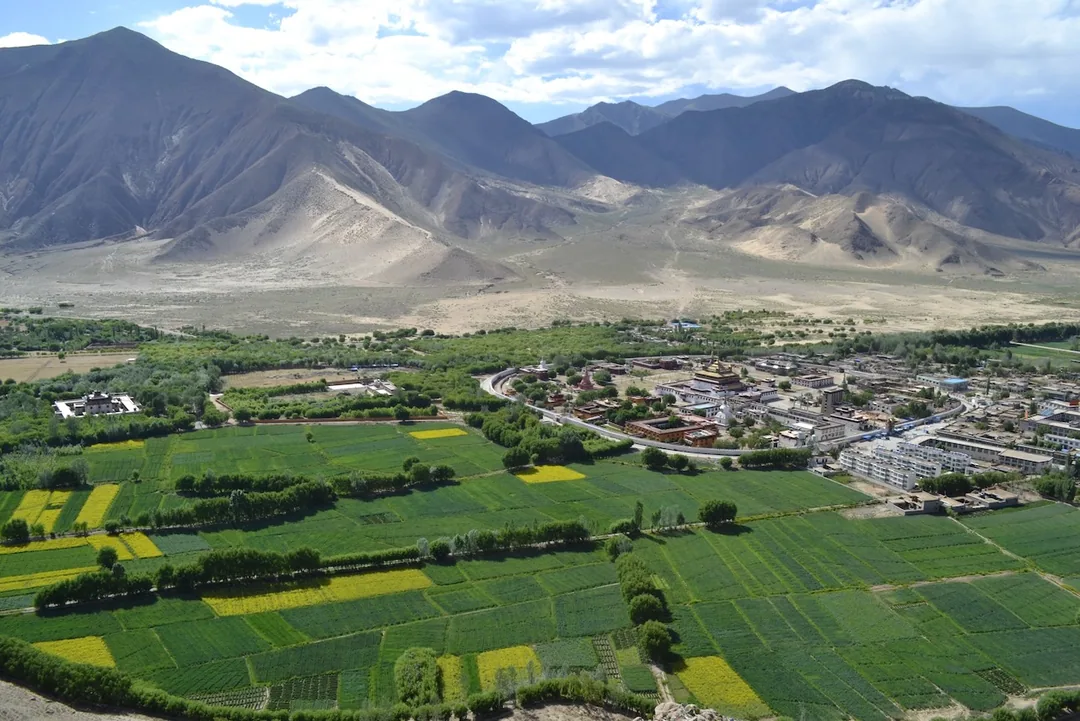
Jokhang Temple & Samye Monastery
Built in the 7th and 8th centuries respectively, Lhasa’s Jokhang anchors Tibetan devotional pilgrimage around the Jowo Śākyamuni, while Samye in Lhoka realizes an entire three-dimensional mandala in stone, timber, and earth.
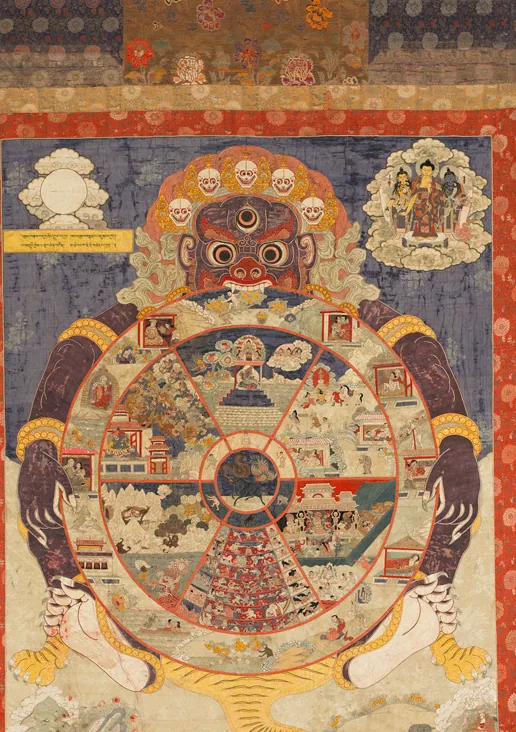
Bhavacakra: The Wheel of Life (Srid-pa’i ’khor-lo)
Painted on the outer vestibule wall of nearly every Tibetan monastery according to instructions in the Vinaya (Toh 3), the Wheel of Becoming maps how habitual reactivity spins into suffering—and precisely where awareness steps free.
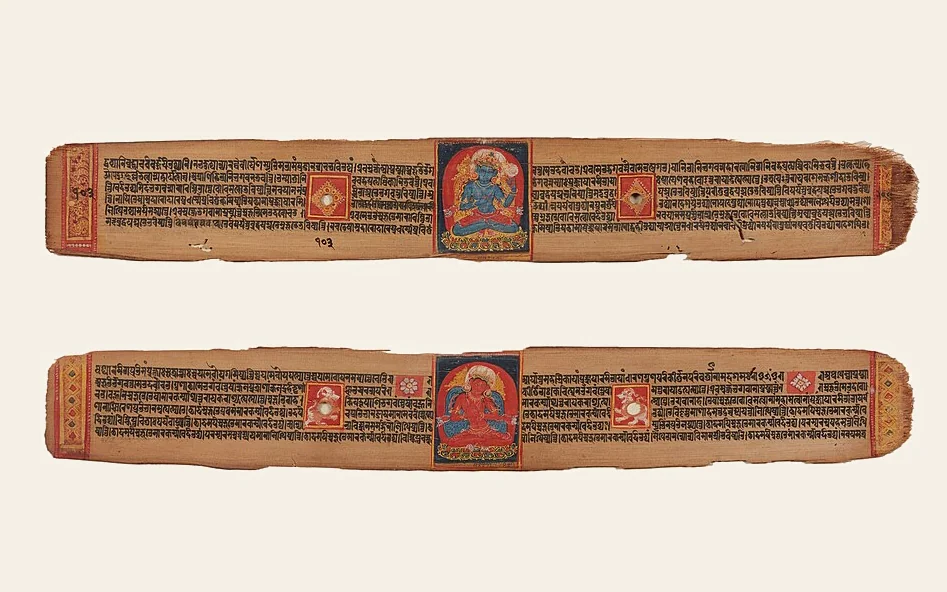
The Heart Sūtra (Sherab Nyingpo · 心经)
In 260 Chinese characters (and a slightly longer framed dialogue in the Tibetan Kangyur), Avalokiteśvara explains to Śāriputra why seeing emptiness—interdependent openness—dissolves fear.
Karma & Interdependence: Why It Is Never Fatalism
In Sanskrit and Tibetan (las), karma literally means “action,” never “predestined fate.” While past choices shape today’s conditions, how one responds right now writes the next cause.