Hevajra & Nairātmyā (Kye Dorje · Bliss-Emptiness Mother Tantra)
Eight-Faced, Sixteen-Armed Sapphire Heruka Dancing With Wisdom Consort Nairātmyā (“Selflessness”)
Whose very name divides into “He!” (great compassion) and “Vajra” (indestructible emptiness), eight-faced, sixteen-armed Hevajra dances in embrace with Nairātmyā—literally “Lady Selflessness”—serving as the central meditational mandala of the Sakya Lamdre (“Path and Its Fruit”) tradition and Marpa’s Kagyu transmission.
Decoding the 16 Skullcups & Lady “Selflessness” (Nairātmyā)
Among all Anuttarayoga tantras, the Hevajra Tantra (Brtag-gnyis, “The Two-Part Examination,” Toh 417–418—also the first major Buddhist tantra critically edited and translated into English by D. L. Snellgrove in 1959) stands out for making its philosophical symbolism unmistakable right in the names of its deities. Hevajra’s consort is literally named Nairātmyā (བདག་མེད་མ།, Dagmema)—Sanskrit for “Selflessness / Absence of Ego”—surrounded in her own 15-deity mandala by yoginīs personifying generosity, mindfulness, and emptiness.
In the sixteen-armed Kapāladhara (“Skullcup-Bearing”) form illustrated in our c. 1604 Art Institute of Chicago thangka, Hevajra’s right eight skullcups hold an elephant, horse, mule, ox, camel, human, śarabha-deer, and cat (symbolizing the healing of eight diseases and attainment of eight spiritual powers), while his left eight skullcups hold the classical gods of Earth, Water, Air, Fire, Moon, Sun, Yama, and Vaiśravaṇa—signifying that all cosmic forces and temporal anxieties dissolve into non-dual awareness.
Saṃsāra & Nirvāṇa Inseparable: Virūpa’s Sakya Lamdre & Marpa’s Gold
Historically, Hevajra shaped two of Tibet’s greatest spiritual streams. First, the Indian mahāsiddha Virūpa received direct vision of Nairātmyā, composing the Vajra Verses (Rdo-rje tshig-rkang) that anchor the Sakya (Lam-’bras, “Path and Its Fruit”). Its core philosophical axiom—’khor-’das dbyer-med (“Inseparability of Saṃsāra and Nirvāṇa”)—teaches that the very mind confused in ordinary life is, in its luminous empty nature, identical to the awakened continuum. Second, Marpa trekked thrice to India to receive Hevajra from Nāropa, bequeathing the Ngok commentarial lineage alongside Milarepa’s contemplative songs.
| Form | Faces & Arms | Key Visual Cue | Textual Root |
|---|---|---|---|
| Kapāladhara Hevajra | 8 faces · 16 arms · 4 legs | All 16 hands hold white skullcups (kapāla) | Hevajra Tantra Part II (Toh 417) |
| Śastradhara Hevajra | 3 faces · 6 arms | Holds vajra, bell, trident & kartika | Hevajra Tantra Part I |
| Sahaja (Kāya) Hevajra | 1 face · 2 arms | Blue body holding vajra & kapāla in embrace | Innate (Lhan-skyes) Lamdre sadhana |
| Solo Nairātmyā (Dagmema) | 1 face · 2 arms | Dark-blue dancing yoginī raising kartika & skullcup | 15-Deity Nairātmyā Mandala |
How It Is Practiced in Living Tradition
Studied historically as a cornerstone of Sakya and Kagyu scholasticism—in fact, it was through Phags-pa Lodrö Gyaltsen’s 13th-century Hevajra lectures that Sakya diplomacy bridged Tibet and the Yuan court. Following strict Vajrayāna samaya, actual meditation on the Hevajra mandala and Lamdre inner yogas requires two-day causal empowerment (rgyu-dbang), oral reading transmission (lung), and authentic Lamdre pith instruction (khrid) from a qualified Sakya or Kagyu Vajra master.
Common Questions & Clarifications
How do I tell 16-armed Hevajra apart from 12-armed Cakrasaṃvara at a glance?
Look at the outer hands: Cakrasaṃvara (4 faces, 12 arms) stretches a raw elephant hide behind his shoulders with his top two hands and holds diverse weapons; Hevajra Kapāladhara (8 faces, 16 arms) has no elephant hide and holds sixteen identical white skullcups in every single palm.
Primary Sources & Further Reading
- Hevajra-tantrarāja-nāma (Toh 417–418), trans. David L. Snellgrove, The Hevajra Tantra: A Critical Study (Oxford University Press, 1959)
- Cyrus Stearns, Taking the Result as the Path: Core Teachings of the Sakya Lamdre Tradition (Library of Tibetan Classics, Wisdom, 2006)
- The Art Institute of Chicago (1997.707 / 148424): Hevajra Kapāladhara and Nairātmyā, c. 1604 Tibet (CC0)
Connected in the Mandala Graph
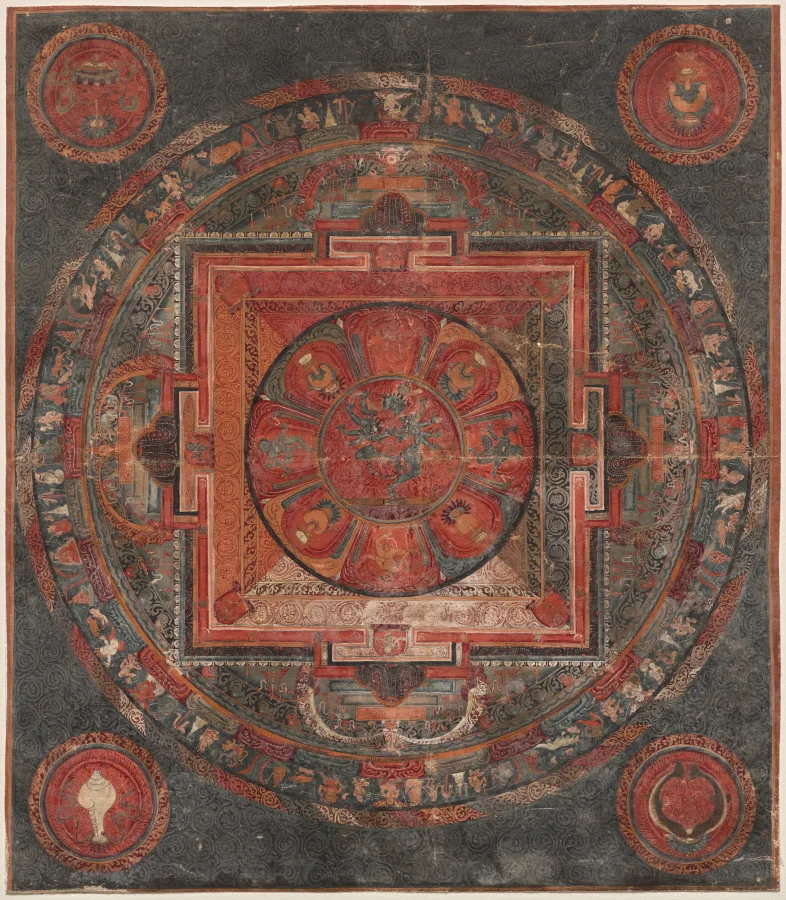
Cakrasaṃvara (Khorlo Demchog · Wheel of Supreme Bliss)
Celebrated across Himalayan art and pilgrimage as the indwelling mandala deity of Mount Kailash, sapphire-blue Cakrasaṃvara embraces crimson wisdom-ḍākinī Vajravārāhī with crossed vajra and bell—embodying Mother Tantra’s realization that great bliss and emptiness are indivisible.
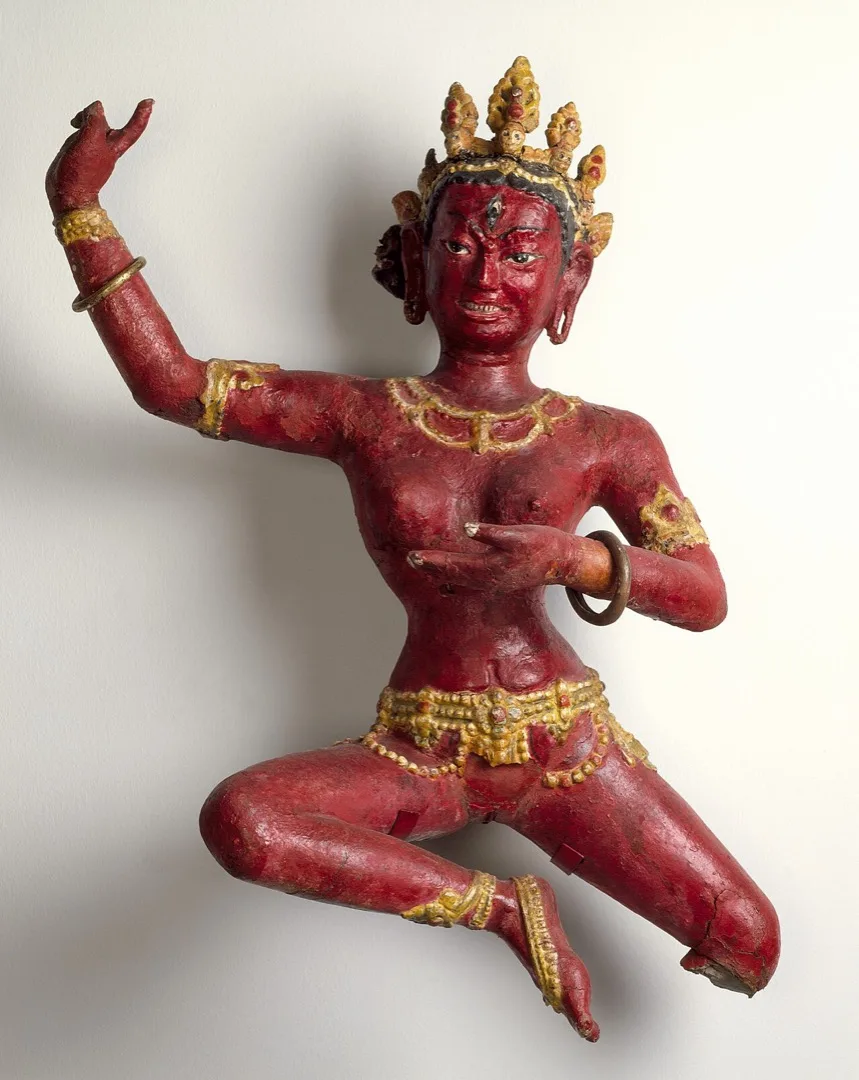
Vajrayoginī & Vajravārāhī (Dorje Naljorma / Dorje Phagmo)
Blazing ruby-red amidst wisdom flames, holding a curved flaying knife (kartika) to sever egoic habit and a skullcup of non-dual bliss, Vajrayoginī—and her celebrated sow-crowned form Vajravārāhī (Dorje Phagmo)—is the supreme female Anuttarayoga yidam across Kagyu, Sakya, and Gelug Buddhism, embodying full awakening in female form.
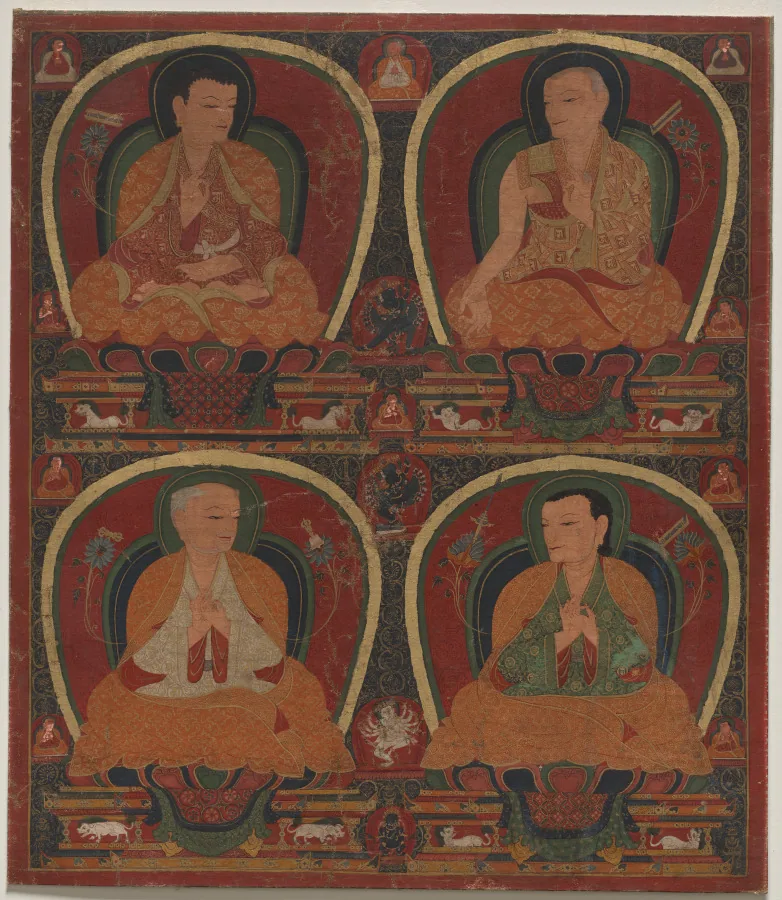
The Four Tibetan Schools & Bön Explained Clearly
Sharing the exact same Kangyur and Tengyur Buddhist canon, Tibet’s four major Buddhist schools differ not in core creed, but in historical translation era, pedagogical sequence, and meditative emphasis.
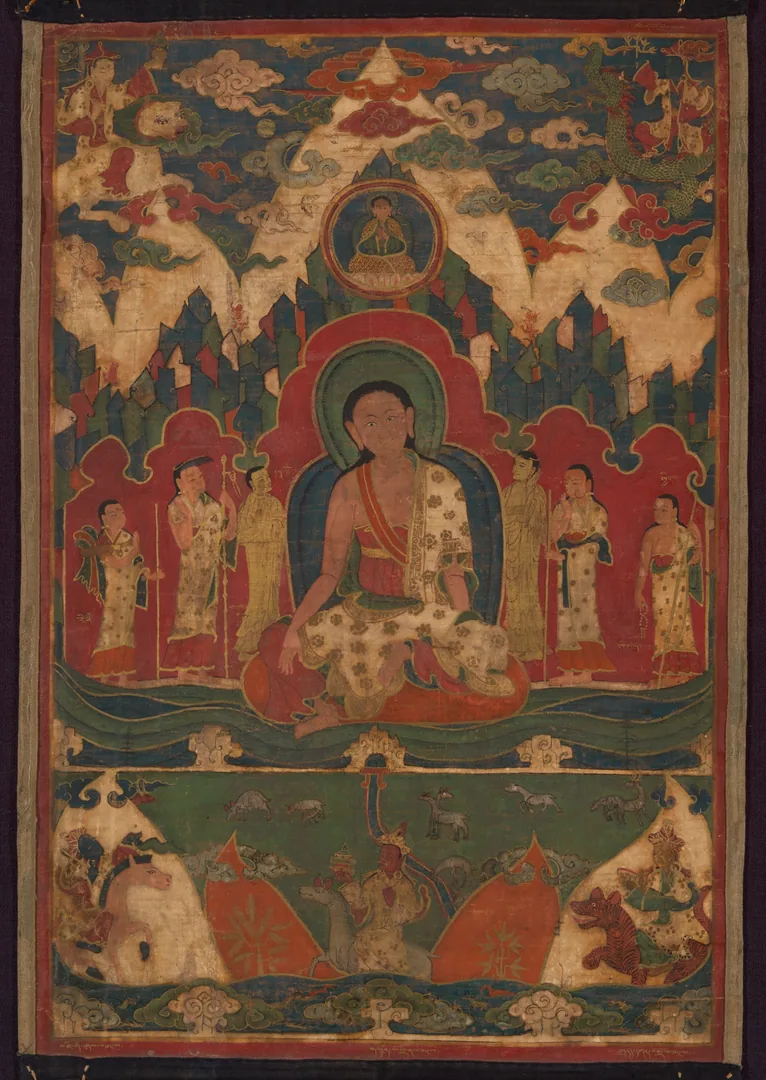
Jetsün Milarepa (1052–1135 · Tibet’s Cotton-Clad Poet-Yogi)
Seated in alpine cave solitude wearing a single white cotton cloth (repa), skin tinged pale green from years of wild nettle soup and right palm cupped at his ear singing spontaneous Vajra Songs (mgur), Milarepa proves no past mistake places awakening out of reach.