Kālacakra (Wheel of Time · Dus-kyi ’Khor-lo)
Cosmos, Subtle Body & Awakening Synchronized · Root Source of Tibetan Astronomy
Meaning “Wheel of Time,” Kālacakra synchronizes three vast domains into a single non-dual mandala: planetary astronomy and calendar science (Outer), the subtle channels and breaths of the human body (Inner), and the contemplative path purifying both into timeless awakening (Alternative).
Wearing the Astronomical Year: How to Read His 4 Faces & 24 Arms
Synthesized in India around the turn of the 11th century through the Laghukālacakra Tantra (Abridged Kālacakra Tantra, Toh 362) and King Puṇḍarīka’s encyclopedic Vimalaprabhā (Stainless Light commentary, Toh 845), Kālacakra treats every detail of iconography as a mathematical diagram of time. His four faces (blue front, red right, white left, yellow back) correspond to the four seasons, four elements, and four awakened bodies; his twenty-four arms—arranged in three distinct color tiers of eight dark-blue, eight red, and eight white—map the twenty-four fortnightly half-months (pakṣa) and solar terms of the astronomical year; while the joints of his fingers encode all 360 lunar tithi days.
At the center of this temporal wheel, sapphire-blue Kālacakra—representing immutable emptiness (śūnyatā) untouched by past, present, or future—embraces golden four-faced, eight-armed Viśvamātā (སྣ་ཚོགས་ཡུམ།, “Mother of All Diversity”), who embodies compassionate awareness knowing all phenomena unfolding across time. In museum art, their yab-yum embrace signifies the non-dual union (advaya) of timeless emptiness and luminous compassion, while beneath Kālacakra’s red right leg and white left leg lie Kāmadeva and Rudra—personifying compulsive craving and destructive aggression overcome by wisdom. Even monastery doorways across Tibet display Kālacakra’s seed monogram, the Namchu Wangden (རྣམ་བཅུ་དབང་ལྡན།, “Powerful in Ten Aspects”), stacking seven Sanskrit syllables crowned by crescent, bindu, and flame to harmonize environmental and inner elements.
The Three Kālacakras & Rimé Lineages: Jonang, Sakya, Gelug & Sand Mandalas
What makes the Kālacakra literature unique across world philosophies is its systematic triangulation of macrocosm, microcosm, and liberation—known classically as the Three Kālacakras. Rather than treating astronomy, human medicine, and meditation as separate compartments, the tantra demonstrates how external planetary cycles mirror internal respiratory rhythms, and how purifying subtle-body winds unlocks non-dual awakening:
| Dimension | Tibetan (Wylie) | Domain of Study | Living Cultural & Contemplative Fruit |
|---|---|---|---|
| 1. Outer Kālacakra | phyi dus kyi ’khor lo | Five elements, planetary orbits, solar & lunar eclipses, 60-year Rabjung cycle | Mathematical root of the 1447 CE Phugpa Tibetan lunar calendar & Men-Tsee-Khang almanac |
| 2. Inner Kālacakra | nang dus kyi ’khor lo | Subtle channels (rtsa), 21,600 daily breath-winds (rlung) & drops (thig-le) | Integrates subtle anatomy with Tibetan Sowa Rigpa medical rhythms |
| 3. Alternative Kālacakra | gzhan dus kyi ’khor lo | Empowerment, 722-deity palace & Six-Branch Yoga (ṣaḍaṅgayoga / sbyor-drug) | Purifies ordinary cosmic & bodily time into the indivisible wisdom body (Mahāmudrā) |
Non-Sectarian Custodianship & Impermanence Written in Colored Sand
Historically, Kālacakra entered Tibet in 1027 CE (the exact starting epoch of the Tibetan sixty-year Rabjung calendar!) through the Ra and Dro translation lineages, flourishing across every school. Sakya masters and the great encyclopedist Butön Rinchen Drub (1290–1364) compiled definitive commentaries; the Jonang school—led by Dolpopa Sherab Gyaltsen (1292–1361) and the 17th-century Rimé polymath Jetsün Tāranātha (1575–1634)—became universally revered as the devoted custodians of the complete experiential Six-Branch Yoga (sbyor-drug) lineage, still practiced in Jonang centers across Dzamthang and Amdo today; while Je Tsongkhapa and Khedrup Je established monumental Kālacakra colleges within the Gelug tradition, and Jamgön Kongtrul and Ju Mipham wove both lineages into the 19th-century Rimé treasury.
In modern museums and civic halls worldwide, Kālacakra is equally famous for its five-story architectural sand mandala (rdul-tshon dkyil-’khor). Monks spend weeks tapping millions of grains of crushed mineral pigment from metal chakpur funnels into geometric perfection—only to sweep the entire palace into a single heap and pour the sand into flowing water at the closing ceremony, offering an unforgettable visual meditation on impermanence (anitya) and non-clinging.
How It Is Practiced in Living Tradition
Consulted daily across Tibetan households through the Phugpa lunar almanac derived from Outer Kālacakra astronomy, and witnessed globally during public colored-sand mandala exhibitions and Kālacakra world-peace gatherings (historically attended as a blessing of peace by hundreds of thousands of laypeople). In strict accordance with Vajrayāna samaya, actual personal practice of the Alternative Kālacakra generation stage and Six-Branch Yoga (ṣaḍaṅgayoga) requires full Kālacakra empowerment (abhiṣeka / dbang), oral transmission (lung), and close experiential instruction (tri / khrid) from a qualified Jonang, Gelug, Sakya, Kagyu, or Nyingma lineage master.
Common Questions & Clarifications
What is “Śambhala” in the Kālacakra Tantra, and how does it differ from Western Shangri-La fiction?
They are quite different! Shangri-La was coined by British novelist James Hilton in his 1933 novel Lost Horizon, loosely inspired by travelers’ tales of Śambhala (བདེ་འབྱུང་།, “Source of Happiness”). In the Laghukālacakra Tantra (Toh 362), Śambhala is the sacred realm where King Sucandra and the lineage of Kulika (Rigden) Dharma-kings preserved the Buddha’s Kālacakra teachings—interpreted by Tibetan masters simultaneously as a pure realm and as an inner state of awakened harmony realized when ignorance is dispelled.
Why is the Tibetan calendar year 1027 CE tied directly to Kālacakra?
Because 1027 CE (the Female Fire Rabbit year, Prabhava) marks the historic year the Kālacakra Tantra and its sixty-year Jupiter-solar-lunar cycle were translated from Sanskrit into Tibetan—giving Himalayan historians and astronomers an unbroken, mathematically exact chronological spine for the past millennium.
Primary Sources & Further Reading
- Śrī Paramādibuddhoddhṛta Śrī Kālacakra-nāma-tantrarāja (Laghukālacakra Tantra, Toh 362) & Vimalaprabhā (Toh 845)
- Vesna A. Wallace, The Inner Kālacakratantra: A Buddhist Tantric View of the Individual (Oxford University Press, 2001)
- Edward Henning, Kālacakra and the Tibetan Calendar (Treasury of the Buddhist Sciences, Columbia University Press, 2007)
Connected in the Mandala Graph
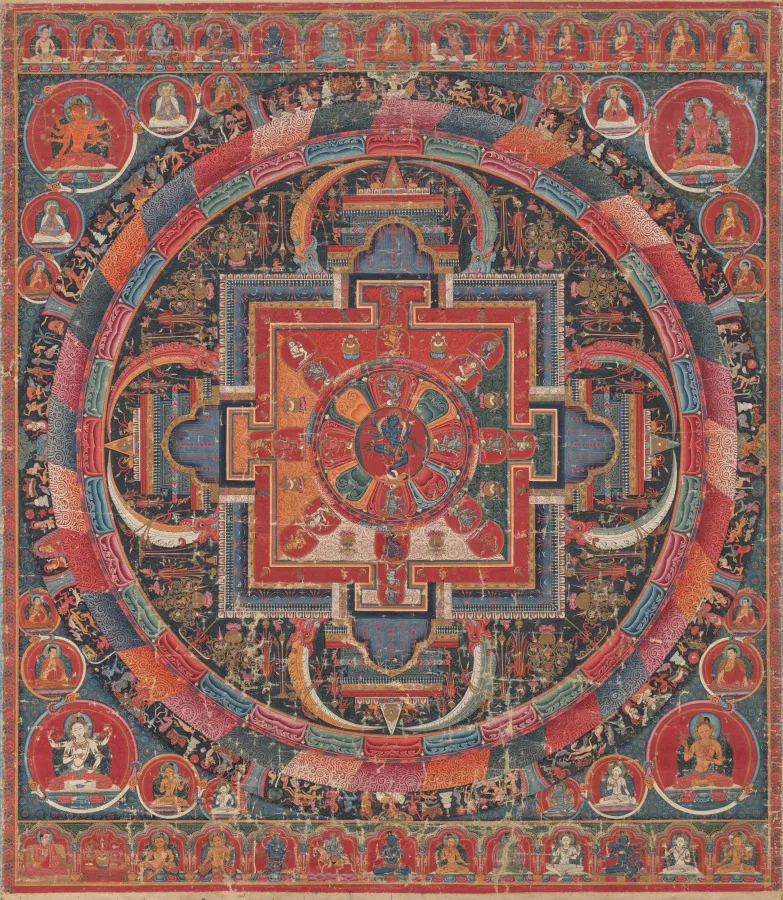
The Mandala (Kyilkhor · དཀྱིལ་འཁོར།)
Rendered in Tibetan as dkyil-’khor (“center and periphery”), a mandala is not decorative symmetry—it is a two-dimensional architectural floor plan of an awakened three-dimensional palace.
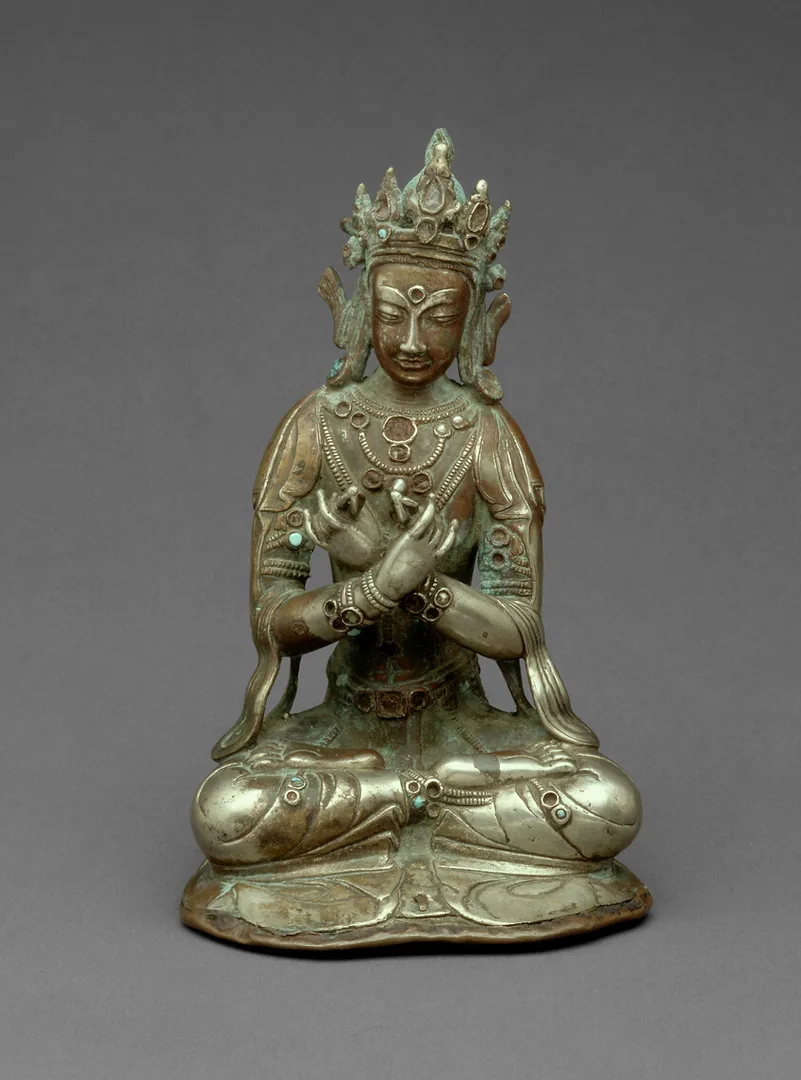
Ādi-Buddha: Samantabhadra & Vajradhara (Primordial Dharmakāya)
Placed at the very apex of every Tibetan refuge tree and thangka lineage, the Ādi-Buddha (“Primordial Buddha”) is never a creator god who made the universe, but the timeless, uncompounded nature of mind itself—depicted naked and sky-blue as Samantabhadra in Nyingma Dzogchen, or crowned in royal silks crossing vajra and bell as Vajradhara in Kagyu, Sakya, and Gelug.
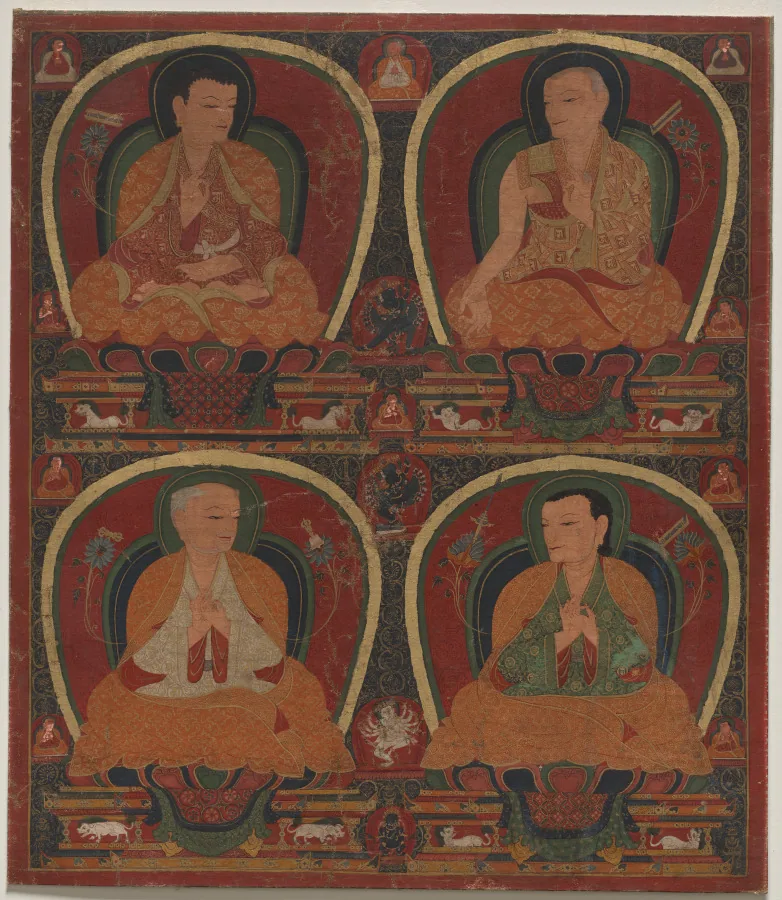
The Four Tibetan Schools & Bön Explained Clearly
Sharing the exact same Kangyur and Tengyur Buddhist canon, Tibet’s four major Buddhist schools differ not in core creed, but in historical translation era, pedagogical sequence, and meditative emphasis.
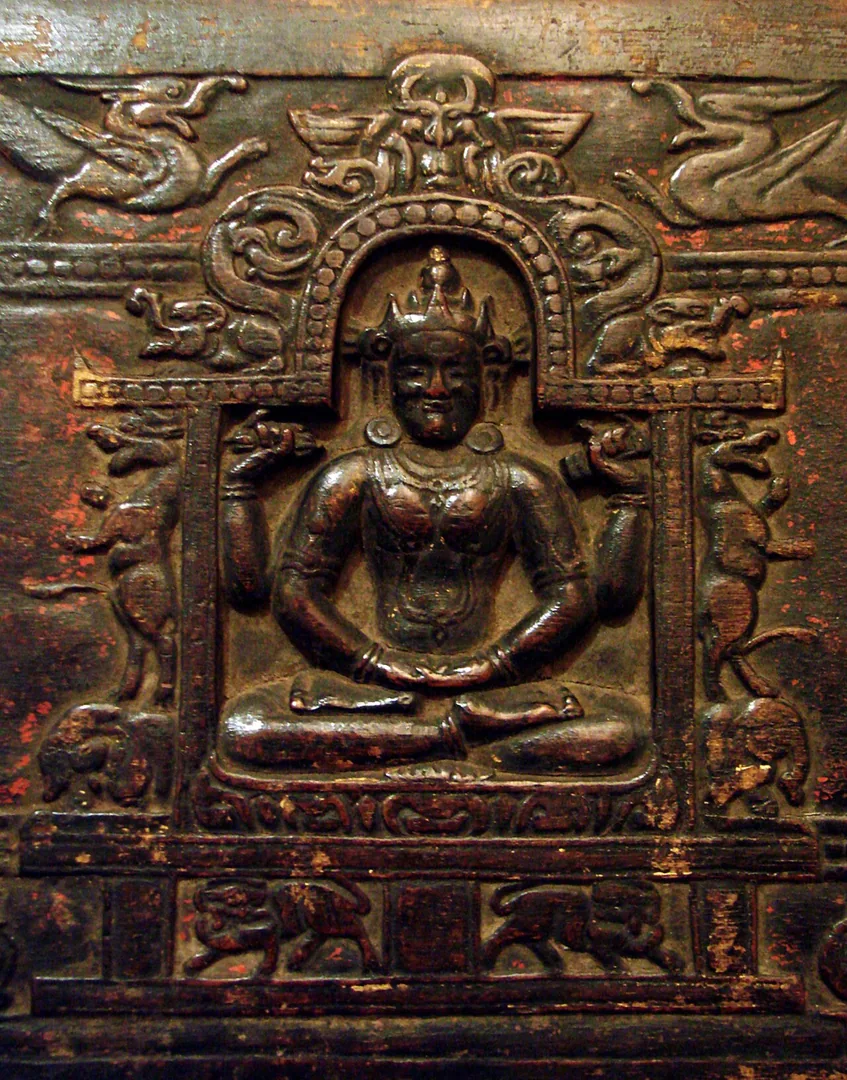
Śūnyatā (Emptiness) & the Two Truths (Madhyamaka)
In Nāgārjuna’s Middle Way philosophy, “emptiness” (stong-pa-nyid) never means nothing exists; it means nothing exists in frozen isolation—and precisely because things lack rigid self-nature, seeds sprout, suffering changes, and awakening works.