Mārīcī (Özer Chenma · Lady of the Dawn Rays)
Golden Goddess of First Sunlight Riding Seven Wild Boars with Needle & Thread
Personifying the shimmering rays of dawn that outrun the sun and moon, golden Mārīcī rides a chariot drawn by seven wild boars while holding a needle and thread and a flowering aśoka branch—revered from Lhasa caravan trails to East Asian temples for swift protection on journeys and freedom from fear.
Seven Wild Boars, Needle & Thread: Decoding Her Unforgettable Symbols
Among hundreds of Buddhist deities, Mārīcī (Özer Chenma, “She Who Possesses Rays of Light”) possesses one of the most poetic and instantly recognizable iconographies in Asian art. In Sanskrit, marīci names the first shimmering beams of dawn and desert mirages—light so swift and intangible that neither thieves nor weapons can seize, burn, or bind it. Because the Mārīcī-dhāraṇī (Toh 564 / T.1257) describes her racing ahead of Sūrya (the Sun) and Candra (the Moon), she became the beloved guardian of anyone stepping onto uncertain roads at daybreak.
Three visual emblems unlock every painting—including the celebrated 17th-century silk scroll brushed by the Tenth Karmapa Chöying Dorje: (1) Seven Wild Boars: In Buddhist psychology, the pig at the hub of the Bhavacakra represents primal ignorance (avidyā); harnessing seven boars (or bearing a sow’s face on her left side) signifies turning blind, fearless animal momentum directly into unstoppable awakened diligence that devours obstacles and eclipses Rāhu. (2) Needle and Thread: Unique in Buddhist sculpture, her sewing needle and cord metaphorically stitch shut the eyes and mouths of malicious slanderers, highway bandits, venomous creatures, and inner negativities—neutralizing conflict without shedding a drop of blood. (3) Flowering Aśoka Branch: Literally the “Sorrow-Free” tree (Saraca asoca, under which Queen Māyā gave birth to Śākyamuni), promising relief from travel anxiety and grief.
Across Asia: Tibetan Caravan Trails, Twenty-One Tārās & East Asian Traditions
Few deities illustrate pan-Asian Buddhist cultural exchange as vividly as Mārīcī. Across Tibet, Kham, Ladakh, and Bhutan, merchants leading yak caravans over snow passes, pilgrims setting out toward Lhasa or Mount Kailash, and households facing astrological obstacles recite her crisp Kriyā-Tantra heart mantra at sunrise—Oṃ Mārīcyai Māṃ Svāhā (ཨོཾ་མཱ་རཱི་ཙྱཻ་མཱཾ་སྭཱ་ཧཱ།). Within the Twenty-One Praises of Tārā (Sgrol-ma nyer-gcig), commentators in the Suryagupta and Nyingma traditions also identify the Twenty-First Tārā (Marīci-tārā, “Tārā of Complete Enlightenment”) closely with Özer Chenma’s luminous dawn activity:
| Cultural Sphere | Local Name | Classic Iconography | Social & Contemplative Role |
|---|---|---|---|
| Tibet & Himalayas (All Schools) | Özer Chenma (’Od-zer can-ma) | Golden 1-faced 2-armed or 3-faced 8-armed goddess with stupa crown on 7 boars | Dawn travel blessing, clearing gossip/obstacles, linked to Vairocana & Tārā |
| Chinese Buddhism & Daoist Synthesis | Molizhitian Pusa (摩利支天菩薩) | Courtly celestial bodhisattva with fan/sun-moon discs; mirrored in Doumu Yuanjun | Monastic guardian among the 24 Devas; travelers’ & Northern Dipper star protection |
| Japanese Shingon, Tendai & Zen | Marishiten (摩利支天) | Dynamic figure standing with fan or bow atop a charging wild boar | Historically revered for invisibility from harm, equanimity & mindfulness |
How It Is Practiced in Living Tradition
Recited widely by travelers, commuters, and pilgrims at daybreak as an open Mahāyāna / Kriyā-Tantra dhāraṇī of safe passage and luminous mindfulness (while complex multi-armed generation-stage sadhanas from the Sādhanamālā and Rinjung Gyatsa carry traditional lung transmission).
Common Questions & Clarifications
Why does Mārīcī wear a miniature stupa inside her hair crown?
Whereas Avalokiteśvara and Green Tārā belong to the Lotus and Karma families, Mārīcī emanates from Vairocana (“The Illuminator”), sovereign of the central Tathāgata family—whose ancient aniconic emblem in Indian Pala and Tibetan art is a luminous caitya / stupa nestled in her chignon.
Can anyone recite Oṃ Mārīcyai Māṃ Svāhā before traveling?
Yes. Preserved openly in the Mahāyāna Mārīcī-dhāraṇī Sūtra across both the Tibetan Kangyur (Toh 564) and Chinese Tripiṭaka (T.1257), her dhāraṇī and short mantra have been chanted freely by lay travelers and monastics alike for over a millennium.
Primary Sources & Further Reading
- Ārya-mārīcī-nāma-dhāraṇī (Toh 564, Tibetan Kangyur) &佛說摩利支天菩薩陀羅尼經 (CBETA Taishō T.1257)
- Miranda Shaw, Buddhist Goddesses of India, Chapter 10: “Mārīcī: Goddess of Dawn” (Princeton University Press, 2006)
- David A. Hall & Himalayan Art Resources: Iconography of Tenth Karmapa Chöying Dorje’s Mārīcī
Connected in the Mandala Graph
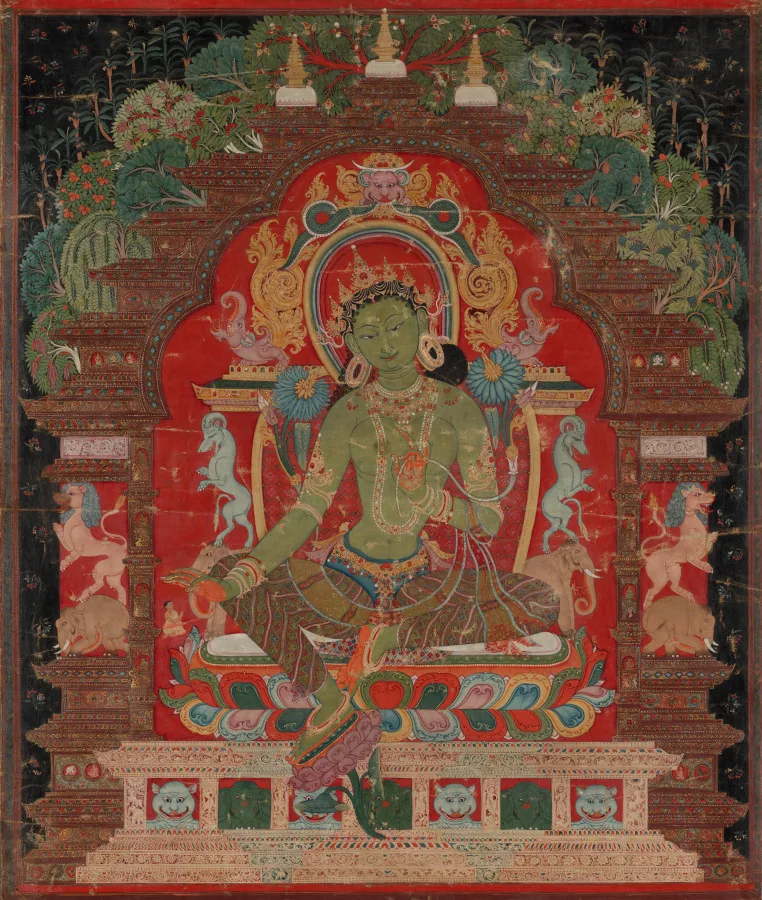
Green Tārā (Sgrol-ljang)
Seated in royal ease with her right foot already stepping off the lotus cushion, Green Tārā embodies enlightened compassion in immediate motion—green being the color of the Wind/Action Buddha Family.
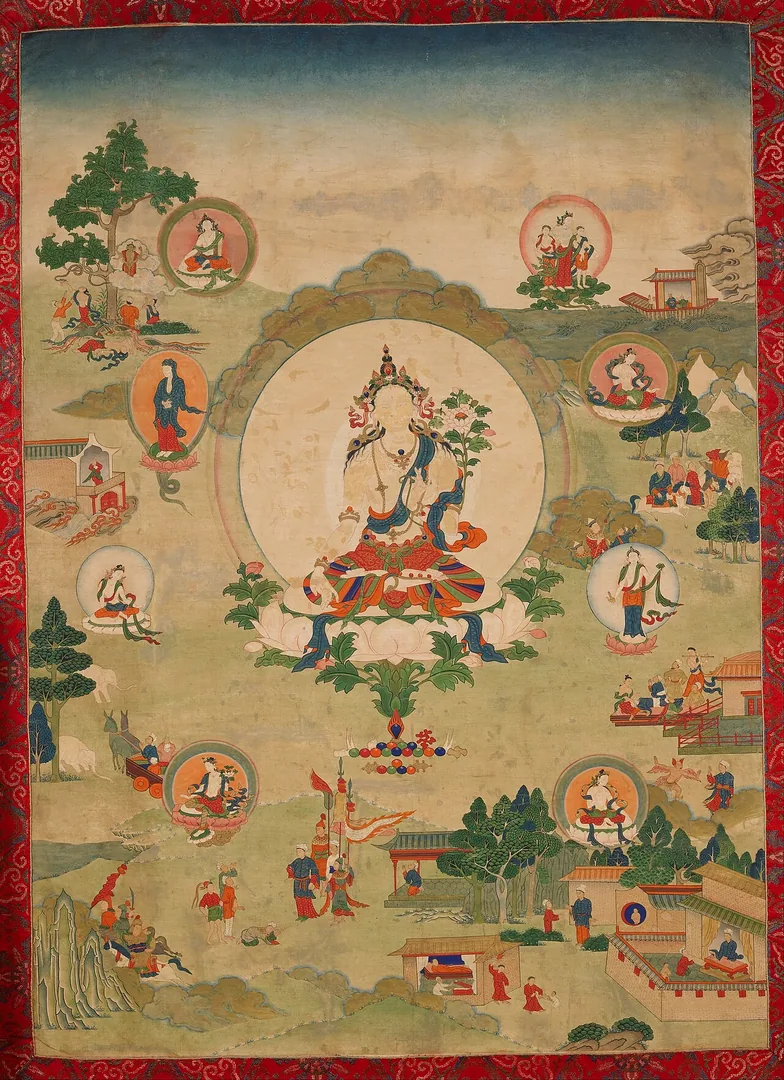
White Tārā (Sgrol-dkar)
Distinguished by seven eyes—on her forehead, palms, soles, and face—White Tārā sits in full vajra posture radiating autumn-moon serenity, forming one of Tibet’s Three Long-Life Deities.
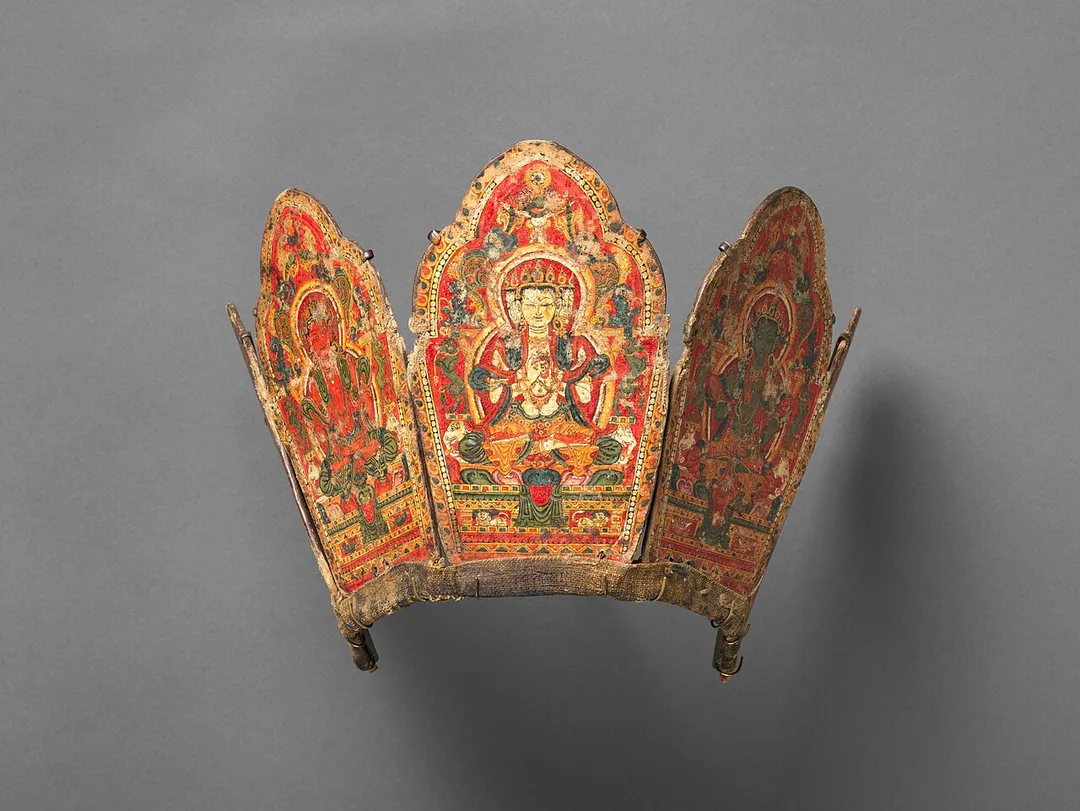
The Five Buddha Families & Five Wisdoms (Rigs-lnga)
Known in Tibetan as Gyalwa Rig-nga, the Five Buddha Families organize every mandala color, direction, element, and deity around one radical psychological premise: the raw energy inside our five most painful emotions is the exact same energy as the Five Awakened Wisdoms.
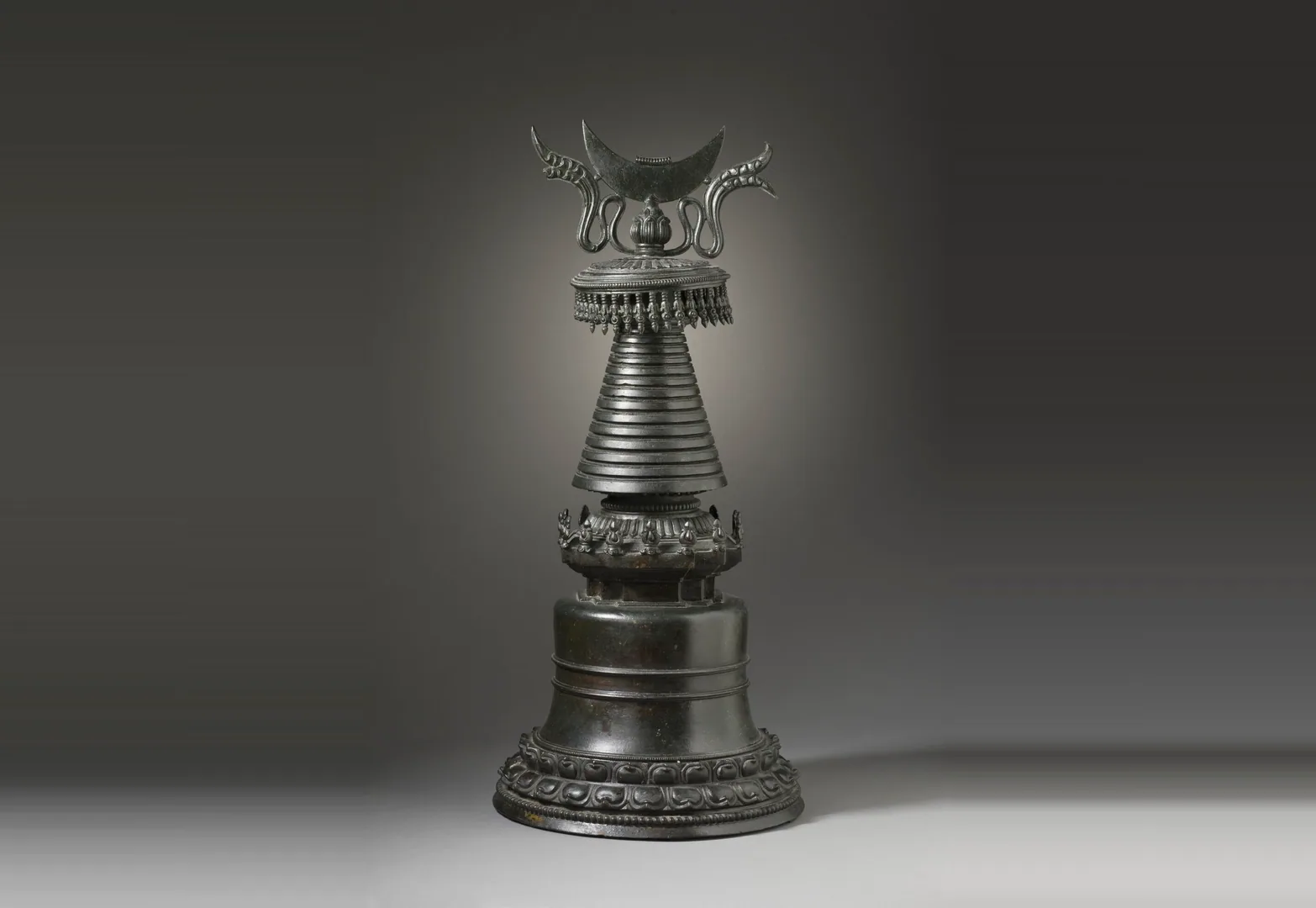
The Tibetan Stupa (Chörten · མཆོད་རྟེན།) & Eight Great Forms
Translated into Tibetan as mchod-rten (“receptacle of offerings”), every Himalayan whitewashed stupa stacks square earth, rounded water, conical fire, crescent air, and dissolving space into a three-dimensional statue of the Buddha’s Dharmakāya mind.