Medicine Buddha (Bhaiṣajyaguru · Sangye Menla)
Lapis-Lazuli Sovereign of Healing & the Twelve Great Vows
Radiating deep lapis-lazuli blue, Sangye Menla wears monastic robes, holding an alms bowl of healing nectar in his left hand and a stem of golden myrobalan (arura) in his outstretched right hand.
Why Lapis Blue—and What Is the Plant in His Right Hand?
In Tibetan thangka workshops, Medicine Buddha’s body is painted with ground azurite and lapis lazuli—historically the most prized mineral pigment along the Silk Road. Unlike opaque stone, the sutra compares his form to pure vaiḍūrya: radiant blue crystal clear inside and out, calming the feverish heat of illness and panic.
Between the thumb and forefinger of his right hand rests a sprig of arura (chebulic myrobalan, Terminalia chebula). In the Four Tantras of Tibetan Medicine (rGyud-bzhi), arura is revered as the “king of herbs” because it balances all three bodily humors—wind (rlung), bile (mkhris-pa), and phlegm (bad-kan).
Pragmatic Compassion: The Twelve Great Vows
What makes the Medicine Buddha Sūtra remarkably humane is its refusal to preach abstract philosophy to someone starving or in acute pain. Across his Twelve Great Vows, Bhaiṣajyaguru pledges first to relieve physical illness, disability, hunger, exposure, and unjust imprisonment—and only when basic dignity and bodily ease are restored, to guide beings gently toward awakening.
How It Is Practiced in Living Tradition
Tibetan physicians (amchi) recite the Medicine Buddha mantra while compounding herbal formulas; families recite it on the 8th lunar day of each month and beside hospital beds.
Common Questions & Clarifications
Does Tibetan Buddhism view Medicine Buddha prayer as a replacement for doctors?
Never. In Tibet, monastic medical colleges (Men-Tsee-Khang) trained physicians in anatomy, pharmacology, and diet alongside Medicine Buddha meditation—treating clinical care as the outer condition and calm mind as the inner support.
Primary Sources & Further Reading
- Bhaiṣajyaguru Sūtra (Toh 504 / Taishō T0450 trans. Xuanzang)
- Yuthok Yönten Gönpo (12th c.), Four Medical Tantras (rGyud-bzhi)
Connected in the Mandala Graph
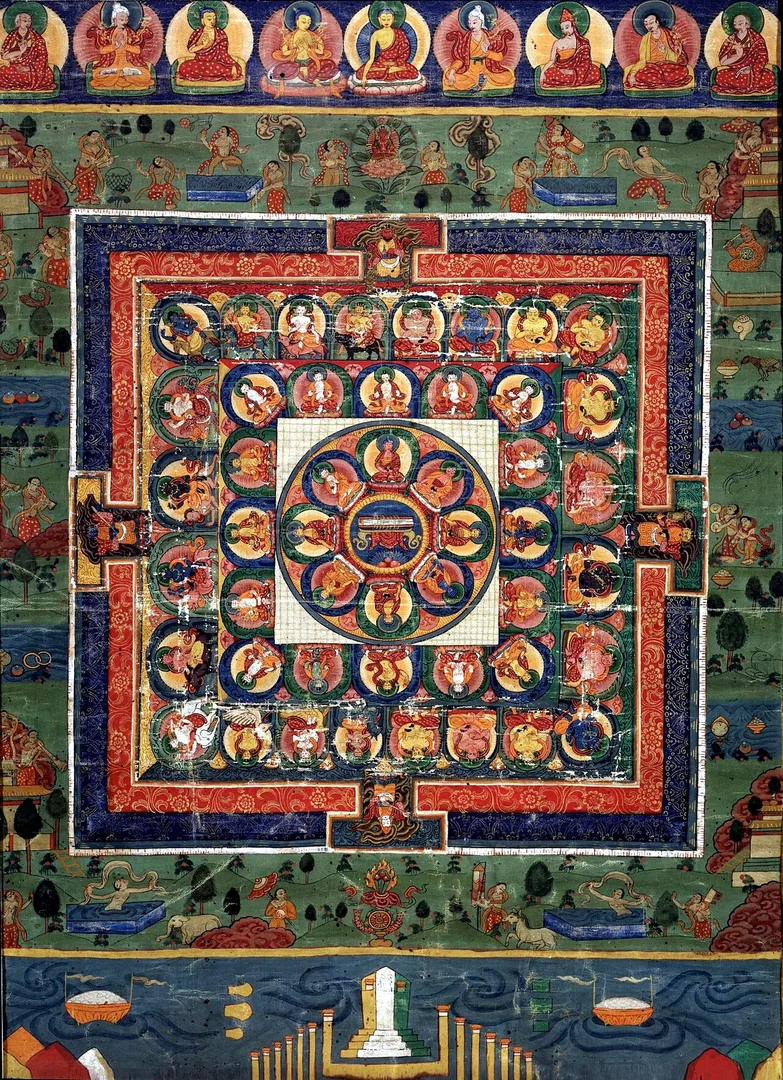
Medicine Buddha Dhāraṇī (Bekandze Mantra)
Pronounced “Bekandze” in Tibetan, the threefold repetition of Bhaiṣajye (“healing remedy”) mirrors Tibetan medicine’s holistic view that bodily recovery, emotional calm, and wisdom belong together.
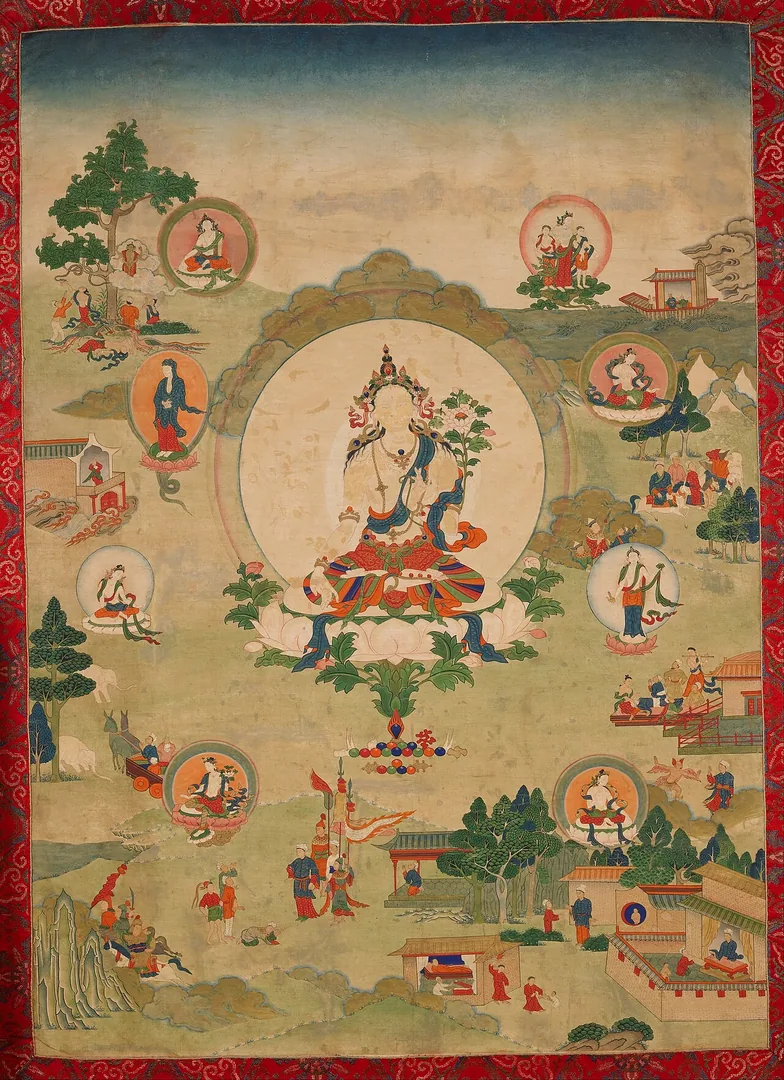
White Tārā (Sgrol-dkar)
Distinguished by seven eyes—on her forehead, palms, soles, and face—White Tārā sits in full vajra posture radiating autumn-moon serenity, forming one of Tibet’s Three Long-Life Deities.
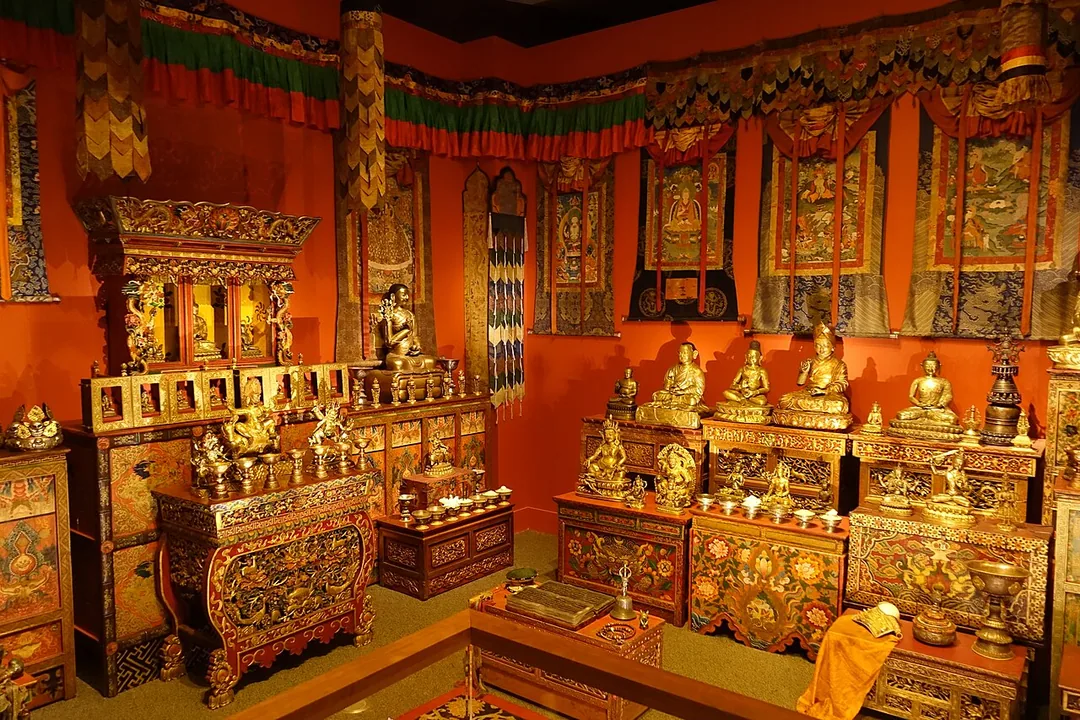
Dedication of Merit (Bsngo-ba · 回向)
No Tibetan contemplation, sutra reading, or prayer-wheel turn ends abruptly; it concludes with bsngo-ba (“turning toward”)—deliberately widening a private wish so everyone walking the same hard road is included.
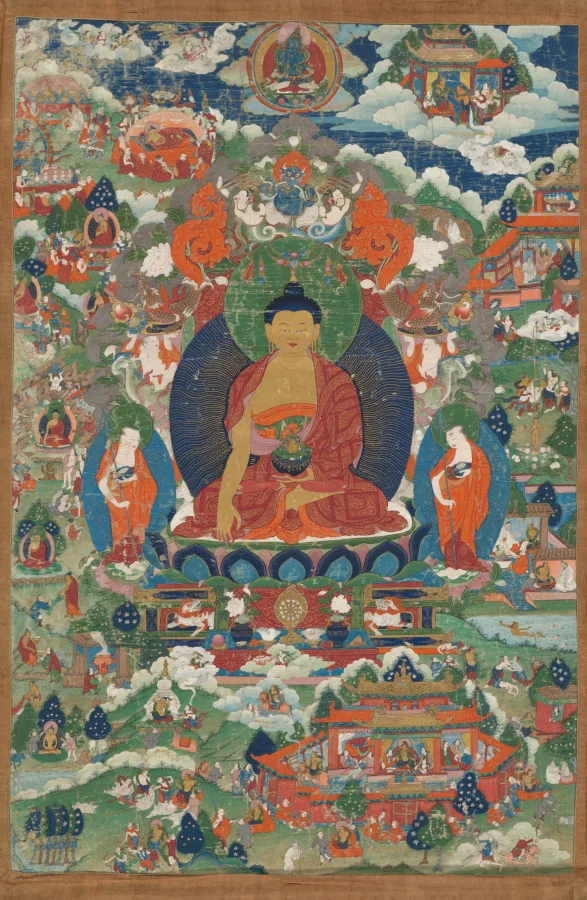
How to Read a Thangka Painting
Meaning “something unrolled” (thang-ka), a Tibetan scroll painting is structured along a strict vertical and proportional grid so portable monasteries on horseback could carry complete contemplative maps.