Za Rāhula (Drangsong Chenpo · Nine-Headed Planetary Dzogchen Guardian)
Wrathful Emanation of Vajrapāṇi Crowned by a Raven Head, Covered in 1,000 Eyes & Coiled Serpent Tail
Second of the Nyingma Three Roots Guardians (Ma-Za-Dor Sum), smoky purple-black Za Rāhula (“Great Planetary Sovereign,” Tibetan Drangsong Chenpo) is a wrathful emanation of Vajrapāṇi unmistakable in Himalayan art: nine stacked wrathful heads topped by a cawing raven head, a torso and belly-face blazing with 1,000 watchful eyes, a coiled nāga-serpent lower body, and four hands drawing a bow and arrow.
Decoding Rāhula’s Five Startling Features: Why 9 Heads, 1,000 Eyes & a Serpent Tail?
In the Rubin Museum of Art’s celebrated Eastern Tibetan thangka of Za Rāhula, every square inch of the deity’s smoky purple-black body bristles with cosmic symbolism. Originating in Indian astral lore as the eclipse-lord Rāhu and subjugated in tantric history by Vajrapāṇi on Mount Malaya (and later bound by Padmasambhava and Vimalamitra to guard the Dzogchen Nyingthig teachings), Rāhula’s form maps the entire macrocosm of time (དུས་ཀྱི་འཁོར་ལོ།) onto the microcosm of the practitioner’s subtle body (རྩ་རླུང་ཐིག་ལེ།):
| Visual Feature | Iconographic Detail on Thangka | Outer Cosmic Meaning | Inner Subtle-Body & Dzogchen Meaning |
|---|---|---|---|
| 1. Nine Stacked Heads + Raven Crown | 3 tiers of 3 wrathful heads (9 total), surmounted at the apex by a dark raven/crow head | Sovereignty over the Nine Planetary Forces (Navagraha) and the three realms | Complete mastery of the Nine Yānas (Nine Vehicles of Nyingma) crowned by swift Atiyoga prophetic vision |
| 2. One Thousand Watchful Eyes | Blazing eyes covering chest, shoulders, arms, and flanks | Countless stars and constellations illuminating the night sky without blind spots | Omnipresent rigpa awareness (kun-tu gzigs-pa) watching every rising thought without distraction |
| 3. Roaring Belly-Face (Lto-zhal) | A fierce wide-mouthed face with fangs right across the abdomen | The eclipse mouth that swallows sun and moon in classical Indian astronomy | Swallowing dualistic grasping of the solar (left/right) subtle winds directly into the central channel (avadhūtī) |
| 4. Bow & Arrow + Makara Banner | Primary hands draw a horn bow & arrow; outer hands hold makara victory banner & snake-lasso | Piercing obstacles across the eight directions with lightning speed | Uniting emptiness (bow) and unerring mindfulness (arrow) to triumph over maras (makara banner) |
| 5. Coiled Nāga-Serpent Lower Body | Instead of two human legs, a massive coiled dragon-serpent tail rises from the sea | Pervading from the subterranean nāga depths up to the zenith of the sky (“Pervader”) | Mastery over subtle life-force energies (rlung) and elemental channels across earth, water, and sky |
Sacred Genealogy & Five-Family Mandala Position
Second of the Nyingma Three Roots Guardians (Ma-Za-Dor Sum): wrathful Vajrapāṇi emanation with 9 heads topped by a raven, 1,000 watchful eyes, coiled serpent tail, and drawn bow governing subtle-body channels.
Source Buddhas, Crown Sovereign & Root Yidams
How It Is Practiced in Living Tradition
Presented here strictly as an art-historical and philosophical reference: in Tibetan medical and astrological traditions (Men-Tsee-Khang), Za Rāhula is also referenced in planetary harmony rites to guard subtle-body wind/channel balance. Within Nyingma Vajrayāna practice, he is honored alongside Ekajaṭī and Damchen Dorje Legpa; formal liturgical recitation requires Nyingma empowerment (dbang), oral transmission (lung), and strict samaya mindfulness.
Common Questions & Clarifications
Is Za Rāhula the same person as Śākyamuni Buddha’s son Arhat Rāhula?
They share the same Sanskrit name (Rāhula), which comes from Rāhu (the eclipse planet), because the Buddha’s son was born during a lunar eclipse—and is revered as one of the Sixteen Arhats! In Tibetan, however, they are always distinguished by prefix: the Buddha’s monastic son is Neten Drajen Dzin (གནས་བརྟན་སྒྲ་གཅན་འཛིན།), whereas the nine-headed Dzogchen protector is Za Rāhula (གཟའ་རཱ་ཧུ་ལ།, “Planetary Sovereign Rāhula”).
Primary Sources & Further Reading
- Guhyagarbha Tantra (Toh 832) & Longchen Nyingthig Protector Liturgies of Za Rāhula (Drangsong Chenpo)
- Rubin Museum of Art · Google Art Project (Public Domain): Rāhula Thangka, Eastern Tibet, 18th–19th Century
- Museum Plate Record: Za Rāhula (Drangsong Chenpo · Nine-Headed Planetary Dzogchen Protector with Raven Crown & Serpent Tail) — 18th–19th century · Eastern Tibet · Rubin Museum of Art · Google Art Project (Public Domain)
Connected in the Mandala Graph
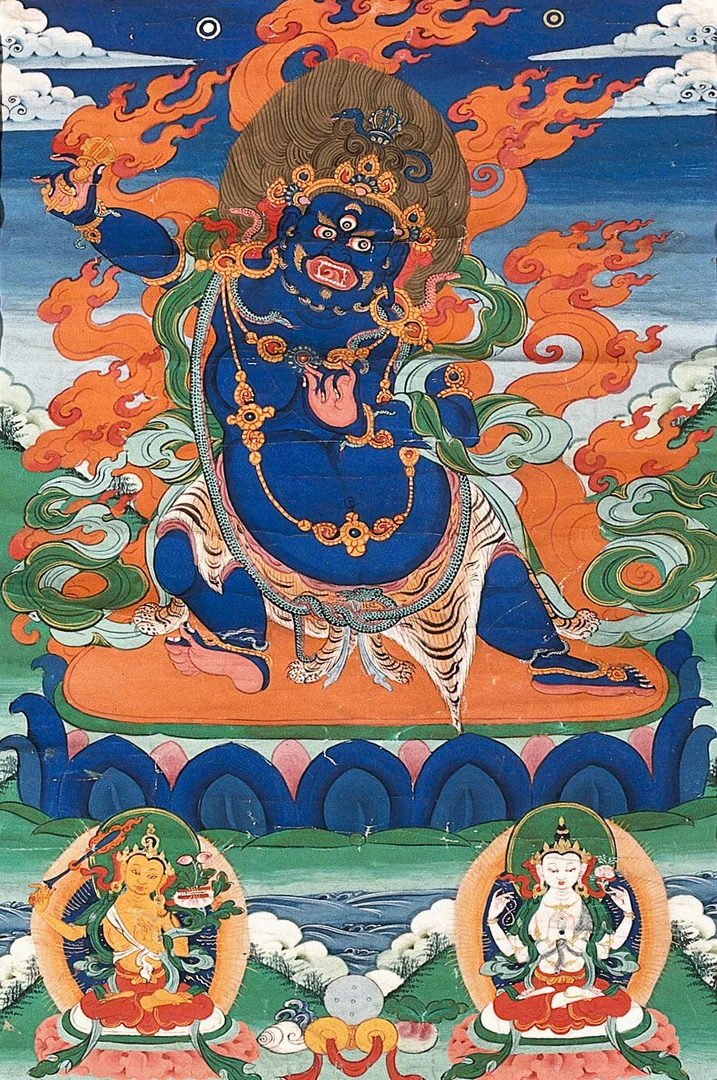
Vajrapāṇi (Chana Dorje · Wielder of the Thunderbolt)
Standing in midnight-blue warrior stance amidst blazing wisdom flames and brandishing a five-pronged vajra overhead, Vajrapāṇi embodies fearless spiritual power—completing Tibet’s beloved Rigsum Gönpo triad alongside Chenrezig (compassion) and Mañjuśrī (wisdom).
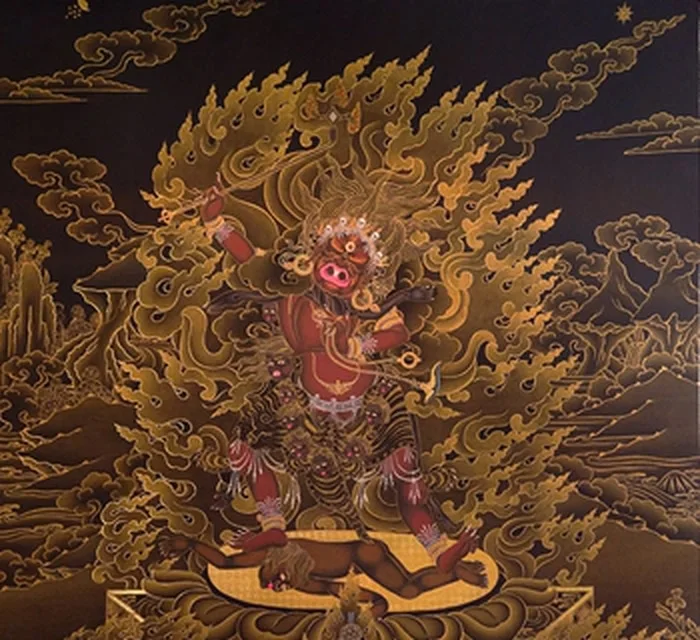
Ekajaṭī (Ralchikma · One-Braided Dzogchen Wisdom Guardian)
Foremost of the Nyingma Three Roots Guardians (Ma-Za-Dor Sum), dark maroon-black Ekajaṭī (“She Who Has a Single Topknot,” Tibetan Ralchikma or Ngagsungma, “Protectress of Secret Mantra”) is the direct wrathful emanation of Dharmakāya Mother Samantabhadrī—her single braid, single central eye, single fang, and single breast visually encoding the non-dual Single Sphere (thig-le nyag-gcig) of Dzogchen awareness.
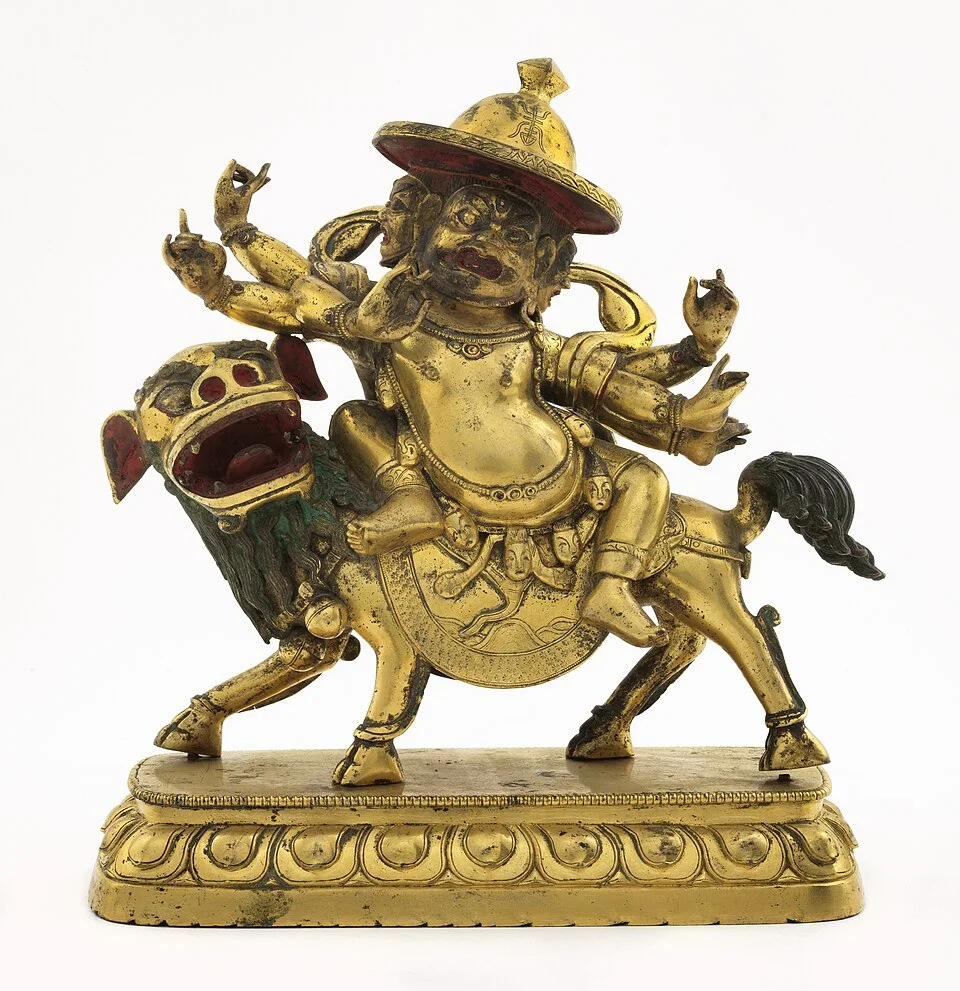
Damchen Dorje Legpa (Vajrasādhu · Oath-Bound Terma Guardian)
Completing the Nyingma Three Roots Guardians (Ma-Za-Dor Sum) and revered equally across Karma Kagyu and Rimé lineages, Damchen Dorje Legpa (“Oath-Bound Good Vajra,” Sanskrit Vajrasādhu) was bound under vajra oath by Padmasambhava in the 8th century to guard Tibet’s concealed spiritual treasures (Terma)—depicted either as a ruby-red Himalayan general in a domed cane hat riding a white snow lion, or in his fierce blacksmith emanation (Garwa Nagpo) riding a twisted-horn red billy goat with hammer and tiger-skin bellows.
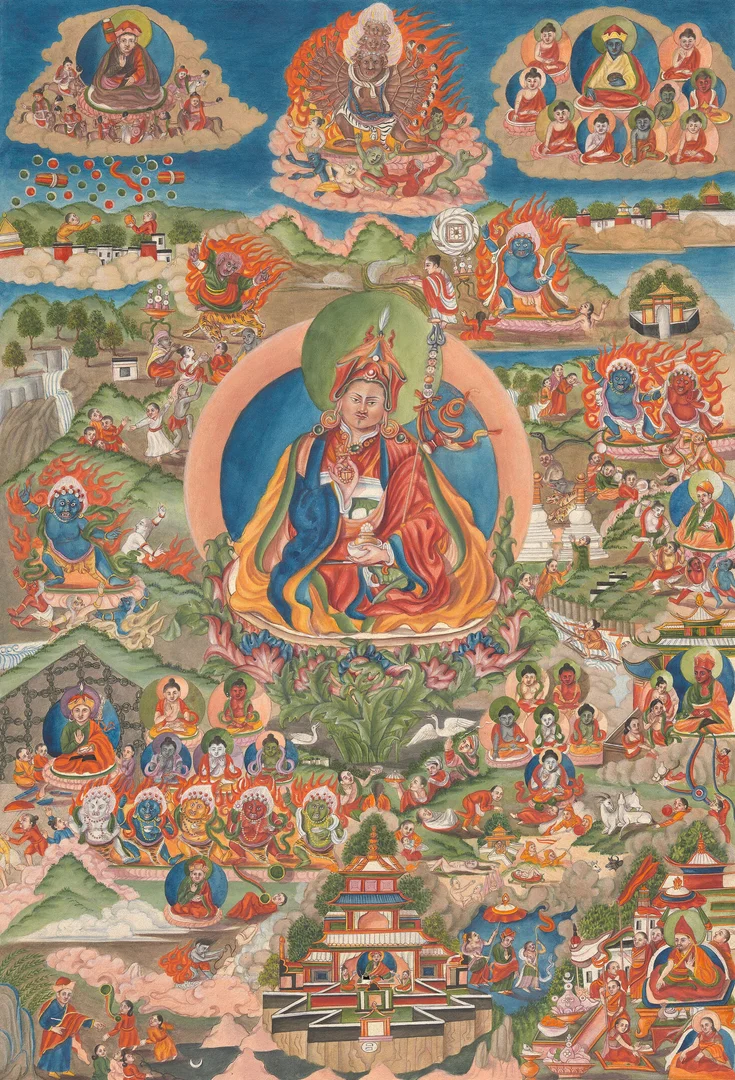
Padmasambhava (Guru Rinpoche)
Invited from Oddiyāna and Nālandā to Tibet by King Trisong Detsen in the 8th century, Padmasambhava (“Lotus-Born”) consecrated Samye Monastery and harmonized Himalayan indigenous spirits with Buddhist Dharma.