Yamāntaka / Vajrabhairava (Dorje Jigje · Ender of Death)
Wrathful Buffalo-Headed Manifestation of Mañjuśrī Who Subjugates Yama, Lord of Death
When gentle persuasion cannot halt the relentless momentum of mortality and karmic compulsion, gentle Mañjuśrī—Bodhisattva of Wisdom—manifests as horned, buffalo-headed Vajrabhairava (“Adamantine Terrifier”), crowning nine fierce faces with Mañjuśrī’s own serene golden visage to conquer death through emptiness.
How to Read 9 Heads, 34 Arms & 16 Legs: Why Golden Mañjuśrī Crowns the Summit
In Himalayan art galleries, gilt-bronze sculptures of Vajrabhairava (the supreme form of Yamāntaka, “Ender of Death”) command immediate awe with their bristling forest of limbs and horns. Canonical origin accounts explain why: when Yama (gShin-rje, the buffalo-headed Lord of Death who grips the outer rim of the Bhavacakra Wheel of Life—personifying blind karmic mortality) terrorized sentient beings, mild peaceful forms could not arrest his momentum. Out of boundless compassion, gentle Mañjuśrī—Bodhisattva of Transcendent Wisdom—assumed Yama’s own dark-blue water-buffalo head multiplied exponentially in majesty, mirroring death in order to liberate beings from the fear of death from within.
Look straight to the very top of his stacked nine heads and the entire composition unlocks: the ninth topmost face is always peaceful, golden-saffron Mañjuśrī adorned with youthful princely locks. That single visual anchor proves that terrifying wrath in Buddhist tantra is never hatred or demonic fury—it is analytical wisdom and tender compassion wearing protective armor. Whether depicted in the monastic Solitary Hero (Ekavīra, དཔའ་བོ་གཅིག་པ།) form or embracing pale-blue wisdom consort Vajravetālī (རྡོ་རྗེ་རོ་ལངས་མ།) in yab-yum (the inseparable union of compassionate method and emptiness-realizing wisdom), every limb encodes a classical Buddhist doctrinal list rather than arbitrary ferocity:
| Iconographic Feature | Count | Classical Philosophical Meaning |
|---|---|---|
| Stacked Faces (crowned by Mañjuśrī) | 9 Faces | Nine scriptural divisions (navāṅga) of the Buddha’s teachings guided by wisdom |
| Sharp Water-Buffalo Horns | 2 Horns | Inseparable Two Truths: conventional interdependence & ultimate emptiness |
| Radiating Arms + Body, Speech, Mind | 34 + 3 = 37 | The Thirty-Seven Factors of Awakening (outer hands peel off elephant-skin ignorance) |
| Striding Legs Pressing Creatures | 16 Legs | The Sixteen Modes of Emptiness (stong-nyid bcu-drug) transcending worldly pride |
Ra Lotsāwa, Sakya Mastery & Je Tsongkhapa’s Gelug Synthesis
The Indian transmission of Vajrabhairava Mahātantra (Toh 468) and the related Red and Black Yamāri cycles (Toh 467–473) traces back to the 10th-century Nālandā pandita Lalitavajra, who brought the texts from Oḍḍiyāna. In the 11th century, the formidable Tibetan translator Ra Lotsāwa Dorje Drak (རྭ་ལོ་ཙཱ་བ་རྡོ་རྗེ་གྲགས།) journeyed repeatedly across Nepal and India to establish the famed Ra lineage, while Mal Lotsāwa and the founding Sakya patriarchs preserved profound Vajrabhairava and Yamāri lineages alongside Nyingma Mahāyoga’s ancient Jampal Shinje (Mañjuśrī Yamāntaka) transmissions.
At the turn of the 15th century, Je Tsongkhapa (1357–1419) elevated Vajrabhairava into the crowning synthesis of the Gelug tantric curriculum: Sang-De-Jig-Sum (གསང་བདེ་འཇིགས་གསུམ།, combining Guhyasamāja Father-Tantra illusory body, Cakrasaṃvara Mother-Tantra clear light, and Vajrabhairava fierce wisdom protection). As Tibetan masters emphasize, Yama is ultimately defeated not by magical force, but by Mañjuśrī’s sharp insight into dependent origination and emptiness—for when grasping at an inherently existent self ceases, cyclic death loses its foothold.
How It Is Practiced in Living Tradition
Revered across Sera, Drepung, Ganden, Tashilhunpo, Kumbum, Labrang, and Sakya monasteries, as well as the Tantric Colleges of Gyütö and Gyümé, particularly during year-end purification rituals clearing obstacles for all beings. Because Vajrabhairava belongs to Highest Yoga Tantra, traditional samaya strictly stipulates that personal sadhana recitation and generation/completion-stage meditation require prior Lamrim foundation (renunciation, bodhicitta, emptiness view) together with formal empowerment (abhiṣeka / dbang), oral transmission (lung), and pith instruction (tri / khrid) from a qualified lineage master.
Common Questions & Clarifications
Is Yamāntaka related to the East Asian Shingon / Tang Esoteric figure Daiitoku Myōō?
Yes! Both derive from Indian Yamāntaka traditions viewing fierce buffalo-associated wisdom as a manifestation of Mañjuśrī. Eighth-century Tang Esoteric Buddhism transmitted an earlier Yoga-Tantra six-faced, six-armed, six-legged form riding a white/blue water buffalo (preserved in Japan as Daiitoku Myōō, one of the Five Wisdom Kings), whereas 11th-century Tibet received the later Anuttarayoga Vajrabhairava corpus featuring the buffalo-headed nine-faced, thirty-four-armed synthesis.
What is the difference between “Solitary Hero” (Ekavīra) and Yab-Yum Vajrabhairava in museum art?
In the Solitary Hero (Ekavīra) lineage associated especially with Ra Lotsāwa and monastic practice, Vajrabhairava stands alone without a consort, holding chopper and skullcup at his chest while embodying method and wisdom within a single figure. In the Thirteen-Deity (bCu-gsum-ma) mandala configuration, he embraces Vajravetālī surrounded by twelve directional companions—differing purely in pedagogical mandala layout, never in enlightened essence.
Primary Sources & Further Reading
- Śrī Vajrabhairava-nāma-mahātantrarāja (Toh 468), Tibetan Kangyur
- Bryan J. Cuevas, Ra Yeshé Sengé’s The All-Pervading Melodious Drumbeat: The Life of Ra Lotsāwa (Penguin Classics, 2015)
- Bulcsu Siklós, The Vajrabhairava Tantras: Tibetan and Mongolian Versions (Institute of Buddhist Studies, 1996)
Connected in the Mandala Graph
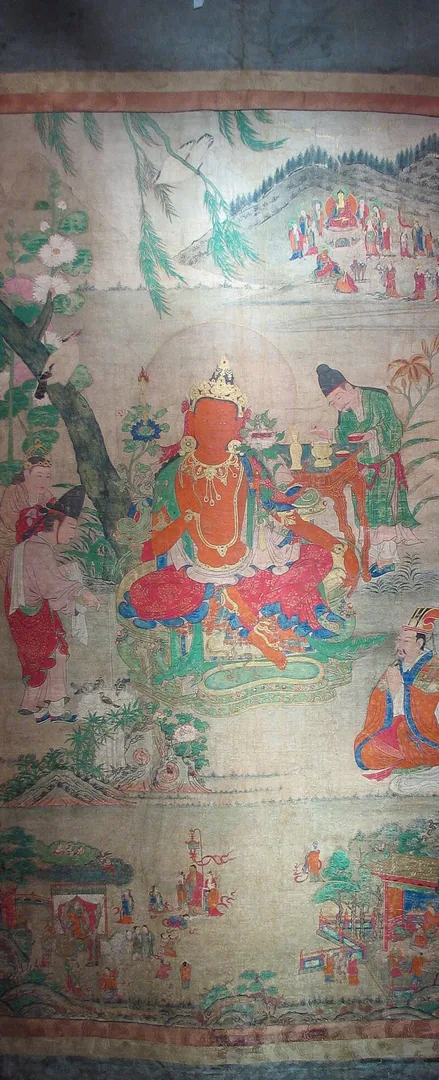
Mañjuśrī (Jampelyang)
Radiant saffron-gold in hue, Mañjuśrī raises a blazing sword overhead with his right hand to slice right through conceptual confusion, while holding the Prajñāpāramitā Sūtra on a lotus at his heart.
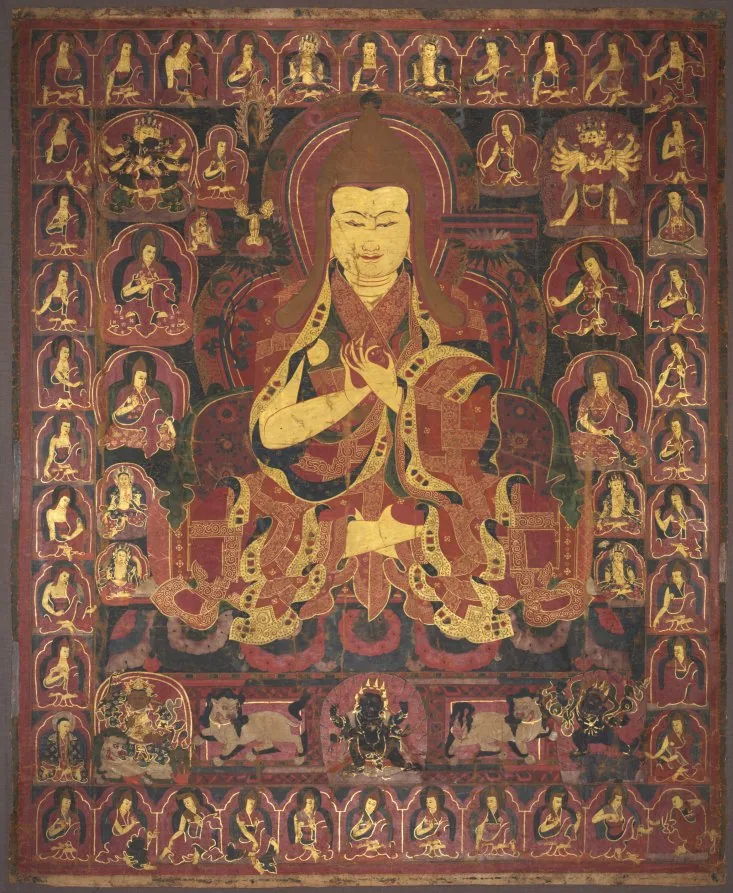
Je Tsongkhapa (Lobsang Drakpa · 1357–1419)
Born in Amdo Tsongkha (modern Qinghai Kumbum) in 1357, Je Rinpoche studied across Sakya, Kagyu, Jonang, and Kadampa masters before founding Ganden Monastery—uniting rigorous Nālandā logic, pure Vinaya discipline, and Tantric contemplation into one seamless graduated path (Lamrim).
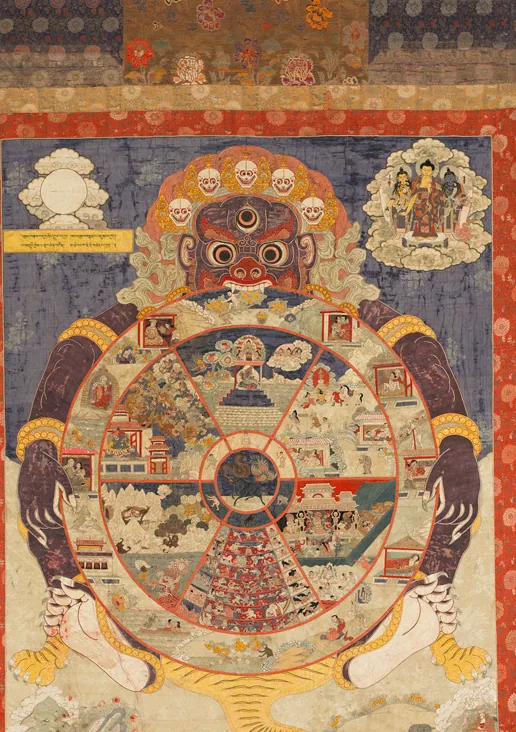
Bhavacakra: The Wheel of Life (Srid-pa’i ’khor-lo)
Painted on the outer vestibule wall of nearly every Tibetan monastery according to instructions in the Vinaya (Toh 3), the Wheel of Becoming maps how habitual reactivity spins into suffering—and precisely where awareness steps free.
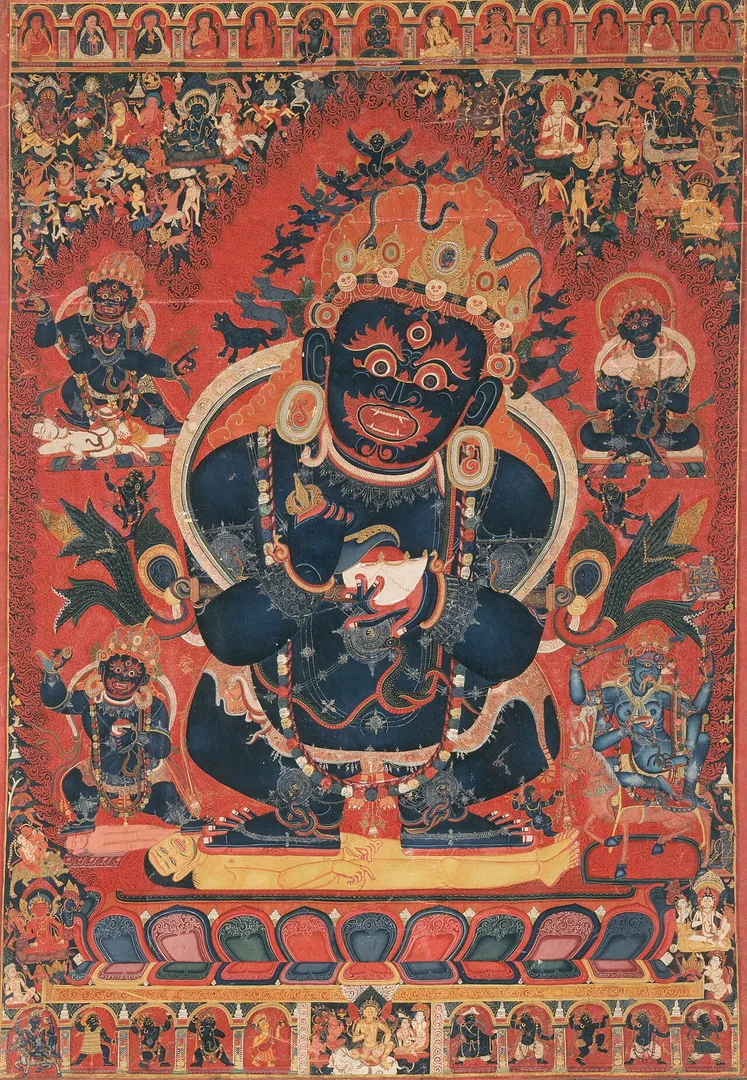
Mahākāla (Gönpo · Wisdom Dharma Protector)
Known simply in Tibetan as Gönpo (“The Protector”), Mahākāla (“Great Black One” / “Beyond Time”) manifests Avalokiteśvara’s compassion in fierce midnight-blue form—shattering self-deception and guarding ethical integrity across Kagyu, Sakya, and Gelug monasteries.