Praises to the Twenty-One Tārās (Chaktsal Nyerchik · 二十一度母礼赞文)
The Most Universally Chanted Open Liturgy Across All Tibetan Lineages & Four-Activity Color Matrix
Unusual among Buddhist hymns for being spoken directly by Buddha Vairocana / Śākyamuni in the Kangyur (Toh 438) rather than by a later poet, these twenty-one four-line Sanskrit-Tibetan verses invoke Tārā across four enlightened activities—pacifying, enriching, magnetizing, and fiercely protecting.
Why Every Tibetan Household Knows These 21 Stanzas by Heart
Step into a Lhasa teahouse at dawn, circumambulate the Barkhor alongside grandmothers spinning hand prayer wheels, or attend morning assembly at any Gelug, Kagyu, Sakya, or Nyingma monastery, and one brisk, rhythmic melody rises everywhere: “Chak tsal drolma nyurma pamo…” Unlike literary hymns composed by Indian or Tibetan scholars (preserved in the ), the Praises to the Twenty-One Tārās (Toh 438) sits inside the itself as buddhavacana—spoken by Buddha Vairocana so that ordinary people facing urgent fear, illness, grief, or indecision have direct, open access to awakened fearlessness.
Rather than treating “twenty-one goddesses” as polytheistic folklore, Tibetan commentaries by Jetsun Drakpa Gyaltsen (Sakya), First Dalai Gendün Drup (Gelug), and Jigme Lingpa / Ngawang Palzang (Nyingma) explain that all twenty-one forms are one single wisdom-compassion (ཡེ་ཤེས་གཅིག) refracted like sunlight through a prism into the four enlightened activities (ལས་བཞི།) needed by living beings.
敬禮速疾無畏救度母,目如剎那電光照世間,三界怙主觀音淚海生,蓮花妙蕊盛敷我頂禮!(第一尊 · 奮迅救度母)
Homage to Tārā, swift and fearless heroine, whose eyes flash like instant lightning, born from the opening corolla of the lotus risen from the tears of the Protector of the Three Worlds!
Stanza 1 (Nyurma Pamo): Recalls Tārā’s origin from Avalokiteśvara’s tear of compassion—active mercy that moves faster than conceptual hesitation.
敬禮百秋朗月圓滿面,猶如千星攢聚極明耀!(第二尊 · 百秋朗月白度母)
Homage to she whose face gathers the radiance of a hundred autumn full moons, blazing with the clear light of a thousand assembled stars!
Stanza 2 (Yangchenma / Pacifying White Tārā): Autumn moons in the post-monsoon Himalayan sky are cloudless and cool—cooling the fever of affliction and sickness.
敬禮安立三真實字印,寂滅事業具足正神力,鬼魅起屍夜叉眾部多,悉皆摧壞最勝度母尊!(第廿一尊 · 具三真實度母)
Homage to she adorned by the setup of the Three Realities (Oṃ Āḥ Hūṃ), perfectly endowed with serene power that utterly dissolves every haunting disturbance—supreme Tārā!
Stanza 21 (perfect completion): Seals crown, throat, and heart with Oṃ Āḥ Hūṃ so outer and inner fears dissolve back into peaceful equanimity.
High-Order Synthesis: Four Enlightened Activities & Three Visual Lineages of the 21 Tārās
Why do two museum thangkas of the Twenty-One Tārās sometimes look completely different—one showing twenty-one serene one-faced, two-armed goddesses differing only in skin color and tiny vases, and another showing dramatic multi-headed, four-to-twelve-armed figures riding lions or wielding vajras? Because Tibet preserved three distinct canonical transmission lineages of the exact same Toh 438 root text:
| Enlightened Activity & Color | Representative Stanzas in Toh 438 | Atiśa / Nāropa Lineage (Most Common Thangka) | Sūryagupta (Ravigupta) Indian Tantric Lineage |
|---|---|---|---|
| 1. Pacifying · ཞི་བ། (Crystal / Moon White) | Stanzas #2 (100 Autumn Moons), #4 (Uṣṇīṣavijayā Tārā), #15 (Mahāśānti), #19, #21 | Peaceful white, 1 face, 2 arms holding utpala supporting a white soothing-nectar kalasha | Distinct forms per verse (e.g., #2 white 12-armed; #15 pure white seated in equipoise) |
| 2. Enriching · རྒྱས་པ། (Refined Gold / Saffron) | Stanzas #3 (Golden Water-Born), #8, #9 (Three Jewels Gesture), #11 (Summoning Vasudharā), #12, #17 | Luminous gold/yellow, 1 face, 2 arms with utpala supporting a yellow jewel/longevity vase | Richly varied attributes (stūpa, wish-granting jewel, auspicious blazing light) |
| 3. Magnetizing · དབང་། (Coral / Ruby Red) | Stanzas #1 (Swift Heroine / Pradyota), #5 (Tuttāra Hūṃ), #10 (Dispelling Sorrow), #16 | Warm coral-red, 1 face, 2 arms harmonizing relationships & gathering auspicious conditions | Includes Kurukullā-like red lotus bow/arrow & hook attributes magnetizing mind |
| 4. Fierce Protective · དྲག་པོ། (Dark Blue / Blazing Maroon-Black) | Stanzas #6, #7 (Trad-Phaṭ!), #13 (Blazing Kalpa Fire), #14 (Frowning Bhr̥kuṭī), #20 | Dark blue-black or smoky maroon, slightly wrathful gaze with protective vase on lotus | Dynamic wrathful stances wielding vajra, sword, cakra & blazing flames crushing maras |
How It Is Practiced in Living Tradition
Traditionally recited in sets of 2, 3, or 7 repetitions at dawn or dusk (the Four-Maṇḍala Tara Offering rite, Mandal Zhi-chog, is Tibet’s most beloved communal prayer service for healing and safe travel), concluding with the ten-syllable root mantra Oṃ Tāre Tuttāre Ture Svāhā.
Common Questions & Clarifications
Why is the central figure Green when none of the 21 individual stanzas describes a green body?
Great observation! Green belongs to the Karma (All-Accomplishing Wind) Family of Amoghasiddhi, which integrates and sets in motion all four activities (white, yellow, red, dark blue) simultaneously—so Green Tārā sits at the center as the universal dynamic matrix from which all twenty-one forms radiate!
Primary Sources & Further Reading
- Namaskāraikaviṃśati-stotra (Praises to the Twenty-One Tārās, Derge Kangyur Toh 438), 84000: Translating the Words of the Buddha
- Martin Willson, In Praise of Tārā: Songs to the Saviouress (Wisdom Publications — comparing Sūryagupta, Atiśa & Sakya commentaries)
- Rubin Museum of Art (Google Art Project Public Domain): 18th-Century Tibetan Thangka of Green Tārā Surrounded by the Twenty-One Tārās
Connected in the Mandala Graph
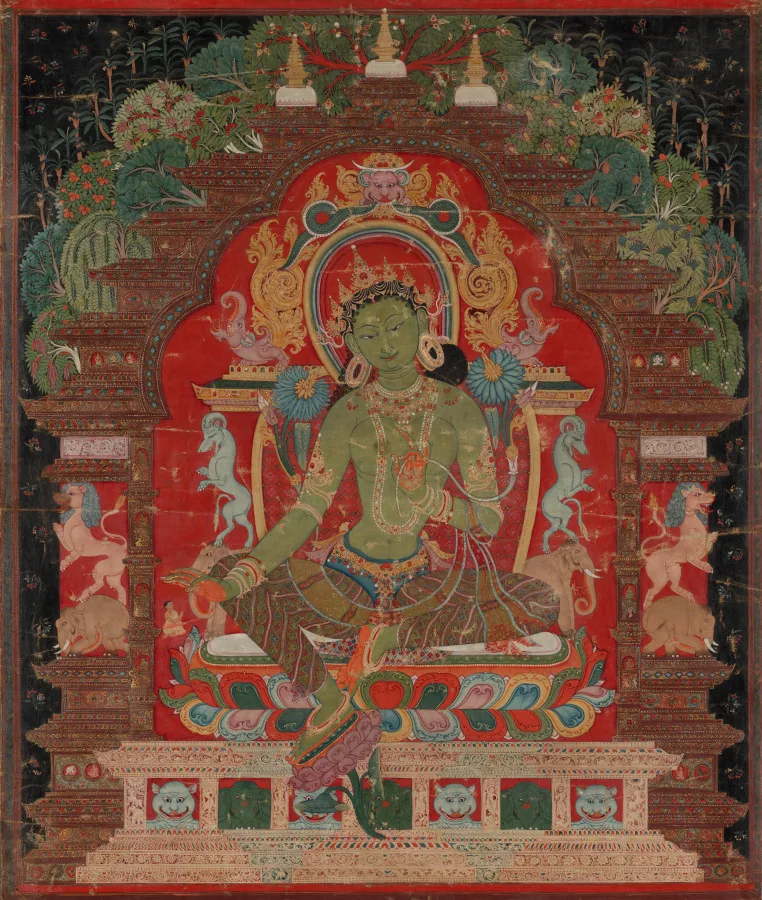
Green Tārā (Sgrol-ljang)
Seated in royal ease with her right foot already stepping off the lotus cushion, Green Tārā embodies enlightened compassion in immediate motion—green being the color of the Wind/Action Buddha Family.
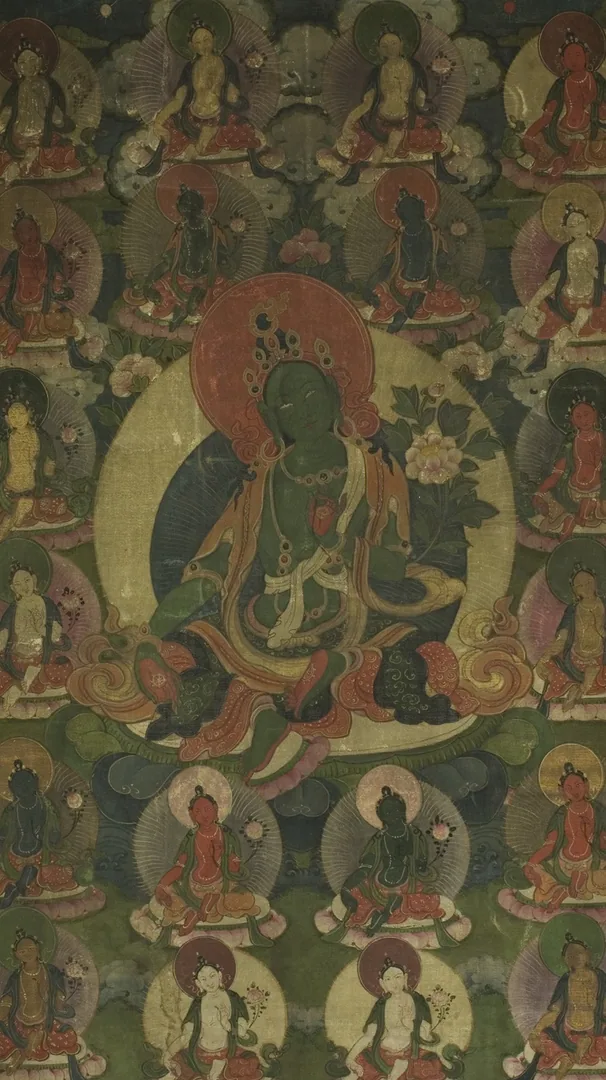
Oṃ Tāre Tuttāre Ture Svāhā (Green Tārā Mantra)
Known in Tibet as the Ten-Syllable Essence Mantra, its three variations on the Sanskrit verbal root tṛ (“to cross over”) trace a clear arc from relief in worldly crisis to freedom from inner anxiety.
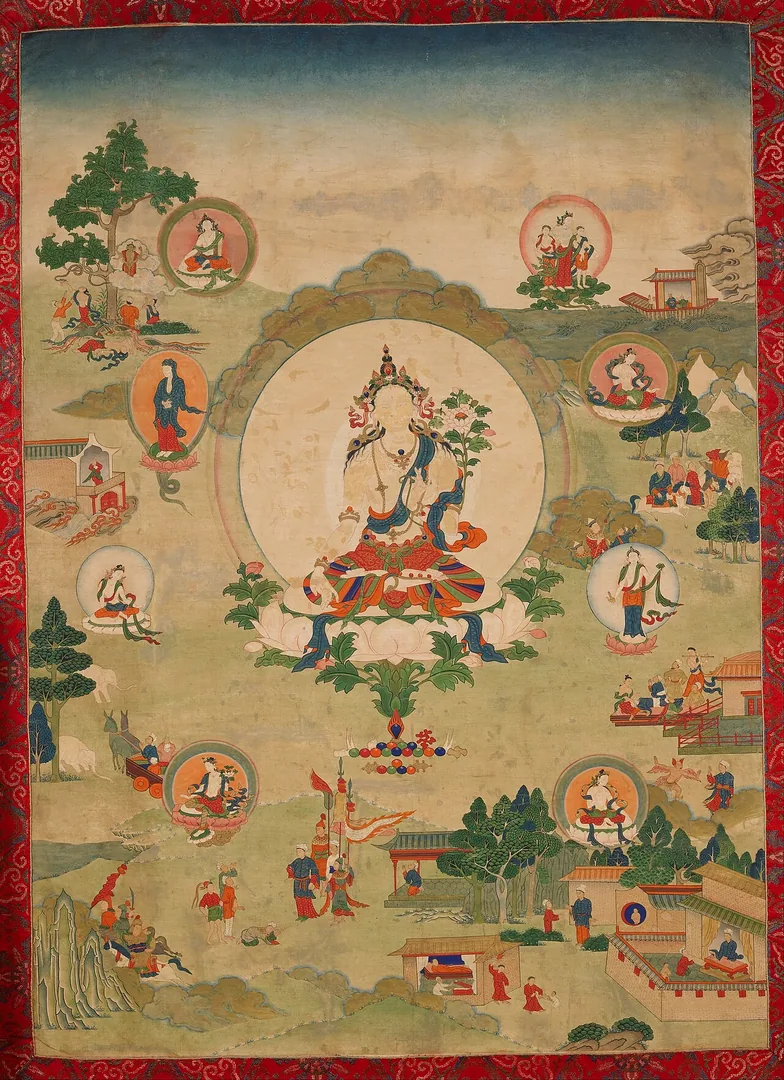
White Tārā (Sgrol-dkar)
Distinguished by seven eyes—on her forehead, palms, soles, and face—White Tārā sits in full vajra posture radiating autumn-moon serenity, forming one of Tibet’s Three Long-Life Deities.
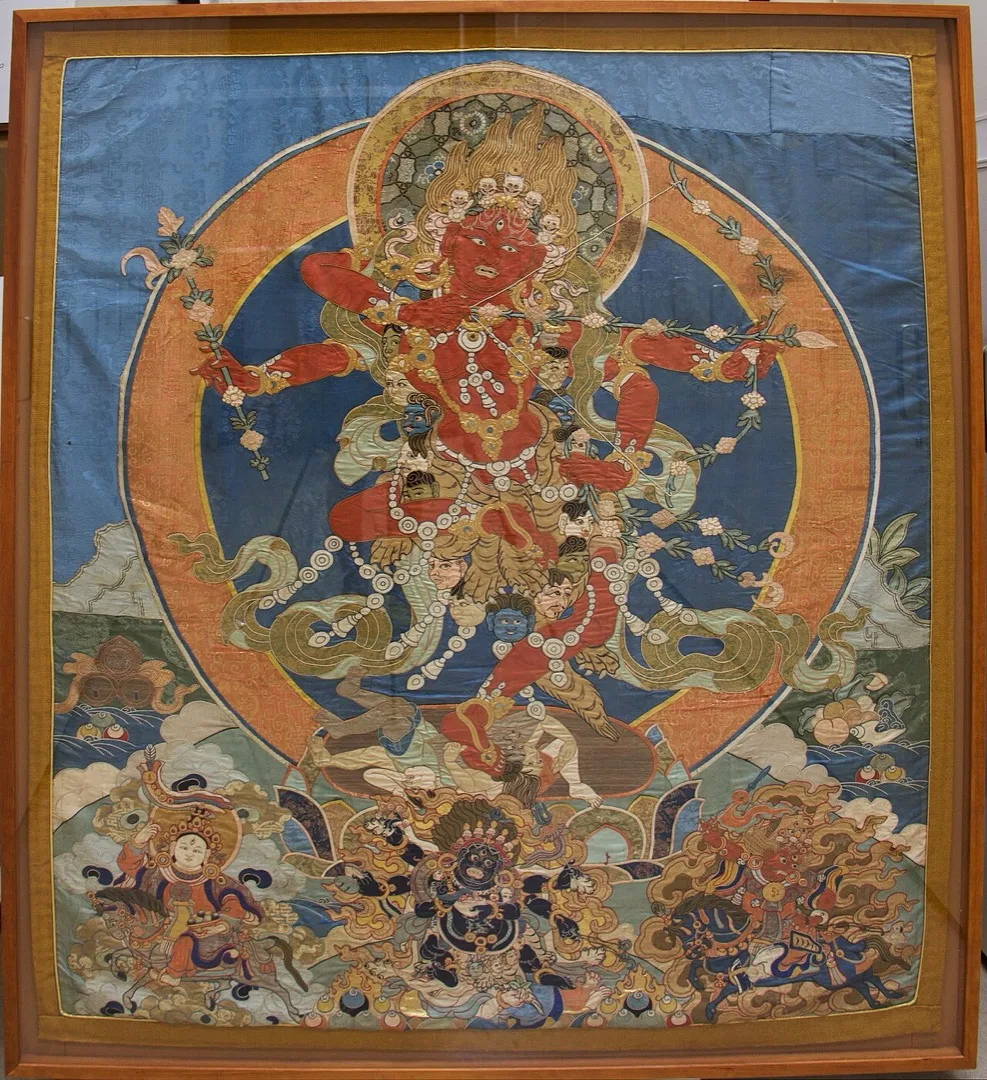
Kurukullā (Rigjema · Lotus-Bow Wisdom Ḍākinī)
Dancing on one foot in a ruby-red aura while drawing a bow and arrow woven entirely of red utpala lotus blossoms, four-armed Kurukullā (Tibetan: Rigjema, “Knowledge-Maker”) is an enlightened semi-wrathful emanation of Tārā in Amitābha’s Lotus Family—celebrated not for worldly manipulation, but for magnetizing fractured minds and conditions toward Dharma and harmony.