8th–12th c.
CMA 1970.10
Pāla India
རྒྱ་གར་ཤར་ལི།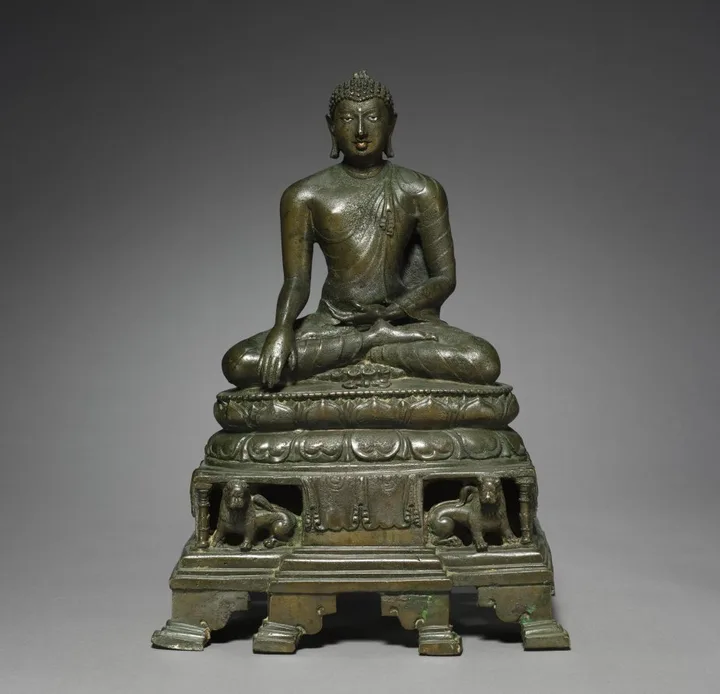
Multi-tiered architecturalrathaka (stepped projection) pedestal with crouching lions and crisp beaded rims.
Five Halls
Quick Lookup · 3 Utilities
Curatorial Interactive Studios
རྒྱ་གར་བལ་བོད་ལི་མའི་བརྟག་ཐབས། Studio 07 · Cross-Museum CC0 Provenance & Li-ma Metallurgy
Select a bronze to find similar faces, crowns and lotus bases in other museums, then compare their photographs side by side. Explore 21 public-domain works from The Met, Chicago, Cleveland, Smithsonian and Harvard.
Instrument I · Find Similar Works Across Museums
Read the periods from top to bottom. Select an object to trace its image neighbours; periods and regions overlap.
Instrument II · Dated Museum Photographs in Five Local Crops
The fastest dating key: stepped lion thrones → wide Newar petals → rolled Yongle tips + reign mark → tall Zanabazar cylinders.
Periods overlap. This compares dated museum photographs, rather than a single inevitable evolutionary sequence. Underside seals cannot be checked from these frontal images.
Multi-tiered architecturalrathaka (stepped projection) pedestal with crouching lions and crisp beaded rims.
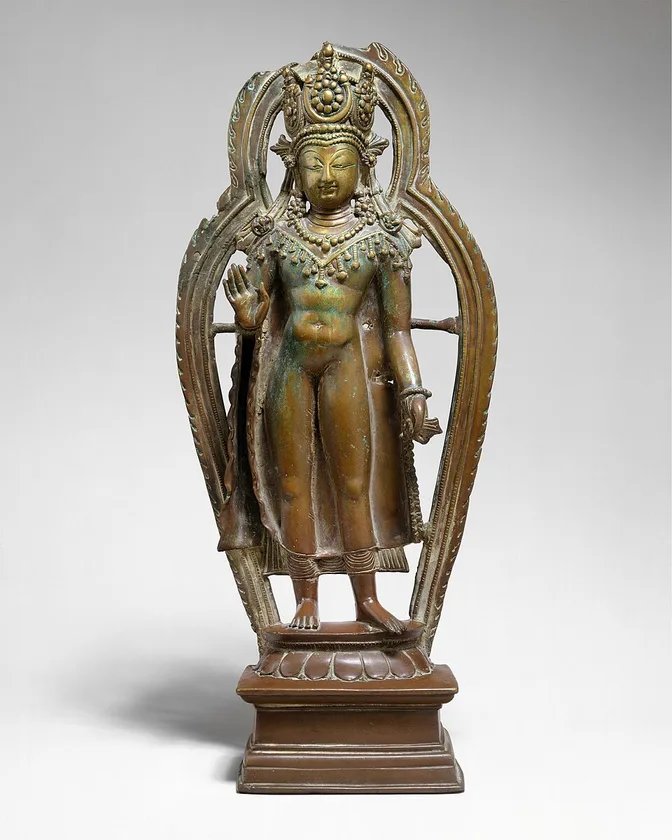
Single register of plump, smooth downturned lotus petals set atop a tall rectangular architectural plinth.
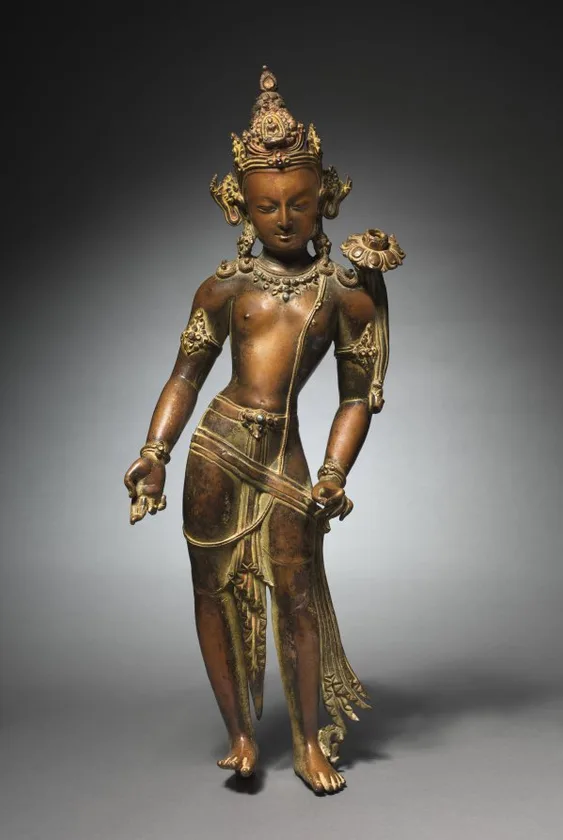
Broad, low lotus pedestal (often cast separately) with wide, gently rounded petals and incised tips.
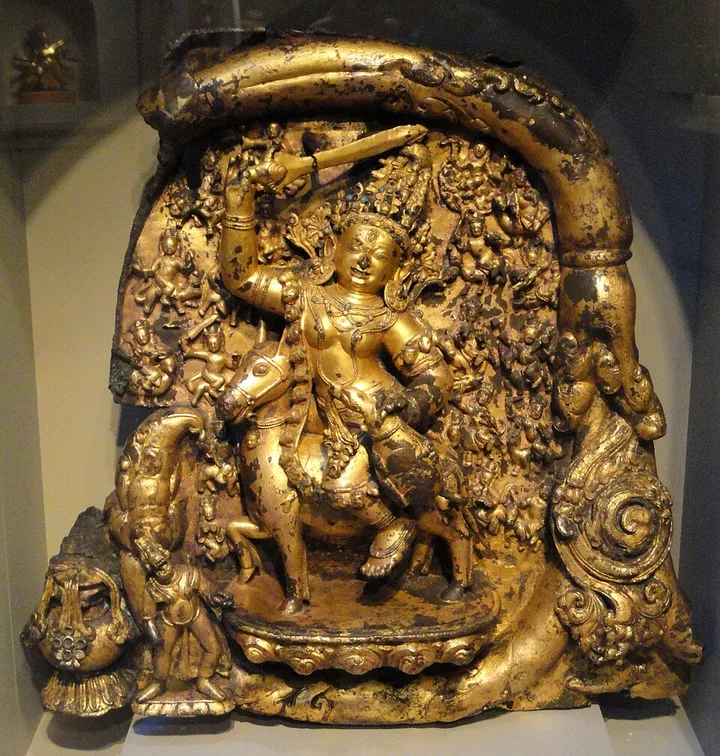
Plump multi-layered lotus petals or stepped lion-and-yakṣa thrones inlaid with coral, lapis, and turquoise.
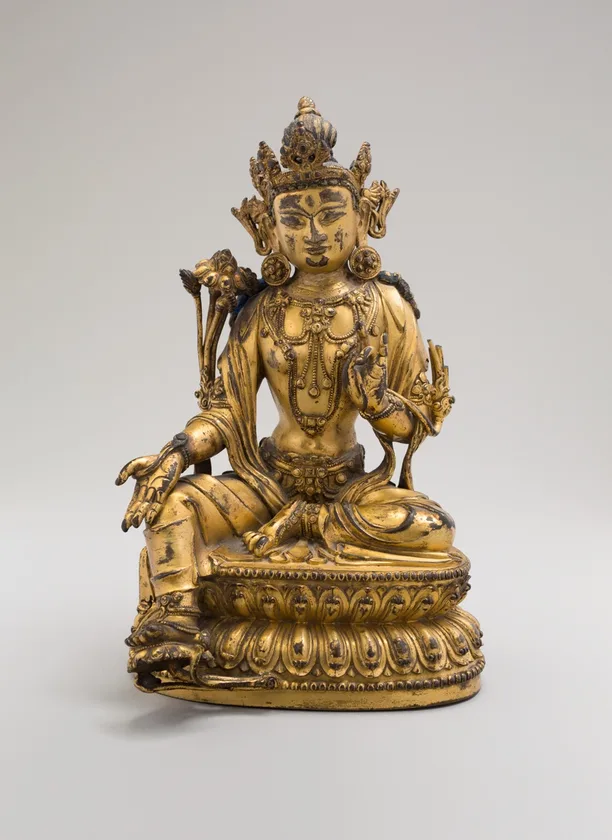
Symmetric waisted double lotus with fine beading top & bottom, rolled petal tips, and incised reign mark on deck.
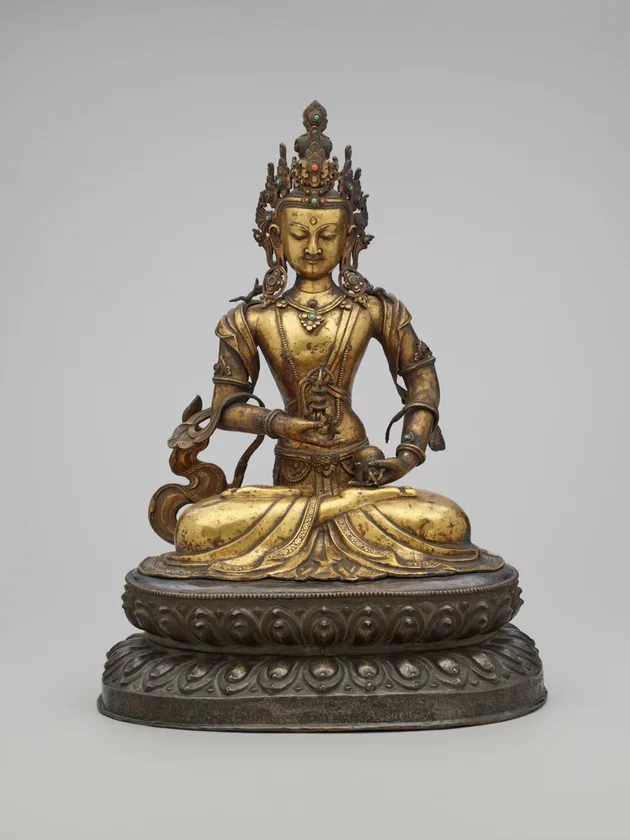
Stepped brocade meditation cushions (’bol-gdan) for lamas, or multi-tiered lotus bases with stylized flat petals.
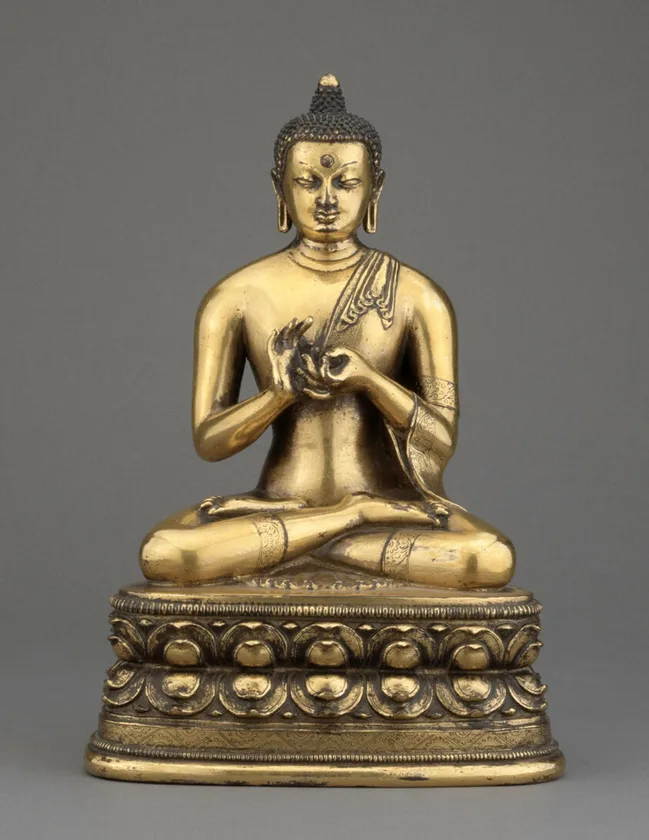
Unmistakable tall cylindrical lotus drum with crisp beaded borders and lush, three-dimensional double-layered petals.
Symmetrical five-leaf imperial tiara with finely pierced scrollwork and traces of mineral lapis blue on hair.
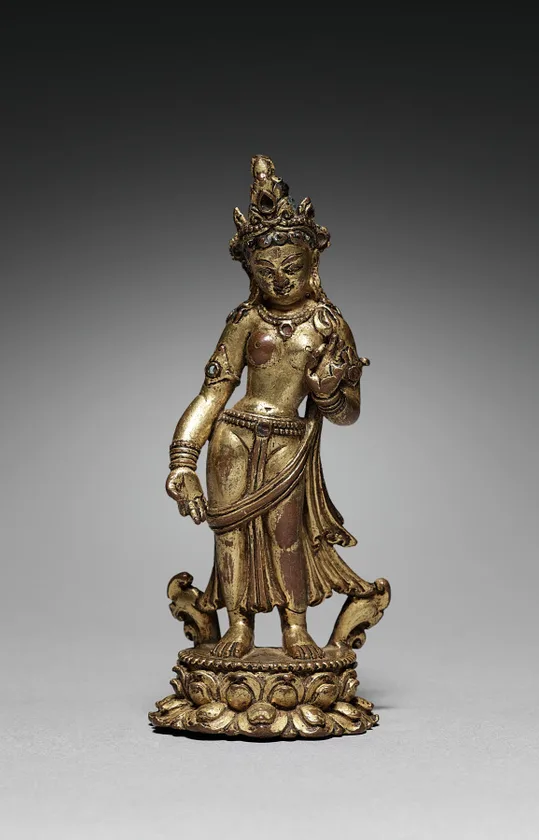
Three-pointed foliate Indra-style tiara richly chased with scrollwork and set with cabochon gemstones.
Square-oval Sino-Himalayan synthesis: gentle downcast eyes, refined nose, and luminous burnished gold skin.
Gentle oval face, broad forehead, aquiline bridge, lowered eyelids, and serene youthful half-smile.
Draped in crisscrossing beaded U-shaped jewellery loops (璎珞) that sway naturally with the body’s posture.
Supple, fleshy modeling cast in pure copper—fluid contours without harsh muscular ridges.
Fluidly modeled fingers and double-hemmed silk skirts pooling gracefully onto the upper lotus deck.
Delicately articulated fingertips and diagonal sash folds hugging softly flexed hips.
Symmetric waisted double lotus with fine beading top & bottom, rolled petal tips, and incised reign mark on deck.
Broad, low lotus pedestal (often cast separately) with wide, gently rounded petals and incised tips.
Instrument III · Five-Script Gesture & Posture Lexicon with Spoken Tibetan Audio
Śākyamuni under the Bodhi tree calling the Earth Goddess Sthāvarā to witness his myriad lifetimes of generosity—also the signature seal of Eastern Buddha Akṣobhya.
Recalls the First Turning of the Dharma Wheel at Sārnāth; characteristic of Vairocana, Maitreya Buddha, Mañjuśrī, and Tsongkhapa.
Bestows both mundane relief and the supreme gift of awakening; signature right-hand gesture of Green/White Tārā, Padmapāṇi, and Ratnasambhava.
Dispels fear across samsara and halts the charging elephant Nālāgiri; signature seal of Kashmiri standing Buddhas and Northern Buddha Amoghasiddhi.
Unwavering single-pointed samādhi supporting wisdom; primary gesture of Amitābha and Amitāyus (often cradling an alms bowl or long-life vase).
Lucid reasoning and refuge in the Three Jewels; paired with varada on Green Tārā, Maitreya, Padmapāṇi, and Dalai Lama portraits.
Cuts through ego-clinging and obstacle-makers; seen on Vajrapāṇi, Blue Acala, Vajrakīlaya, and Mahāsiddha Virūpa arresting the sun.
Indivisible union of skillful compassion (vajra) and emptiness-wisdom (bell); root seal of Vajradhara, Cakrasaṃvara, Hevajra, and Vajrasattva’s paired implements.
Unshakable diamond stability of Buddhahood beyond birth and death; standard seated posture of all Tathāgatas and lineage patriarchs.
The instant visual key separating Green Tārā from White Tārā: abiding in emptiness (left leg) yet already stepping into samsara to rescue beings (right foot).
Living responsiveness of compassionate bodhisattvas—perfected in Pāla Bengal, Kathmandu Newar copper, and Zanabazar’s Maitreya.
Skillful means and wisdom trampling ego-fixation and the four māras; characteristic of Hevajra, Cakrasaṃvara, Vajrayoginī, and Dharma protectors.
Curatorial & Computational Methodology
Li-ma is a Tibetan term used for metal images. This page groups the selected museum objects by recorded region and period so that their visible forms can be compared. These groups overlap in time and are not an exhaustive traditional taxonomy or a chemical classification.
Compare lotus petals, facial modelling, crowns, posture and inscriptions against dated museum records. Such features can suggest useful comparisons; they cannot establish a date or place from one photograph alone.
The 21 museum photographs are encoded offline with the open DINOv2-small model. Normalized 384-dimensional CLS vectors produce whole-image and four local-crop cosine rankings. Average-link clustering yields five display groups. Model revision and image hashes are downloadable; visual similarity does not establish shared authorship, alloy composition or workshop.